
#322 Healing our Fractured World: Re-Awakening Indigenous Consciousness with Marc-John Brown of the Native Wisdom Hub
As the old paradigm splinters into rage-filled, grief-stricken fragments, how can we lay the foundation for the total systemic change we so badly need?
Even beyond the listeners to this podcast, it is obvious by now that there is no going back. As Oliver Kornetzke wrote in a particularly sharply written piece on Facebook back on 22nd January – before Alex Pretti was murdered by Trump’s Federal Agents – what white America is not experiencing is not new, and is not a flaw in the system, it is the system. This is what he says in more detail:
White Americans are not witnessing the collapse of something noble. They’re witnessing the unveiling of what has always been true. The rot now visible is not a flaw in the foundation. Rather, it is the foundation. It was poured with concrete, inscribed into laws, and baked into the American mythos. The violence, the inequality, and the selective application of “justice”—none of it is a betrayal of the American promise. It is the American promise, applied unevenly by design.
For centuries, Black, Indigenous, and other marginalized communities have lived under the weight of this system—disenfranchised, disappeared, surveilled, caged, and killed. They were told to be patient, to be peaceful, to vote harder, to “work within the system.” And when they told the unvarnished truth—that the system is the violence—they were mocked, criminalized, and ignored.
Now the machinery begins to grind down those it once served, and only now does the shock begin to register. But this isn’t the system breaking. It’s merely the mask coming off.
The laws of this land protects power and wealth. It has always protected power and wealth. The state defends itself. And democracy here has always been ornamental—used to sanctify what power had already decided. The rule of law is not impartial. It’s a weapon, a performance, a convenience afforded to the privileged. The pageantry of justice is reserved for those never meant to feel its weight.
What you’re seeing now is not the end of the American dream. It is the truth of the American reality, finally uninterested in disguising itself. The empire is simply turning inward.
Many will not want to read this. They will flinch, deflect, and rationalize. They will call me divisive, bitter, and extreme. They will attack, argue, and dismiss. And in doing so, they will only prove the point by choosing their comfort over clarity, and their denial over responsibility. Because that, too, is by design: the privilege of ignoring the truth until it shows up at your own door.
So what do we do? It is a founding principle of this podcast that there is still time to turn the bus that is humanity from the edge of the cliff of species-level extinction. We believe the Egregor, the Super-Organism, the death cult of predatory capitalism… whatever you like to call it, is in its death throes. In its flailing, it might yet take us all with it, but that’s not a given and in every single act of compassion, courage and community that we’re seeing around the world from Greenland, to Venezuela, to Minnesota and beyond, we are building the leading edge of a new system.
But we need a spiritual base to this. I genuinely think we get through only if we can lift ourselves out of our Trauma Culture and into a new way of being – an Initiation Culture fit for the twenty first century. We talk about this a lot on the podcast, and sometimes, we talk to other people who get this, and who are working explicitly towards a shift in consciousness of the whole human race.
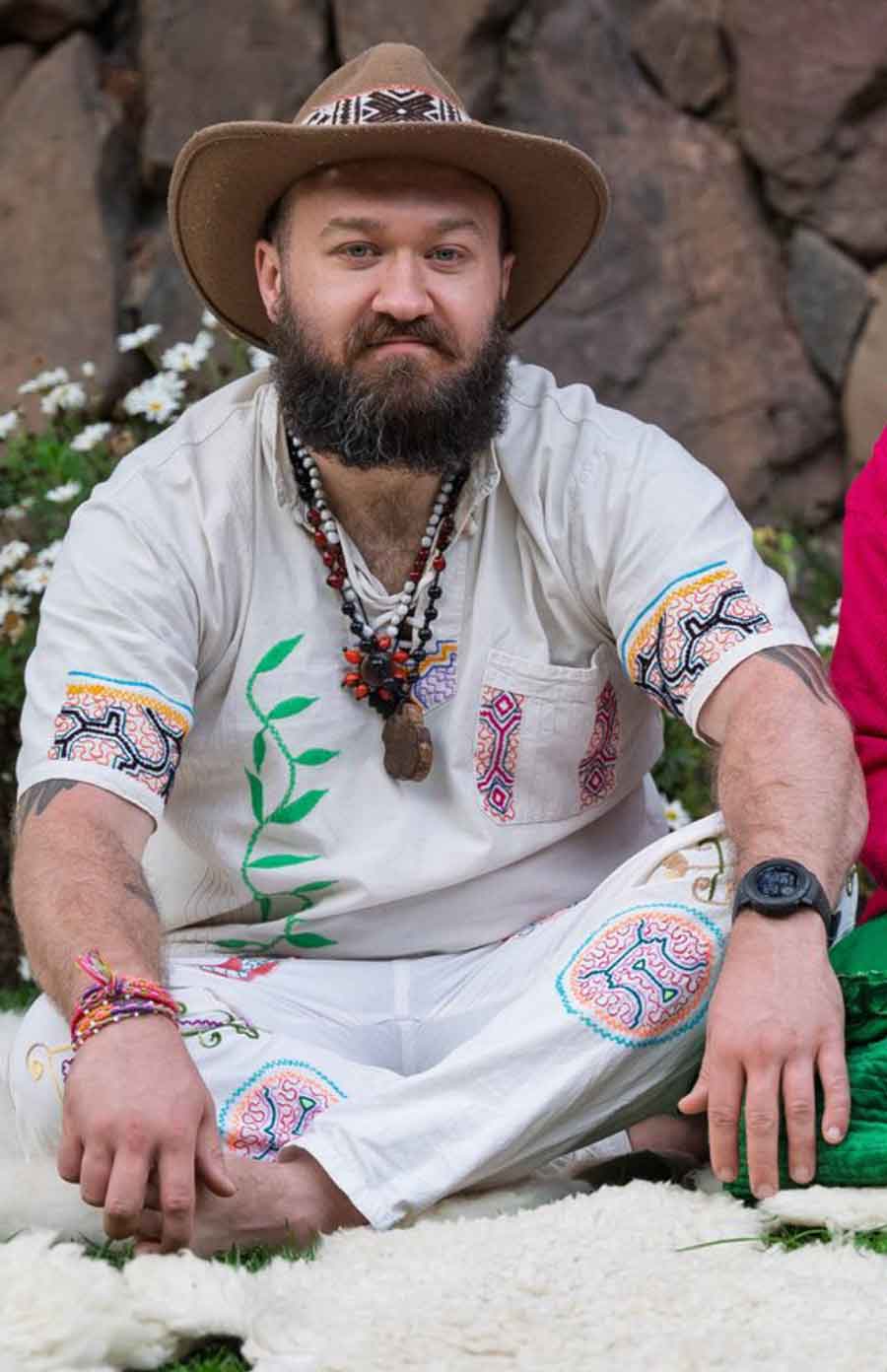
Today’s episode is one of those. Our guest is Marc-John Brown who describes himself with characteristic humility, as an integration coach, transpersonal life coach, and spiritually-oriented business coach. Since 2019, he has been an apprentice of the Shipibo-Konibo tribe of the Peruvian Amazon Jungle and an ally and collaborator among multiple other living indigenous peoples. Having met him, I’d say that Marc-John is deeply connected with the spirits of the land in a way that is both profoundly wise, and deeply grounded. He is one of those who comes to Elderhood at a young age, moving through the world with dignity and humility, helping others to reach the core of what it is to be human at this moment of total transformation.
Born and raised in Scotland, he has a deep spiritual connection to south America and to the indigenous peoples of that land. With his wife, Erika Huarcaya a native Peruvian of the Chanka peoples, Marc-John runs the Native Wisdom Hub, which seeks to bring people of our culture – the white, western culture that is currently eating itself alive – into authentic, enduring connection with the web of life such that we can all begin to change the way we are in the world.
On a recent Substack post, Marc-John says, ‘We believe that, in large part, healing happens through nervous system co-regulation between indigenous wisdom keepers and modern seekers. Building healthy relationships. Creating psychological safety. Allowing trust to grow where mistrust has festered.’
So this conversation delves deeply into the nature of the trauma we experience – and how we might heal the relationships between all parts of ourselves, ourselves and each other, ourselves and the web of life.
Episode #322
What we offer
If you’d like to support us, come along and join the Accidental Gods Membership. Here, you can share in the ideas, the programme that will help you connect to the Web of Life in ways that will last—and you can come to the Gatherings half price. Or if that doesn’t appeal, come along to one of the Gatherings. Or buy a subscription/Gathering for a friend… do something that feels like a good exchange of energy and minimises our connection with old economic paradigm. Remember that if any of this is difficult financially, contact us and we’ll find something that works for you.
Details below:
We offer three strands all rooted in the same soil, drawing from the same river:
If you’d like to join our next Open Gathering offered as part of our Accidental Gods Programme, it’s Honouring Fear as your Mentor on Sunday 8th February 2026 from 16:00 – 20:00 GMT – details are here. You don’t have to be a member – but if you are, all Gatherings are half price.
If you’d like to join us at Accidental Gods, this is the membership where we endeavour to help you to connect fully with the living web of life.
If you’d like to train more deeply in the contemporary shamanic work, you can find us at Dreaming Awake.
You can explore the recordings from our last Thrutopia Writing Masterclass here.
In Conversation
Manda: Hey people, welcome to the Accidental Gods podcast; to the place where against quite a lot of the news unfolding at the moment, we do still believe that another world is possible and that if we all work together, if we all work together, there is still time to lay the foundations for a future that we would be proud to leave to the generations that come after us. I’m Manda Scott, your host and fellow traveller, as our world descends ever faster into chaos. We recorded the conversation you’re about to listen to on Friday the 23rd of January, 2026. It is the nature of podcasting that the intro is generally recorded after the conversation, and not always on the same day. And because we live on the farm and we’ve had storms and life is complicated, and I spent most of yesterday walking fields, I am recording this on Sunday the 25th of January 2026. On Saturday the 24th, as I’m sure we all know, Alex Jeffrey Pretti was shot dead on the streets of Minneapolis. And yes, I am completely aware that it has been descending into chaos all around the world for a very, very long time. And that just because people who look like me, who make relationships like me, who speak like me, or at least a little bit like me, are being executed on the streets of America by Trump’s thugs, is not to say that this is not commonplace elsewhere.
Manda: There is an old adage that fascism is what happens when colonialism comes home, and now we’re living through the truth of this. And amongst the many other responses to this, I think it is clear now, even beyond the listeners of this podcast, that there is no going back. Electing the right colour of suit with the right colour tie is not going to create the total systemic change that we need. Oliver Kornacki wrote on Facebook on the 22nd of January that what white America is experiencing, and by extension the rest of the world; because when America sneezes, the world catches a cold; is not new, and is not a flaw in the system. It is the system. I’m going to read you a bit of his post, because I think it’s relevant to what’s happening now and to what we talk about on the podcast.
Manda: ‘White Americans are not witnessing the collapse of something noble. They’re witnessing the unveiling of what has always been true. The rot now visible is not a flaw in the foundation, rather, it is the foundation. It was poured with concrete inscribed into laws and baked into the American mythos. The violence, the inequality, the selective application of justice, none of it is a betrayal of the American promise. It is the American promise, applied unevenly by design. For centuries, black, indigenous and other marginalised communities have lived under the weight of this system, disenfranchised, disappeared, surveyed, caged and killed. They were told to be patient, to be peaceful, to vote harder, to work within the system. And when they told the unvarnished truth that the system is the violence, they were mocked, criminalised and ignored. Now the machinery begins to grind down those it once served, and only now does the shock begin to register. But this isn’t the system breaking, it’s merely the mask coming off. The laws of this land protect power and wealth. They have always protected power and wealth. The state defends itself. And democracy here has always been ornamental, used to sanctify what power has already decided. The rule of law is not impartial, it’s a weapon, a performance, a convenience afforded to the privileged. The pageantry of justice is reserved for those never meant to feel its weight. What you see now is not the end of the American Dream, it’s the truth of the American reality finally uninterested in disguising itself. The Empire is simply turning inward’.
Manda: That’s not all of the posts, but it’s the bulk of it. I’ve put a link to Oliver’s Substack in the show notes. He hasn’t published this there yet, but there’s a lot of other stuff well worth reading. And given that every word of this is so obviously true, and we have spoken a lot about this on the podcast, this is the trauma culture coming to its fruition. The system is not broken; it’s doing exactly what it was always designed to do. It’s just that we can see it more clearly now. However, the system is not fit for purpose if that purpose is a continuation of complex life on Earth. I don’t care how many cans of beans the oligarchs and the oligarchs and the billionaires have got stashed in their vast underground hideaways, they will not survive the collapse of the current ecosphere, and anyone who thinks otherwise has been reading too many science fiction novels, or is simply projecting. So what do we do? It is still a founding principle of this podcast that there is time to turn the bus that is humanity from the edge of the cliff of species level extinction. We believe the egregore, the superorganism, the death cult of predatory capitalism, whatever you like to call it, is in its death throes, in its grand and mighty flailing around it might yet take us all with it. But that is not a given. And in every single act of compassion and courage and the building of community that we’re seeing around the world, from Greenland to Venezuela to Minnesota and beyond, we are building the leading edge of a new system.
Manda: But that system needs a spiritual base. I genuinely believe we get through only if we can lift ourselves out of our trauma culture and into a new way of being. An initiation culture fit for the 21st century. We talk about this a lot on the podcast, and once in a while we talk to other people who get this and who are working as hard as we are towards a shift in consciousness of the whole human race. Today’s episode is one of these. Our guest is Marc-John Brown, who describes himself with characteristic humility as an integration coach, transpersonal life coach, and spiritually oriented business coach. It goes deeper than that, though. Since 2019 he has been an apprentice of the Shipibo-conibo tribe of the Peruvian Amazon jungle and an ally and collaborator among multiple other living indigenous peoples. Having met him, I would say that Marc-John is deeply connected with the spirits of the land in a way that is both profoundly wise and deeply grounded. He’s one of those who comes to Elderhood at a young age, moving through the world with dignity and humility, and helping others to reach the core of what it is to be human at this moment of total transformation.
Manda: Born and raised in Scotland, Marc-John has a deep spiritual connection to South America and to the indigenous peoples of that land. With his wife Erica, a native Peruvian of the Chanka peoples, Mark-John runs the Native Wisdom Hub, which seeks to bring people of our culture, the white Western culture that is currently eating itself alive, into authentic enduring connection with the web of life, such that we can all begin to change the way that we are in the world. On a recent Substack post, Mark-John wrote we believe that in large part, healing happens through nervous system co-regulation, between indigenous wisdom keepers and modern seekers, building healthy relationships, creating psychological safety, and allowing trust to grow where mistrust has festered. So this conversation delves deeply into the nature of the trauma we experience individually, collectively and ancestrally, and how we might heal the relationships between all parts of ourselves, ourselves and each other, and ourselves and the web of life. This is what we’re here for, people. There is still time, but it’s going to take everything from all of us. So here we go with ideas of how we can do it, and what each of us might bring to the table. People of the podcast, please welcome Marc-John Brown of the Native Wisdom Hub.
Manda: Marc-John Brown, welcome to the Accidental Gods podcast. How are you and where are you this grey January morning?
Marc-John: Thank you. Uh, how am I? I’m good, I feel settled, I feel fairly solid. and I feel ready for this conversation. And I’m here in Alexandria, right next to Loch Lomond, ancestral homelands of the MacGregors and also of Robert the Bruce. Beautiful lands, yeah.
Manda: Now I have deep Scotland envy. I grew up in Eaglesham, which is just south of Glasgow, but we spent a lot of our time on Skye, so we travelled up that road up the side of the loch very, very often and it’s such a beautiful place. So thank you for giving me a taste of home. I can smell the loch water and the mountains and the bracken. It’s great. So I met you at the south edge of Loch Ore, actually, last September, I think. I seem to be booking up six months in advance. We are currently booked into October, which is insane. However, what struck me at the time was your groundedness and your humility and your obvious big hearted connection to the more than human life that came through in everything that you did. You embody that which for me is what we need to do as a culture; is to get to a point where everybody is that, rather than performatively cosplaying that which some people do, or simply not knowing that we need to get there. And in the context of that, you have a Substack, which I will link in the show notes. And towards the end of your most recent post, you say: “I don’t know exactly what a re indigenised world looks like, but I know it’s foundation. Consciousness that honours nature as kin. Relationships that heal cross-cultural trauma and recover cosmological wisdom. Technology in service of connection, not extraction. Modern systems infused with ancestral wisdom. This is the work; not blueprints for cities, but the shift in seeing that makes those blueprints possible”. And this is absolutely the foundation of this podcast, and where I have recently got to in my understanding of the world. And you were obviously there way ahead of me. So my core question is, how did you get to that understanding and where does it take us, and how do we bring that into scale, in time? Those are big questions, so pick any of those questions that appeals to you and let’s run with it.
Marc-John: Yeah yeah, really really big questions. And hey, you know, you’re saying like I’m obviously ahead of you. I’d reel that back and say, if I’m here with you, we’re mirroring each other, right? You’re seeing yourself in me and…
Manda: Thank you. Yes.
Marc-John: Yeah. And I really feel, I mean, even more so as I kind of contemplate the magnitude of the questions you just asked me, I can’t be anything but truly humbled. We hear this all the time, that knowledge becomes wisdom when it moves from the head to the heart, or from the head to the body, right? We hear this, it’s a cliche, we hear it everywhere. We need to become embodied. And what does that actually mean? What is the bridge between knowing and embodying? Well, I would say that that is exposure and life experience. You know, lived experience. I think that’s the bridge and there’s no other way about it. There’s no other shortcut, you have to live it to be it, or to become it. And so that moment where it locked into place for me, it’s also featured in another essay that I wrote on my Substack prior to the one you just quoted from. It was a time of initiation down in the Amazon jungle. I was in my, what we call a connection ceremony, where I was being connected. And the reason I love James Cameron and Avatar is because of this precisely, because it gives us such a visual representation of what plant spirit connection truly is.
Marc-John: So if we can use Avatar as a reference point to help people to conceptualise what went on in this connection ceremony, essentially what my maestro was helping me to connect those hair follicles with Awah or with those flying dragon things that they fly around on, and I can’t remember their names, forgive me. That’s essentially what was happening. I was being connected and merged with the plant spirits that I was set to work with more extensively and apprentice with, and have work through me in my ceremonial healing work, if that’s what you want to call it. And I think the thing that made it happen was, and it was a moment of absolute terror, where I struggled to hold my centre point, but I found it through breath. And that was when a plant spirit was brought to life and channelled through my body, in a very very real way. It’s what happened; it came up through the earth through my coccyx area all the way up through my spine and out of my crown. And of course, in that moment I was absolutely terrified when it first happened. I found my centre, remembered my Maestro, my master healer teacher, his words of when they come to connect, just find your place of calm. It’s normal. So tuning in to all of that, tuning into my breath, I found my place of centre and just allowed this connection to to happen. And I think the bridge, where the coin truly dropped, if you will, was realising that my Maestro, my master healer teacher, had brought that into existence by singing it into being, by singing it into existence. That’s where the coin dropped. It was like, of course this is it. This is indigenous consciousness, right?
Manda: That you can sing this into being, that you know how and you can create the song, and the song works with the plant spirits and then you feel the impact of it.
Marc-John: Yes. And reality is birthed, reality is created, through song or through thinking or through praying or through whatever medium it may be, to channel that vibration of intention and visualisation. Oof! And in terms of bringing it into marriage with our current systems, again, I don’t know what it looks like, but what I know is that the relationship needs to be established or re-established. It runs through our DNA. It exists within our ancestral memory, and it just has to be re-awoken, as it was re-awoken in that ceremony for me. There is a ethnobotanist, Maria Fadiman. Have you heard of Maria Fadiman?
Manda: I haven’t, but we’ll look it up.
Marc-John: Yeah. She says something, and I’ve quoted her somewhere, she says we cannot care for that which we do not have a relationship with. So the relationship needs to be, and I wouldn’t even say established, it’s re-established. I wouldn’t even say awoken, it’s re-awoken. Because it exists. It’s there in in our DNA, it’s there in our ancestral memory. Once we can truly reawaken and re-establish that relationship, that’s the foundation. From there. I don’t know.
Manda: But we don’t have to know, do we.
Marc-John: Exactly.
Manda: Then we ask the plants, or we ask the web of life, whichever part we connect to. This resonates so much with so many things. Let me have a think. So John Young says that by the age of 12, the average indigenous youngster that he encounters, even now, has made meaningful relationships with over 400 other species. Whereas in our culture, we probably made a meaningful relationship with our screens by the age of 12 at this point. And there are people working very hard to ensure that we’ve gone beyond the attention economy to the affection economy, where they are now trying to program everything so that it captures people’s hearts, not just their minds. And yet the web of life is alive and vibrant and working through us. It seems to me that if everybody has to go through what you went through to get that connection, 8 billion people would require at least a billion maestros, probably. And that’s maybe not going to happen. And I know you teach things. We both teach things. And I’m wondering, this is probably leaping ahead, but one of my core questions for this year is how do we help people to do the inner work so that they can connect to the web of life authentically in a way that’s free flowing, so that they can ask ‘what do you want of me?’ And respond to the answers in real time. How do we get that at scale in time? And I wonder what your experience is. You teach people and is it that you have to sing into being a plant spirit through each of them for the penny to drop? Or are there ways that we in the West can do the work to do the healing, to reverse what in some of us might be 12,000 years of separation from the web of life? What are the pathways? Is it always that we just need to have someone who knows how to sing something through us.
Marc-John: To decolonise our consciousness, right? To decolonise our way of being? I mean, the short answer is no. There are many mediums. And the way that we take this work to peopl of course, is through work with plant spirits and a connection to plant spirits. And we always say to people, even if you’re sceptical in the face of the idea that this plant has consciousness and knows and understands you as a person, as a being, and may also know what your needs are and also how to have those needs met. Even if that seems so foreign and there’s a lot of resistance towards that, all we request, all we invite you to explore, is being open to it being a possibility. Even if just for the duration of this ceremony. One hour, you know? Even if it’s just for this next hour, be open to it. And then, of course, there’s shamanic drumming. And you can literally be in a tower block in New York and be connecting to an animal spirit, with the power of a drum.
Marc-John: And there’s growing research obviously around our circadian rhythm and optimal time to connect with screens, versus nature. The optimal combination of these, when to do which during the day. I really believe that this whole movement of you know, when you first wake up in the morning, before you open your laptop and look at the screen, go barefoot, stand in the grass. Just allow yourself to be regulated by the energy of nature. If we could just add one more little ingredient into there, that is exactly what I’ve just said; be open to the idea, even if just for that 15 minutes, that you are allowing your feet to be touched by the grass. Even if just for that little 15 minutes, you open yourself to the possibility that the earth beneath you knows you intimately, understands you, understands your needs, and knows how to have them met. Do it. Ask the question. Ask what you want to ask.
Manda: What have you got to lose?
Marc-John: Exactly. Then if after those 15 minutes you want to close back up and just get on with life, then go do it. But at least have that little window where you’re just opening yourself. And I think, you know, 8 billion people on the planet, it’s a big job. It’s a big job.
Manda: It’s a big job. But my feeling is, the more people who honour your invitation and do that, you suspend disbelief for a very short amount of time and you ask for what you need rather than what you want. What your soul needs, what your spirit needs, what your true self needs. And at the point when the flow of the world begins to respond to that, your ability to suspend disbelief expands a little bit and expands and expands until you have a point where a spirit arises through you and your world is different after.
Marc-John: And if we can touch just one person with that, or two people or three people.
Manda: Exactly. But then it ripples out, doesn’t it? My sense when I met you in real life and even now talking to you over zoom, is I can feel that groundedness in you. And so people, even if they’re not aware that that’s what they’re looking for, will feel that around you. And so my sense, Gurdjieff said a century ago that it only took 80 fully enlightened human beings to transform the planet. He didn’t spell out what fully enlightened meant and he lived in a world where there was 500 million people. But even so, I think we don’t have to reach all 8 billion. I feel, and I’m checking whether you feel, there’s going to be a critical mass. I don’t know what that critical mass is, but it’s probably not huge, to create an energetic shift. Does that settle with you?
Marc-John: Absolutely. Yeah. Thank you for reflecting that knowledge back to me. It’s something that I don’t just think. I feel it’s a knowing, I know to be true. And there was a lady some number of years ago, you’re just bringing her to my memory now; Kiesha Crowther, she was bringing Native American teachings to the world a couple of decades ago, I think, or maybe like 15 years ago. She said something along these lines, that really, really stuck with me. We only need one third of any given population to shift in consciousness and vibration for it to then ripple out.
Manda: That’s interesting. I’ve been listening to Pam Gregory, and she connects with someone who, I don’t fully understand what’s going on, but anyway they’re speaking as if the archangel Raphael is speaking through them, and that being said if one third of the population would bless their water; their drinking water, the showering water, all of the water, then your whole species would shift. And I guess there’s also a suspension of disbelief that is required to really honour the water. It’s a similar concept. And it’s really interesting that independently they’ve each said one third. I was thinking closer to 10%, but if it’s 30%, let’s go with it. So let’s take a step back a little bit, because you sound to me as if you grew up pretty close to Glasgow, and yet you’re working with a Maestro and experiencing plant spirits coming through you, which is not the usual experience of the people that I met when I lived in Glasgow. So how did you come to be the person who’s writing the substack that you wrote and leading the courses that you write and having the experiences that you have?
Marc-John: Are you ready for this one? My goodness. We were talking before we began recording and I’m going to paraphrase, but you said something about asking somebody to speak about something and your question just being a key where they just open up and tell a very long story, and this might be one of those moments.
Manda: That’s fine. You’re the one who has to go pick up your kids. That’s the time limit. So go for it.
Marc-John: So actually, I’m from Edinburgh. I’m from the west of Edinburgh originally. I’m originally from a council estate environment called Broomhouse. I don’t know if you know Broomhouse?
Manda: No, I’m Glasgow, sorry.
Marc-John: Pretty rough part of Edinburgh. And then my mum, bless her, really bless, bless this decision that she made, in the mission to protect me from I guess the rigours and the dangers of growing up in that environment. She chose to move me to the centre of the city, to Haymarket.
Manda: Which I do know. It’s beautiful cobbled streets and old shops and it’s gorgeous.
Marc-John: So we moved to there and I lived ten years of my life there. And they say you can take the jaguar from the jungle, but you can’t take the jungle from the jaguar, you know; the same kind of social patterns, the same intergenerational trauma patterns continue to live out. And, you know, my childhood was really not easy, not pleasant, not nice. But I guess what you could consider to be like my saving grace in that time, from 11 years old, two families of South American immigrants, one Argentinian, one Paraguayan. And, of course, the Paraguayan guy because he’s so proud as well, the Paraguayan would always tell me about how his country has two constitutionally recognised languages, Spanish and the indigenous tongue of Guarani. And he spoke Guarani, he taught me Guarani words, right? Haupei Mbaetekopio, Iporã ha nde? He taught me these these words. That was really the first seed was planted. And by the time I met the Paraguayan, it was two years after I met the the Argentinian. So I would have been 13 by that time. By the time I was 15, there were few people in the English speaking world that would recognise that I wasn’t a native Spanish speaker when hearing me speak Spanish.
Manda: Wow.
Marc-John: And there were only a handful of people in the Spanish speaking world that could immediately tell that I wasn’t a native speaker. So pretty much completely bilingual. I went on to university in Stirling to do Spanish and Latin American studies. But this insatiable drive to get out of the corner of the classroom that I was sitting and studying all this stuff in books and just to go and live, you know, I couldn’t contain it. And so I left uni after only about four months, worked for six months to save up money and then went to live in Argentina.
Manda: Right. When was this? Relative to the Falklands War, was it before or after?
Marc-John: No, after. It was definitely after. So this was the year 2008.
Manda: Oh long after.
Marc-John: And of course, you’re mentioning that, when I went to Argentina, I mean, there are still even today in 2026, there are still signs, you can drive along motorways in Argentina and there are road signs with spray paint or with whatever they’re using to produce their letters, saying ‘Las Malvinas son Argentina’s’ the Falklands are Argentinian. You just brought me that memory. So I lived in Argentina for like 6 or 7 months. In that space of time, I met a woman who just blew my mind open. She’s a clairvoyant. She literally looked into my eyes and told me she was able to see six lives past and six lives into the future. And she said, you’re going to get married really young. Bear in mind, at the time, I’m what, 19 years old? She says, I can see you’re going to get married at 20, 21, 22. Don’t see it going past 22. I can see that kind of the age bracket. Between 20 and 22, you’re going to get married. And the woman that you marry, she’s going to be of a very indigenous race, she’s going to of an indigenous community. This is what she said, because I can see that you feel much more attracted and much more affinity with the indigenous populations. And I was like, okay, this is all kind of news to me. 19 years old, like living in Argentina by this point, four months that sent me off on an absolute spree. I emptied the bookshelves of multiple bookshops in Buenos Aires, then learning about past life regression, learning about the journey of the soul. This was my spiritual awakening. I wouldn’t say it forced me, but it definitely inspired me, catapulted me into cancelling my flights home, taking to the streets. Selling all of my designer gear on the streets like diesel t shirts, Armani jeans, all this stuff. You know, all this stuff that I had, my little diamond earrings that I used to wear back then, you know.
Manda: You were such a different person.
Marc-John: Totally different. Sold it all. Some people back then, on that street of Buenos Aires, got serious bargains. Made a little bit of extra cash, sold my 100 litre Osprey backpack and bought a little 40 litre backpack. And then I hitchhiked all the way through Chile and Bolivia into Peru. As I was hitchhiking through Bolivia, the scene is completely different. The population is like really high percentage still indigenous to the land, and hitchhiking as a concept doesn’t really exist. Because actually it’s a lot more common in Europe and what would we call them? Europeanised?
Manda: Colonised.
Marc-John: Colonised. Right. Yeah. There we go. Colonised. As a concept, hitchhiking isn’t really a thing. So what I found myself doing was travelling in the back of construction trucks, that were offering subsidised travel fees to the indigenous populations, to travel village to village to do commerce with their crops, their animals. And you know, I was in the back of trucks with tractor tires and chests of drawers and goats and chickens. And that’s where I came face to face for the first time with that world. And so the meeting point of my spiritual awakening and my study of past lives, the journey of the soul and whatnot, coming face to face with these people with this way of being, was the collision of realities that made my entire life what it is. And five days after getting into Peru, I met the woman who two weeks later, I would move in with. Three months later, I would marry. And 17 years down the line, here we are still today. We’re 17 years together in March, 17 years married by June. I got married on my 20th birthday.
Manda: Right. Gosh. So the woman was right that you’ve spoken to? Yes. Fantastic.
Marc-John: Yeah. And here we are, 17 years down the line. So that is how it all came to be. My wife is of an indigenous community, of an indigenous population that is still living, still alive, still practices with their traditions. And from there, you know, we’ve travelled South Korea, China, Malaysia, all around Europe and all around South America. Always looking to connect with Earth centric traditions, and see how we can be in reciprocity with each other and learn from from each other. So that is how we got to where we are today.
Manda: And that’s a brilliant edited highlight. Thank you. And this could be a jumping off point for a lot of different things. But one of the things that’s leaping up for me, just before we started recording, we were talking about how do we live within the death cult of predatory capitalism and survive and yet help to dismantle it from the inside? And I’m wondering, as you were travelling in the back of the trucks and you’re beginning to meet indigenous people whose culture, I’m guessing is still more or less intact. Francis Weller talks about initiation cultures versus trauma cultures and our culture’s the trauma culture, which is separate. It’s the trauma, the original, the core of what Vanessa Andreotti’s grandfather said the core wounding is the belief in separability. And that we have that sense that we are separate and we promote that within our culture. But that initiation cultures, in Francis Weller’s terms have intermittent, episodic, contained encounters with death. And the containment is held by the people and the more than human world, and it’s all through life, it’s not just the adolescent initiation. But that at these periods, the individual reconnects with the web of life to ask for the help to step through, and then becomes freshly aware of that reciprocal relationship with the web. And that sits very badly with capitalism, where we have that traumatic rupture. And we were talking about how is it that we can exist within capitalism and hold that sense or keep the flow with the web? And I wonder, how did the people that you were meeting, because they were travelling in the back of a truck for commerce, they were having to interact with the death cult in its nastiest form, because it doesn’t like indigenous people. And yet they were, I assume, keeping a version of their culture intact. How does that work?
Marc-John: Argh, you know, as I listen to you speak, I had this image appear in my mind and I think it’s just the epitome. This image that popped into my mind, it’s a memory, right? Like, did I carry, I don’t anymore, but did I carry a little bit of guilt around that for a bit? I probably did, but I think what’s what roared loudest in my being for sure, after this exchange that I’m about to tell you about, was intrigue. And all these questions that you’re asking me in this conversation that we’re having right now, is like, this is it, you know? So the image which popped into my mind was I was in the back of a truck with a whole bunch of Aymara and Quechua people from Bolivia. And there were some tremendous views, like right at the top of the Andes Mountains, way up high. Don’t ask me what altitude we were at, but up there there were these mirages, just bodies of water, that I could barely tell where the water ended on the horizon and the sky began, it was almost blurred. But I could see these flamingos as well in the water. And I’m just like, oh my goodness. I think this might be the nicest image I have ever fathomed, live. And I thought, I need to get a photo of this, you know. And so I asked one of the guys in the back of the lorry, like, here’s my camera, can you take a photo of me with that? And he was like, no, no. Why? Like I’m not going to do anything with it. Like what do you think I’m going to do with it? And he showed like he was sceptical that he didn’t trust what I was going to do with the photo or what I was going to do with him having handled my camera. But actually, I learned when I did manage to convince him to take the photo, I learned it was just because he didn’t have any experience of this world. And he took the camera and he was like, I remember he had his tongue hanging out the side of his mouth.
Manda: Like trying to work out how to make it work
Marc-John: Trying to work out how to make this thing work.
Manda: Right. And five year olds in our culture just going click, click, click. But five year olds in their culture are doing stuff that we could not fathom.
Marc-John: Absolutely. Like that was the epitome, for me, of everything you’ve just asked. And at the same time, it’s like I’m cold; I’ve got cold feet, I’ve got cold hands, I need to make a fire. Can you help me? I’ll bet you with every penny I’ve got.
Manda: The fire would be there.
Marc-John: Boom! In a very short space of time, he would have a fire made, you know. And I guess, and you know, my experience of this threshold point of existence and point of encounter is fairly extensive at this point. And what I see is there is a seriously concerning level of contamination, cultural contamination that happens when these the indigenous populations who don’t really have any experience of working with market based economics, monetary systems. You know, their value systems. The concept of value is so far from what is known as valuable in this predatory capitalism that you have so beautifully expressed. There is a point where money infiltrates just that little bit too much, and then the culture and the consciousness becomes contaminated and greed begins to be seeded. I’ve seen it so many times, so many times. And it is that exact thing, that exact phenomenon right there, is perhaps me and my wife’s biggest struggle in life. Because we collaborate, have intimate relationships, work with five different indigenous communities in Peru, that might grow as our projects expand.
Manda: You said you were thinking of moving back, so then it will grow.
Marc-John: Yeah. No doubt, no doubt. And it’s like they are being forced into this world. They have no choice. You know, they have no choice.
Manda: With very little choice. Yeah.
Marc-John: Very little choice, right. And we are stewarding that threshold point. Maybe not stewarding it, but we’re at that threshold, we’re sharing that threshold with them and doing our best to help guide it and orient it in ways that are conducive to keeping the cultural values, I guess, strong, alive. Without it being necessarily swallowed by this thing, this mono-culture. Because that’s exactly what’s trying to happen here, is that the entire population of Earth, you know, something out there, some consciousness, some power out there, wants to swallow it all up to become one mono-culture, you know?
Manda: Yes, yes. Various people have called it the Moloch or the Egregore, or whatever we call it. I remember talking to Alnoor ladha, and he recounted the story in North America of the Wetiko or the Wendigo. And and it sounds, the way he describes it, it was a kind of bogeyman that they would occasionally mention to kind of frighten the kids with a bit, although I guess I think Frightening Kids is probably a very Western thing to do. But anyway, it was a very rare thing, and it would be maybe a band of hunters got caught in the snow, and maybe the survivors had had to resort to cannibalism. And then they came back and everybody recognised that they’d got this virus thing, they got this thing entity in them, and there were really complex, long, detailed ceremonies to help heal this person, to remove this entity that had got into them so that they could return into the people. Because otherwise it was contagious. And then the white people arrive on the shores and they’ve got an entire culture that’s wetiko. And how do you deal with that? If it was one person in a tribe of 150, you can handle it. When it’s hundreds of people storming off a ship, and they just don’t care about anything that lives, what do you do? And so what I’m hearing from you, which in a way feels really exciting, is that you’re trying to modulate the infection rate of the Wetiko, so that they can interact with the death cult in a way that isn’t deathly. And I’m wondering how that works. And I’m wondering if the plants help to modulate that. Because my belief, my projection, my hope is that the web of life is a hyper complex system that knows where it needs to go, and that if we can connect with it in the way that you connected with the plant, we will be guided.
Manda: And that everything that is happening in the world isn’t irretrievable. It’s just that we need to shift quite fast to something that is in service to life, instead of in service to pain and death and the commodification of suffering. And so you’re right there at that interface, at the leading edge of how do we do this? Because I’m thinking this out loud, but the image that I’m getting is up until now, the Wetiko has swamped anything that it’s come to. The Egregore just eats everything. But if you can create a space where indigeneity filters the other way, then it is my belief that no human being really wants to be part of the death cult. We were not born to pay bills and then die. At a core level we know this, but that’s all it offers us. You’re on the hamster wheel until you’re useless, and then we’ll throw you away. And offered a different way of being, I think anyone and everyone would take it, if they could see how. And what you may be doing, and I’m asking this, is perhaps offering a way for a kind of antidote to the wetiko to filter back into the death cult. Is that a thing, or am I just making that up?
Marc-John: Maybe, you know, maybe. And hey, this is why I knew that before coming into this conversation I was ready, because these were the exchanges that I was having. You know, it was like this concept of professionalism. The concept of professionalism is a product of the Western way of being. What is it to be professional, you know?
Manda: Yes. Ruthless and avaricious and prepared to do whatever it takes to get to the top of the pile. Yes.
Marc-John: Right. And in this particular context, the exchange that I was having was around details of contractual obligations. Get this: right before our call, I promise you, in the half an hour before our call, this interview, this exchange was happening. And that’s why I’m saying, I can’t remember if I said it before we hit record.
Manda: You did before we hit record. So it’s worth saying again, for the people who haven’t heard. We were due to record five days ago and you were not well. And it sounded to me like you were also not well this morning and you were thinking, no, I can’t do this. And then you had this exchange, and by the end of it you thought, yes, I can do this. But tell us about the exchange.
Marc-John: Exactly. Well contextualised. Thank you. I couldn’t have done it as well as you just did. Thank you for providing the context. And so we have dear friends on this path who are collaborators and who provide us space to be able to do our work. And there was some level of misunderstanding that was happening around everybody’s responsibilities. And we’re in 2026 now. And the original kind of correspondence in text form came in 2023. And then there was like a modified version of it in 2024. And of course, from the western professional Perspective it is my duty and my responsibility, as a professional, in an act of professionalism, it is my responsibility to remember those contractual things. If we’re thinking from that, if we choose to think from that place.
Manda: Your side of the contract is that you know the contract. Yes.
Marc-John: Exactly right. If we choose to think from that perspective in that mindset, you know. And so this was the exchange that we were having like, okay, if we’re thinking in this way then yeah, that is my responsibility. And if there was any ambiguity in the middle of this, as to who’s responsible for what, that ambiguity from this perspective, thinking with this mindset, may be said to be down to my oversight. Cool. I can own that, You know, and I do, I own it. But then there’s a conversation to be had beyond that, and perhaps even more important, that this way of interacting with each other literally forces people to be and exist and express themselves and vibrate in a very certain way. Right?
Marc-John: And so I brought the question. I was like, well we bring indigenous elders from the Amazon jungle, from the Andes mountains, and we are I guess in many ways their bridge. We’re the bridge between modern, you know, inhabitants of the western world, Western societies and these ancient worlds from the jungle and from the mountains. And if we weren’t there, then how right would it be that we try to hold, for example, the indigenous elder coming fresh out of his village with no understanding of Western market based economic paradigm or dynamics. How right would it be that we want to hold that elder accountable to this contract that we have set up between ourselves, when the consciousness that created the paradigm within which this contract is valid.
Manda: Is not their consciousness. Yeah.
Marc-John: It’s so far from where these people are and how they understand the world around them. And what if that little bit of oversight, professional oversight on my part might have come down to, what in Western medical terminology may be considered neurodivergence, you know, or simply not being ‘good’ at these ways of being.
Manda: Spreadsheets not your thing. Yeah. I can resonate with that. Spreadsheet’s not my thing either. Yep.
Marc-John: So and that was the conversation that was happening immediately before this interview. And I thought, wow, perfect segue for this interview.
Manda: Interesting. Yes. And I’m wondering how it landed. We can’t obviously name people or get too close, but this is exactly, this is the interface between who we need to be and who we are just now. And my belief is that we have to make this transition peacefully, because power over is part of the old paradigm. Violent revolution, first of all we’d lose, and second it’s not the answer. Violent revolution always leads to another hierarchy and power over. It’s not the way forward. And so how peacefully do we move to the edges of the existing system, such that there’s a stepping off point to emerge into a new reality? Because in systems thinking, you can’t see the new system from the old system. If you can, it’s not a new system; you’re just painting the wheels on the bus a different colour. So we can’t see what we’re going to emerge into. But I think we can quite readily see the edges that we need to get to, to emerge into a new system that’s worth having. And you’re there, you’re at that edge.
Manda: So I’m feeling in my own physicality, a kind of like a corkscrew, except it’s going clockwise, of that incompatibility and trying to navigate. And I don’t want to twist like that. I want there to be a flow and a kind of up and outness, almost like you described with the plant. And I wonder, how do you have those conversations? Because at the bottom line, somebody somewhere has to pay bills, presumably, and that’s what they’re worried about. It all comes down to the fear. In my view, capitalism is the commodification of suffering. And the bottom line of everybody’s tensions around it is the fear of lack and of loss and of abject poverty. And there’s a good reason why they didn’t like the idea that we could put homeless people in hotels during Covid, because suddenly there weren’t homeless people on the streets, and everybody didn’t have that as their terrorising baseline. And so everybody or not everybody but the people who are worried, they have an inner part that is defending themselves quite fiercely against that level of lack. And so how do we how do we help them to to step into a different space? How did you help them or did you help them to step into a different space?
Marc-John: Uh, well, I think it’s an ongoing conversation, both on a macro level and within that particular relationship. One thing that I can be very grateful for is that these particular people, these particular collaborators, should I say, is I feel blessed to be surrounded by people with whom I’m collaborating and with whom I’m also friends, that are ready to this level of work. Our ‘professional’ relationships, if you will, they’re almost like a playground, like a dojo for refinement of the way of relating. And truly I’m blessed. I’m truly grateful for this. And I know that this is an ongoing dialogue. It’s an absolutely ongoing dialogue. And the number one thing at the centre of all of it is power. Where does the power lie and how does everybody take responsibility for their own power? And how do we cater to our own power and nurture our own power? Because power is not a bad thing inherently, you know, not a bad thing inherently. Power is magnificent when used ethically, right?
Manda: Power with but not power over, in the old 60s phrasing.
Marc-John: Right, yeah, exactly. So where do we nurture the power in the space, in the collective, between ourselves, whilst nurturing our own power and thus our own sovereignty, without needing to be in this dynamic of power over. Of I’m right, you’re wrong. No, you said this, I said that, you know there’s this tug of war of power that wants to happen, that is purely a product of the colonised mind of the ego mind. It’s moving beyond that into just a recognition of the energies. Just a recognition of the energies that are at play, honouring those energies that are at play and using it as a sacred theatre to learn and to grow and to enrich in ourselves, so that together we can collectively grow and evolve.
Manda: Wow. Yes, that sounds so alive and full of potential. And imagine scaling that up! Imagine if that was at Davos this last week. We are recording this at the end of the week of Davos, two days after Mark Carney gave what I think will be one of the defining speeches of our era. And and yet imagine if that relationship with power had been possible in that space. Because it feels to me that what you’re bringing in is rooted in your connection with the land and with the aspect of the more than human world that you work with. Because in the end, it has to, I would say, it’s not just about our power and our sovereignty. It’s about our commitment to being in service to life, leading who we are and where we are. So that it doesn’t just become about, I have this space and you have that space, it is that we are part of a larger whole. And I’m remembering, this is something that’s very big for me at the moment, is Dick Schwartz of Internal Family Systems has recently written a book with Thomas Hübl called Releasing Our Burdens. And they are, within both of their systems, identifying how much of the trauma that we carry is ancestral. And in our culture, certainly in the Western white culture, that could easily go back 12,000 years, because you can’t do our form of dominance agriculture until or unless you believe yourself to be separate from the web of life.
Manda: And that’s a lot of generations to be handing down that core belief of inseparability as our trauma. So what happens when we soften into that? What happens? Thomas says that trauma is a moment frozen in time. And we carried that moment frozen in time for 10,000 generations. What happens when we thaw it? And what happens to people around us? And what happens to our capacity to engage with each other, all parts of ourselves, ourselves and each other, ourselves and the web of life, and yet still pay the bills. Because it must come, I guess. And again, I’m thinking out loud, that’s why I’m taking so much of your time. That there must come a point where paying the bills is no longer what we’re here to do. And we don’t want to end up in a cardboard box under a bridge somewhere. So how do we get to that? Have you got any insight, instinct, forward feeling? Did the lady you met in Argentina explain the details to you perhaps? That would be jolly useful. Of how do we let this ripple out to a point where capitalism just cannot any longer sustain its own contradictions?
Marc-John: Yeah. Well, first and foremost, again, listening to you speak brings images and memories into into my mind’s eye. And in that exact exchange before this conversation that I was having, I did actually mention that we are literally at the threshold here. We are at the frontier, at the forefront of collaboratively building this new world. And what that is requiring, you know, the image of Jesus Christ carrying the cross on his back comes into my mind. And rather than it being a big, massive wooden, heavy cross, the weight that we are carrying is the energy of all the generational traumas that have come before us. And this is the work that we are actively doing right now in these exchanges, to lay that cross to rest, you know, to compost it, to birth something new. We’re holding this line of sovereignty, true sovereignty, you know, true, healthy, prosperous sovereignty. And at the same time, it’s bloody hard. And sometimes I just want to go and hide under my duvet and pretend it’s not happening.
Manda: You could play with the kids and just lock everything else out.
Marc-John: Hug my kids and watch movies. Yeah, totally. And so, yeah, I don’t have a clear answer to the question that you asked me, but what I can speak to is what we have in our felt sense is right. And it’s our way of working with the indigenous populations that we work with. I mean, how many psychedelic conferences around the world have we knocked the doors off to bring indigenous elders in? One thing I didn’t say to you earlier is that age 22 I did actually qualify as a language interpreter. In today’s life and in today’s world, the way that expresses itself is I’m sitting shoulder to shoulder with indigenous elders, interpreting their language, interpreting their words into rooms of Western people and people who have come from the Western mindset. And it really is an interpretation, because it’s not just language, it’s cosmology, you know. So translating cosmology is a whole other task in and of itself. But to continue in answering your question, our way is to continue to give space for the voices of the living indigenous populations to exist. And that includes in our ceremonial healing containers, in all that we do, really. We’ve done events online. We’ve been in online conferences where we’re bringing the indigenous elders in. And rather than us telling their story, allowing them to tell their story with their own voice. This is our work. This is how we do it. And it’s profit share and it’s revenue share. We share our revenue and we share our profit, depending on the specific project or whatever the requirements of the project or offering may be dependent. Sometimes it’s just easier to go: this is the revenue; have your half, we’ll have our half and you deal with your costs and we’ll deal with our costs. And then there are other projects and moments and offerings where it’s easier for us to just deal with everything and then split the profits, you know?
Manda: Yeah, we’ll take the costs and then whatever’s left, we’ll share it. Yeah.
Marc-John: Yeah, exactly. Have your costs covered, our costs covered, then split the profits down the middle. That is pretty much our expression of a solution in the interim. I know that there’s a lot more to do beyond this.
Manda: You’ve got to start somewhere.
Marc-John: Yeah, yeah, yeah. And that’s what we constantly embody. So when we’re going down to Peru, I mean, even just in December there last month, my wife went down and she held a women’s retreat in Peru whilst I stayed home with the kids. Because for the first time in a long time, actually, she was going alone to facilitate our work without me. There were gaps that I would normally be filling. So I was leaving gaps because I was not fulfilling my role other than staying back and looking after the children, and sometimes being on video calls with people who needed to understand what was going on in medicine spaces and whatnot. So we had to meet with several different people to help fill those gaps that my absence was leaving. And in that process we came face to face with multiple people, and quite a solid percentage of those people offering their services into our retreat space were not native to the lands. They were not native tradition bearers. And we chose, in line with our ethics we chose only to work with tradition bearers and people that are indigenous to the lands. And that’s not to say that anybody else is wrong or is not doing things right or whatever, but in our ethical standing, that is what feels right to us. We are bringing people from the USA, Canada, Australia, Belgium, Denmark, we bring people from all over.
Manda: I was going to ask, thank you.
Marc-John: We bring people downn to our offerings in Peru, to offer them these modalities, these plants, these medicines, these spaces that are not a product of Western culture. And so in acts of responsibility, not rescuing, there’s a big difference between rescue and responsibility. Big difference. In an act of responsibility and solidarity with the indigenous populations of those lands, the original bearers of those traditions, in order to continue pouring into their cup of cultural continuity, to keep their communities alive in this modern world, we choose to work only with indigenous tradition bearers and people who are indigenous to the lands and to the cultures and to the traditions. So I know that was a bit long winded, but, um.
Manda: No, no, it was really interesting and it opened up a whole new set of questions. But I’m aware of time. Also, just to let everyone know, the sound like a buzzsaw that’s happening is actually my cat snoring. So I apologise for that happening over the top of anything that I say. The previous noise was the puppy digging holes in the floor, but she’s wandered off. We have a little bit of time left. Responsibility rather than rescue I think I understand. But there was something in there… Cultural continuity. So in your piece that I originally read out at the top, you said this is part of re Indigenisation, re Indigenising the world. And so even that as a question. Re Indigenising feels to me that potentially, and because I wrote the Boudica books, people want me to talk about how we were 2000 years ago when our indigenous culture was still alive. And first of all, we can’t know because it was 2000 years ago, and we have it filtered through the Romans. And however much dreaming we do, it’s really hard to verify.
Manda: And second is my feeling is we have to step forward into something that takes the best of who we are now. We can’t keep shaming people for being human, we have to give them a way of stepping forward into being proud of being human. And some of that will involve something that you said also, technologies that heal and connect rather than extract. How do you see us stepping forward into a 21st century indigeneity that works? I’m guessing it will have local flavours, but there must be, I think, and maybe you think differently, common values, common asks, commonality of connecting to the more than human world and ‘asking what do you want of me?’ and responding in real time. Which I’ve probably said often enough that most people listening to the podcast can recite it with me. But still, I think that’s what we’re here for. How do you see us stepping into that, and what does it feel like when we get there? If you can answer that before you have to go and pick up the kids.
Marc-John: Yeah, yeah. It will be an absolute pleasure really. And I knew when you invited me to this interview that we would go to these places. And I’m always so grateful to be able to have these conversations kind of opened and offered.
Manda: Me too. Thankyou. It’s mutual.
Marc-John: Yeah. Thank you. Well, I’m sure that you are familiar with Nicholas Breeze Wood in Wales?
Manda: Yes. I have sat in ceremony with Nick quite often. Yeah.
Marc-John: Okay, cool.
Manda: A long time. Very long time ago. Like before you were born time ago, if I’ve done the arithmetic of your birthday right.
Marc-John: 1989 boy.
Manda: Yeah. There you go. Before you were born, I had sat in circle with Nick.
Marc-John: Right. Okay. Wow, that’s amazing. I mean, Nick Breeze Wood is, like, I have a lot of respect for the integrity of the way he walks his path, unwavering, really. And I love it because I relate to it so much. I’m like, of course this is it for me as well. He was unfortunate to be born into a society where his ancestral traditions were all but lost. All but lost. Same here in Scotland, right? You know, Celtic, Druidic, traditions are they’re all but lost. There’s very few tiny little crumbs of, pockets of the society that are still either keeping alive or reviving. And on that note, I will just give a quick shout out to Àdhamh Ó Broin. He is a man from Argyll and Bute, and the first language of his household is the Argyll and Bute dialect of Gaelic. And he’s brought his children up to speak Gaelic and it’s beautiful, really beautiful. So a special shout out to him, because he’s not just keeping alive, he has fully revived traditions. And he is a bearer of traditions of these lands, not so far away. He was our first footer as we came here, because he wanted to come over and welcome us to the land. And that to me was a very special moment.
Manda: Nice.
Marc-John: And I guess that, in and of itself is part of what I think it looks like, in answer to your question. I’ll say no more because that exact act, the tradition bearer of Argyll and Bute, was our first footer when we moved into this house.
Manda: You need to explain to people not in the UK, actually not from Scotland what a first footer is, because I think that’s unique to Scotland.
Marc-John: Oh, really? Right. Okay. And instead of bringing me pieces of coal, you know, he brought me lavender from across where he lives, which was beautiful. Ah, such a warm and fuzzy feeling.
Manda: So it’s the first person to step across the threshold. And traditionally in Scotland, Hogmanay, which is New Year, is much bigger than Christmas, and the person who is your first foot across the threshold in the new year, should be a tall, dark, handsome stranger I was taught when I was young, and they should bring a lump of coal. So it’s obviously not that ancient of a ceremony, because coal’s not that old. But presumably before that they brought peat or they bring something to keep the fires going. So yeah. So the first footer for you was when you got to your house, this was your first person arriving, I’m guessing.
Marc-John: Exactly. In that context, he was our first footer. He was the first person to step over the threshold of our door here into our home. And he brought us some lavender. Oh, beautiful puppy.
Manda: She’s not quite so small anymore and she’s just going to start singing. So I thought I’d just give her a cuddle and maybe she won’t sing. Go on.
Marc-John: Okay, cool. She’s so beautiful. Yeah. And so it’s that and what Nicholas Breeze Wood said, about him being born into a place where the traditions are all but dead, almost dead. Me too. But what has helped him to reconcile that capacity to connect with the lands which saw him born, was the time that he spent with Mongolian and Tibetan medicine people. And learning how they do it in their communities, and bringing that to here. And being able to listen to the voice of the land and listen to the voice of nature on the land that saw him born. That is where we’re able to revive, bring to life, that level of indigenous existence, indigenous consciousness, indigenous vibration. And it could be listening to the land and listening to the plants and listening to the trees to learn initiatory knowledge and receive initiatory instruction. Or it could be going and bringing other living indigenous cultures, living indigenous traditions to these lands for the purposes of initiation and running their processes of initiation on our lands and in our cultures, so that it can then be adapted and translated. And when I say practices of initiation, I’m talking rites of passage, and moving through the phases of life intentionally and ceremonially, through the seasons of life. Through maturation from child to teen, teen to adult, adult to elder. Right? Honouring the seasons.
Manda: Right. It totally makes sense and it’s very coherent. We had Bill Plotkin on in the autumn. He has this theory that childhood, adolescence, adulthood, elderhood each is split into two. The detail probably doesn’t matter, but that our culture is locked in early adolescence. And because we lack the adults and the elders to move us through that, and only by either exactly as you say, finding the adults and the elders that we will trust, and that our wounded parts will and can listen to. Bring that from other cultures, or enable enough of our culture to grow into adulthood and elderhood. Which for him is finding what it is that we’re here for. The transition for him between early adolescence and late adolescence is that discovery of who I am, what it is that I need for my sense of meaning and purpose. And then adulthood is living that out into the world and sharing it with other people, which is exactly what you’re doing. And then Elderhood is reflecting on all of the cycles of that. And in cognitive neuroscience, when we get over 60, our pattern matching finally kind of settles because we’ve seen enough patterns to match.
Manda: And then we can begin. I’m sure people can be elders long before they’re 60, but there’s something about that overview of then being able to usher other adolescents through into into adulthood. And absent that, if we if we stay as early adolescents, it’s the early adolescence that says I need to be big and powerful and demonstrate to the world how big and powerful I am. Because actually, I’m fundamentally quite insecure because I haven’t discovered who I am yet. And so, yeah, that resonates a lot with everything that we’ve heard before, and also with the richness of your experience of living through that. And it seems to me that however old you are, you are speaking from a position of elderhood within our culture. And you are able to usher other people, at least into adulthood, which is what we need. First of all, how does that Land? And second, are you seeing with the people that you work with, and you said you get people from all over the white culture; are you seeing them moving into a place of groundedness and stability, and the capacity to share within their own circles and spheres, the teachings?
Marc-John: Yeah, yeah. I mean, first and foremost, yes, it does land. And, again, images come to my mind when when I listen to you speak. And the image that came to my mind was actually a meme that I saw about a certain US president, saying, hey, we could just take him to Alaska and tell him it’s Greenland. And did you see it? And tell him it’s Greenland!
Manda: Yes, yes. We could give him a ribbon to cut and tell him he’d got Greenland.
Marc-John: And even include a little trophy in the mix, and the job would be finished.
Manda: Give him the Greenland Peace Prize. Tell him you’ve got Greenland and he wouldn’t know. Yes. How did that arise? Of people being locked in adolescence… I’m not sure he’s even made it that far.
Marc-John: Yeah, well, one of the sad truth is that people locked in childhood and adolescence are ruling our world, are leading our societies, you know. But yeah. So to answer your questions, yes, it absolutely lands. And I do receive the eldership, elder hood, I receive it with gratitude and humility, still knowing that I absolutely have a hell of a lot of my own work still to do, you know? Absolutely. Like there’s a lot of work still to do. And really knowing how much of my own work I still have to do keeps me very, very humble. And even these exchanges that we were having, you know, before we came to this interview, this conversation, the exchanges I was having on WhatsApp with those collaborators, all of that just continues to anchor me in humility. Because there is so much that I’m still not capable of and that I still don’t understand, that I still don’t know that I still haven’t experienced, and that I still actually can sometimes find myself flailing a little bit in the face of. Because I don’t know how to react or what to do.
Manda: Yeah.
Marc-John: Whilst I do receive and it does Land, you know, speaking as an elder in the community does Land, and I’m grateful and graceful in receipt of that. It is received with the most sincere humility because of exactly that.
Manda: Yeah. And I can see that in you. And if it didn’t, every genuine elder I’ve met has been exactly that, very aware of their own work still to be done, because it is never ending. I think it was Ram Dass who said, if you’ve done all your work in the world, you know you’ve done all your work in the world because you’re no longer alive, right? If you’re alive, there’s still work to do, right?
Marc-John: Yeah, yeah yeah. So true. And the work is really, it helps to give us life force. And life force is what keeps our soul in our body and our body functioning and alive in this world. So I’m very much alive in these times, so symbolic of just how much work there is to be done.
Manda: Yeah. And I am aware of the time.
Marc-John: Yeah. Well, I’m relaxed. Thank you for the consideration, though. Just to answer your other question; do I see others? Yes, I absolutely do. And I’ll tell you something, again, I’m blessed, I’m truly blessed, I mean I feel like one of the most blessed people on earth to have my closest, nearest and dearest friends, with whom I share so much intimate connection and all the juicy human stuff; empathy and compassion and friendship. And they are the richest relationships in my life and I’m blessed to have them. And I’m also blessed by the fact that they are also kind of at the frontier of this work, you know.
Manda: Doing this work.
Marc-John: Doing this work. And we can do it together, you know. Yes, they each have their own respective organisations, you know, retreat centres, men’s work movements and whatnot. And here we are collaborating and being in collaborative relationship and working together. And also, you know, um, doing this important work. Like triggering each other and having feelings of resentment coming up towards each other and having to work through that collectively, whilst looking at each other in the eyeballs and whilst seeking to regulate our nervous systems together. All of this beautiful stuff is happening in our life and I’m so blessed for it. And at the same time, the people who come to us within the context of our individual organisations, whether that be the men’s work organisation or the retreat centre organisation or our organisation, you know, Native Wisdom Hub and the work that we do with the indigenous populations; everybody unanimously shares this burning love for witnessing people who have chosen to walk the path receiving our mentorship, our guidance. And for us to kind of look out and see the people who are coming to us over long periods of time developing and growing. And ah, that is priceless, you know. And then beginning to lead their own circles and beginning to lead their own things, their own teachings, beginning to give their own teachings. And their teachings are not necessarily our teachings, you know.
Manda: No, no. They’ve evolved.
Marc-John: They may be influenced. And this is such a beautiful thing. So a bit of a long winded way to say that yes, we see this in our community and we feel very proud, in a non paternalistic way, proud and happy and touched.
Manda: To be proud of our students, of the people that we’ve shared circle with I think is is one of the most amazing things there is. Just to see how people evolve. It’s so beautiful. And maybe that way we get to the 30% or whatever the percentage is of the population. Because they start to lead and it ripples out, and then others start lead and it ripples out and and it grows all the time and it’s glorious. We are way over our hour that we normally have. Is there anything else that you feel would be useful or good, or that your spirits incline you to share with our audience now?
Marc-John: Well, I guess I will give a special mention to my wife, Erika Huarcaya. Have you met Erica?
Manda: No. You came with just the children.
Marc-John: So the mother of my children and my wife, now for 17 years, just. A special shout out to my wife Erica, and the work that she is also doing in, you know, keeping her ancestral traditions alive and helping spread her ancestral traditions, into the knowledge and consciousness and understanding of people from modern societies. I feel very proud of her and I feel very proud of our work together. Go tune in to my wife as well because she’s amazing.
Manda: Okay. Yeah, we will do. I’ll share all of your links in the show notes so people will be able to find you. And you’re in the UK probably for the rest of this year and then maybe in Peru.
Marc-John: Yeah. At the moment we’re ten months in loch Lomond in Scotland and two months Peru. At the moment, that’s kind of roughly the balance we’ve got. And we’re looking to, by December 2026, to have that turned on its head and be ten months Peru, two months Scotland. So.
Manda: Right. So your kids will be going to school in Peru if they go to school at all.
Marc-John: Yes. There’s lots of community and also land based kind of education movements across South America. And so we’ll be tapping into that and of course, using our trips into the jungle and through the communities in the mountains as their school as well.
Manda: Oh, what a way to learn. I want to be reborn as one of your kids. That would be fantastic. All right. Thank you. I think we’re probably at a good place to end. I have so enjoyed this conversation. It feels so rich and so alive and so full of wisdom. And I am deeply grateful to you for making the time and for being well enough to come. So, Marc-John, thank you for coming on to the Accidental Gods podcast.
Marc-John: Thank you for having me. And thank you to anybody and everybody out there who has tuned in and listened and been present with us. I’m immensely, immensely grateful. Thank you.
Manda: And there we go. That’s it for another week. Enormous thanks to Marc-John and Erica for all that they are and do, and to the people they work with for their generosity of spirit, for sharing with us in our incredibly fractured culture, the wisdom that might take us forward to something different. I’ve put links in the show notes to the Wisdom Hub, to Marc-John on Facebook and to his Substack. If there’s anything there that speaks to you, please do follow it up. There is a huge amount of wisdom there. And as I have said many times on this podcast, I don’t see a way through that isn’t predicated on total systemic change and on a shift in consciousness that has a spiritual basis. If we can learn how to declare an inner truce between all parts of ourselves, how to connect freely, fully, courageously, compassionately, creatively with each other, and how to flow with the web of life, then I think we make it through. Partly because then we can ask the web what we need to do and stop trying to figure it out ourselves, because we are absolutely, clearly not very good at that. And the definition of insanity is doing the same thing time after time and expecting a different result. So let’s do something different. Let’s actually just get out there and talk to the trees and the rocks and the red kites and the river and the hill and whatever is around you, and ask it for help. All of my experience is that the help is there waiting to be given. But we do need to ask.
Manda: So there we go. Before I go ahead with the credits, I want to let you know that we have another gathering online on Sunday the 8th of February, 4:00 till 8:00 UK time. And the topic for this one is Honouring Fear As Our Mentor, which back in August last year when I was starting the gatherings, seemed like it might be a good thing. And now, in the end of January 2026, seems like an exceedingly good thing. Because yes, I am sure we are all feeling rage and despair and terror, along with all of the gratitude and compassion and joyful curiosity that we can possibly muster. And one of the things that I have really taken on board in the last year is that it’s never about the trigger. Yes, some appalling things have been happening around the world in the last few weeks. Appalling things have been happening around the world for many, many decades, if not centuries, if not millennia. We are perhaps more aware of them because of social media. But whatever it is that triggers the fear, or the grief or the rage or the despair or whatever it is inside me, the part that responds is a moment frozen in time, a part that is defending a very old wound that may be mine, may be part of the collective of which I am a single member, or maybe ancestral. But whatever it is, it’s there to let me know that there is this moment of freeze, and that therefore my work is to thaw it.
Manda: And I can’t do that work until I have begun to thank that part for showing itself to me. And so we will be spending a lot of time exploring what our triggers are, and how we can remember that it’s not about the trigger, and we are the generation who have the time and the scope and the understanding to do the work to thaw this, so that we don’t have to hand it on down the line. So that there is a line to hand on down through. Because if we don’t do the work, we are seeing the results of unhealed parts projected outwards at scale on the streets of our cities. So, if that resonates for you, there’s a link in the show notes and we’ll see you on Sunday the 8th of February, 4:00 UK time, which is currently GMT.
Manda: And now back to the credits. Thanks to Caro C for the music at the head and foot and for this week’s production. To Lou Mayor for the video, Anne Thomas for the transcripts, Faith Tilleray for all the work behind the scenes that keeps us going. And as ever, an enormous thanks to you for listening. If you know of anybody else who wants to understand the ways that we can re indigenise, how we can bring ourselves to be an initiation culture fit for the 21st century, how we can begin to be what it takes to bring ourselves to a post-capitalist world, then please do send them this link. And that’s it for now. See you next week. Thank you and goodbye.
You may also like these recent podcasts
Making Glorious Trouble with Uffe Elbaek, activist, system builder and author of Doubt, Hope, Action
We talk a lot on this podcast about the need for a new system: politically, culturally, in business, media and art…in everything we do. And yet, we don’t often have the opportunity to talk with someone who has set up a new political party – still less one explicitly predicated on the core values of courage, generosity, transparency, humility, humour and empathy. You’d think it would be hard to argue against these, but, as Uffe Elbaek discovered when he entered the Danish Parliament…the system doesn’t always want to be courageous, or transparent, or generous, or to embody humility, humour and empathy.
We All Came By Boat’ – exploring Ireland & Britain’s ancient myths and the world’s future mythologies with Clare Murphy
Cupla Focal! (Irish Gaelic for ‘A Couple of Words’) – so here are a couple of words and then a few more: what happens when the Fires in our Hearts become tsunamis of feeling that take us beyond the narrow imaginal cul de sacs our culture has created, and throw our doors wide open to the wonder of the past and the absolutely unknowable, glorious, constantly surprising possibilities of the future we haven’t built yet?

Love, Anger and Betrayal: Stories from the front line of Climate Action with Jonathan Porritt and Daniel Knorr
“Climate activists are sometimes depicted as dangerous radicals. But the truly dangerous radicals are the countries that are increasing the production of fossil fuels. Investing in new fossil fuel infrastructure is moral and economic madness.” Antonio Guterres, UN General Secretary
Honouring the Web of Life – Thoughts from the Edge #5 with Manda Scott
How does it feel to honour everything: the things we take for granted, the things we judge as being bad or wrong, the things that disturb us, as well as the things whose loss we grieve so deeply? Manda explores the idea that shifting to a place of honouring can transform our entire worldview and help us to find meaning and purpose in a world on fire.

STAY IN TOUCH
For a regular supply of ideas about humanity's next evolutionary step, insights into the thinking behind some of the podcasts, early updates on the guests we'll be having on the show - AND a free Water visualisation that will guide you through a deep immersion in water connection...sign up here.
(NB: This is a free newsletter - it's not joining up to the Membership! That's a nice, subtle pink button on the 'Join Us' page...)