
#320 What ought we be? Hope, despair and the resilience of life with Professor David Farrier
We live in an ever-changing world, but it is not always obvious what kinds of evolutionary change we are seeing in the broader web of life: in physiology, behaviour, language – and human responses to these. How plastic is the natural world? How resilient? How capable – or not – of adapting to the chaos of the climate emergency, the cascade of toxins in our air, soil and water, to the plastics, heavy metals and other detritus we throw out into the world as if the entire planet were one vast sewer for waste we forget about as soon as we’ve had the dopamine drip that acquiring it evoked?
How thin is the ice on which we are skating? And how can we change the ways we do things so we don’t fall into the void of extinction.
Our guest this week spends his life exploring these questions. David Farrier is Professor of Literature and the Environment at the University of Edinburgh. David’s first book, Footprints: In Search of Future Fossils, looked at the marks we are leaving on the planet and how these might appear in the fossil record in the deep future. It was named by both The Times and Telegraph as a book of the year, earned praise from Robert Macfarlane and Margaret Atwood, and has been translated into ten other languages.
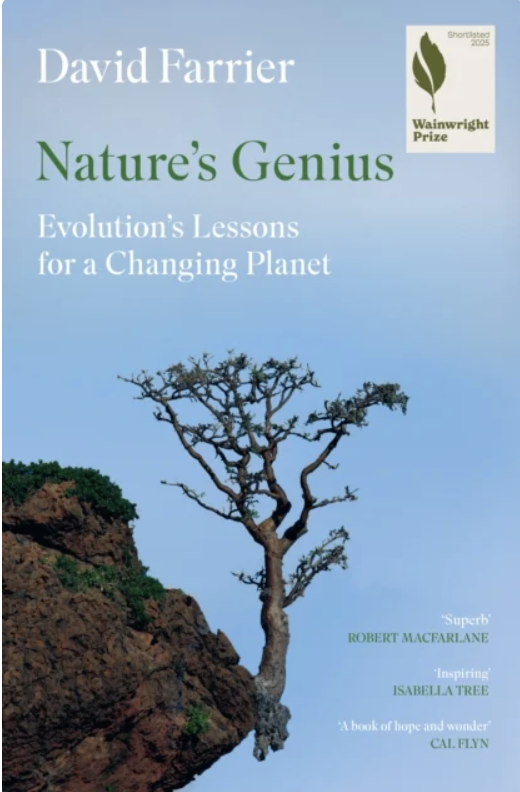
His most recent book is the one we’re going to be exploring today – Nature’s Genius: Evolution’s Lessons for a Changing Planet is one of the few non-fiction books I’ve come across that is capable both of going deep into the science of the anthropocene – the full genetic, chemical, noise-pollution havoc of it and going deep into how we can engage with indigenous cultures, languages and ways of thought so that we in the western trauma culture might become something new. As he says early in the book, ‘We pollute because we see ourselves as separate from the rest of the living world, but…learning to coordinate our time with nature’s rhythms…could revolutionise our politics.‘ The whole quote is in the episode. What you need to know now is that this is a genuinely ground-breaking, mind-opening book and I cannot imagine better reading as we step into 2026. If you need to know I’m not alone in thinking this, it has been shortlisted for the Wainwright Prize for Conservation Writing, and the Saltire Award (Scotland’s national book awards) for non-fiction. For the New Scientist and Waterstone’s bookshop, it is ‘Best popular Science Book of 2025’. You do need to read this. And in the meantime, enjoy a conversation that left me buzzing for long after we stopped recording.
Episode #320
What we offer
If you’d like to join the next Open Gathering offered by our Accidental Gods Programme it’s Honouring Fear as Your Mentor on Sunday 8th February 2026 from 16:00 – 20:00 GMT. You don’t have to be a member but if you are, all Gatherings are half-price.
If you’d like to join us at Accidental Gods, we offer a membership (with a 2 week trial period for only £1) where we endeavour to help you to connect fully with the living web of life (and you can come to the Open Gatherings for half the normal price!)
If you’d like to train more deeply in the contemporary shamanic work at Dreaming Awake, you’ll find us here.
If you’d like to explore the recordings from our last Thrutopia Writing Masterclass, the details are here.
In Conversation
Manda: Hey people, welcome to Accidental Gods. To the podcast where we do still believe that another world is possible and that if we all work together, there is still time to lay the foundations for a future that we would be proud to leave to the generations that come after us. I’m Manda Scott, your host and fellow traveller in this journey into possibility, and we are recording this in December, ahead, we believe, of putting it out early in the new year. So Happy New Year in this kind of weird time flip that we’re doing. And this is really appropriate for the topic today because one of the many things that Professor David Farrier explores in his book Nature’s Genius, is how time is not always considered to be linear by other cultures. Probably not by other species, and certainly not by the web of life. So let’s take a step back and have a look. And this is important because we, that is we humanity, we the whole of the human species, but particularly our culture, are now changing every facet of life on Earth and are the main drivers for evolutionary change. The combination of a warming world, an acidifying world, the chaos of toxic overspill and everything that we just dump into the environment, is pushing either extinction or adaptation in every species on Earth, including us. And so it’s good to have a really clear eyed look at this. And this is what Nature’s Genius does.
Manda: The subtitle is Evolution’s Lessons for a Changing Planet, and those lessons are both good and bad. In the conversation that follows, you’ll hear David say several times that we cannot be complacent. Yes, many species are adapting and evolving very fast to the horrors that we are imposing on them, but not everything is. We are losing species at a terrifying rate, and there are probably limits to the adaptations that can happen. Nonetheless, some of the things that are happening are genuinely fascinating. I had no idea, for instance, that elephants were evolving without tusks simply by the pressures of poacher predation. If you don’t take the ones without the tusks, then more evolve without tusks. What this does to the general elephant population is as yet unknown and unknowable, and this is one of several points that we get to in the podcast. We are doing this without thinking. We’re doing it just as a by-product of being human, of being ungrown adolescents in a wider world, where all we care about en masse is GDP growth, acquiring stuff, keeping the wolf from the door. And this is not sustainable. We know this, and we know that we have to consciously evolve to be something else. But I rarely have the chance to have a conversation with someone who really gets this, who takes this as their starting point and then moves on. And David Farrier does this. He is professor of literature and the environment.
Manda: Yes, both of these, at the University of Edinburgh. His first book, Footprints in Search of Future Fossils, looked at the marks we were leaving on the planet and how these might appear in the fossil record in the deep future. It was named by both The Times and Telegraph as a book of the year, earned praise from Robert McFarlane and Margaret Atwood, and has been translated into ten other languages. His second and most recent book is the one we’re going to be exploring today. As I’ve said: Nature’s Genius; Evolution’s Lessons for a Changing Planet. This is genuinely one of the few non-fiction books I’ve come across that is capable both of going deep into the science of the Anthropocene, the full genetic, chemical, noise pollution, all pollution havoc of it. And going deep into how we could possibly engage with the remaining indigenous cultures, understanding the ways that they see language, the ways they think, the ways that they know themselves to be integral nodes in the web of life, not separate. So that we in the Western trauma culture, with all our myths and stories of separation, might become something new. As David says early in the book, “we pollute because we see ourselves as separate from the rest of the living world. But learning to coordinate our time with nature’s rhythms could revolutionise our politics”. I’ve cut several bits out of that. The full quote is early on in the podcast.
Manda: What you need to know now is that this is a genuinely groundbreaking, mind opening book, and I cannot imagine better reading as we step into 2026. And if you need to know that I’m not alone in thinking this. It’s been shortlisted for the Wainwright Prize for Conservation Writing and the Saltire Award, which is Scotland’s national book award for non-fiction. For the New Scientist and Waterstones bookshop it was the best popular science book of 2025. It’s beautifully written, fantastically researched. You will learn new things on absolutely every page and it’s a masterclass in bringing together Western thought with indigenous knowing. The awe and the wonder and the creativity of some of the things that we can do, together with the horror of what we have done, and the capacity of indigenous peoples to view things differently, and perhaps to offer a way out of this mess. So I genuinely recommend that you read this book. And in the meantime, that you enjoy a conversation that left me buzzing long after we stopped recording. So people of the podcast stepping in to 2026, please welcome Professor David Farrier, author of Nature’s Genius; Evolution’s Lessons for a Changing Planet.
Manda: David Farrier, welcome to the Accidental Gods podcast. How are you and where are you as we close to the end of the year, and we’re jettisoning this out into January; so people will hear it in the new year. So tell us how you are.
David: Hi Manda, it’s great to be with you. Thank you. I’m very well thank you. I’m delighted to be with you on the podcast. I’m sitting in my office in the University of Edinburgh. It’s very quiet here because the teaching semester is over. The students are busy on essays and exams. Yeah. So it’s a quieter period, and it’s nice to have that kind of quiet as the year draws to a close. And, you know, the darkest point comes upon us, to have that period of quiet to kind of reflect; it’s the time of year I really enjoy.
Manda: Brilliant. Yes. The looks within time of let’s just settle and see where we are and where we might need to go. And this is the year we have published your book. There will be a picture in the show notes for people not on YouTube. For people on YouTube, this is one of the most exciting and thought provoking and inspiring books I have come across this year, and I am so grateful that you connected with me and suggested that I read it. Because it’s opened a lot of doors and brought me again to the edge of realising how thin is the ice on which we are currently skating. And you are a professor of literature and the environment. And before we dive into the book, even just that; the fact that there is a professor of literature and the environment, which feels such a thoughtful and generative and thrutopian thing to be. And I basically want to come and do a PhD with you, but I don’t know how I’d fund it or manage, because you’re in Edinburgh and I’m in Shropshire. However, how did you come to be that? Was this something you went to Edinburgh and said, hey, we need to bring these two things together, because generally one is in humanities and one is in science, and that needs not to be a thing. Or did Edinburgh come to you? Tell us how that happened.
David: It happened very organically. I’ve been in Edinburgh for about 15 years now, and around the time I came here coincided with increasing interest I had in writing about the environment, writing about place, and writing about how the world is changing and we’re changing it. And I discovered loads of people here working in the humanities, in philosophy and divinity, in art history, who had similar interests, similar questions. And the environmental humanities has been a field for about 15, 20 years now. And it just seemed like a very natural home and a place to ask those questions. In terms of the job title, it’s a bit more of a boring story, really. When I came up for promotion, I had the opportunity to propose my own chair, my own title.
Manda: Wow. How cool is that?
David: It is, it is. But I feel like these are questions, you know, the kind of questions that we have about how we’re changing the world, what should the future look like? They’re questions for the humanities. They’re questions for literature.
Manda: Yeah, they’re questions for every single living human.
David: Exactly. What does it mean to be human in this moment? There’s a wonderful line that I always come back to in an essay by Amitav Ghosh, a fantastic novelist and essayist, Amitav Ghosh. And he says the climate crisis is also a crisis of the imagination.
Manda: Yes, absolutely. And he says we will blame politicians and bureaucrats for their failure to act, but actually, future generations will also blame creatives, because it’s not the job of politicians and bureaucrats to imagine different futures. And I would say if they were capable of imagining different futures, they wouldn’t have their jobs, because the current system is not set up to foster people who imagine different futures. Although I now have friends who are MPs who are very capable of imagining different futures, so I’m a bit more careful than I was. But thank you. Oh, gosh. Now I want to set up our shamanic monastery near to Edinburgh, because we need to be working with you on this. I don’t know if I’ll persuade everyone else that we need to move, but we’re in the kind of formative stages, so guys, this might be a thing. So, there are so many very exciting bits in this book, and I had thought that we might start at the end with the Maori connection, but we’ll move towards that. Page 11, in the introduction you say: “we (that is, we humanity) pollute because we see ourselves as separate from the rest of the living world. But the way other creatures are learning to live with chemical and plastic pollution can suggest ways to reconnect with the world around us. Climate change is altering the many wild clocks that regulate migration, breeding and blossoming. But learning to coordinate our time with nature’s rhythms, to make time with a whole forest, could revolutionise our politics. Understanding better our impact on how living things think, dream and communicate can help us reimagine what it means to live and work together”.
Manda: And I read that and I cheered out loud and it set off so many spirals in my head. And then I wanted to read the rest of the book to find out how you thought that could unfold. And that’s where I would like us to go. It feels to me as if you’re one of the few people I’ve come across who understands the science of how the living world is having to adjust to the impact of humanity, to what some people call the Anthropocene and other people are calling the Gaiaocene, and other people are calling other things. But fundamentally, the human species is now driving the evolutionary change, both of ourselves and the whole of the living web of life. And we’re doing it unconsciously. We’re doing it by accident. And some people clearly, we could talk about domestication, we’ve been doing some of it very deliberately, and now we’re looking at CRISPR, and there are people doing things that I think are incredibly dangerous. We’ll get to that deliberately. But largely there is evolution happening as a by-product of careless impact. And yet it could be careful impact. And there is, I think, and I want to know if you think, still time for us to step back from the brink and do things with more awareness. We’ll only do it with more awareness if we understand ourselves to be integral nodes in the web of life. And first of all, how does that land with you? And second, where does it take us in terms of not being the accidental drive towards things that we don’t understand and can’t predict?
David: Yeah, well, I’m fully on board with that, that we need to understand ourselves, as a node in the web of life and not a central node either. Although we are having a profound influence on the world around us and have historically put ourselves at that centre for far too long, in ways that are really at the root of what has taken us to this point, I think as well. This this distortion in our sense of ourselves in relation to the rest of the living world is so much at the root of this, I think. Maybe a way to answer that question is to say just briefly about kind of where the book came from for me, actually. And the journey that I took in writing it.
Manda: And it’s worth saying you spent a lot of time travelling the world. You’ve been to a lot of places to talk to a lot of people with this book. So there’s a lot of impressive actual travelling as well as cognitive travelling. Sorry. Carry on.
David: Thank you. I mean the travelling it’s a conundrum, because you don’t want to travel unless you can possibly avoid it. And yet in some cases it was important to go to places, to meet people and to be in those places as well. And we might come on to that. My last book, very briefly, was about what our long lasting traces on the planet will be; our future fossils, you know, what our plastic and our concrete and nuclear waste; what traces will be there? What stories will be told about us based on that? And having written about kind of deep time, deep future change, I wanted to write about change right now. And first of all, the thought, the realisation that human activity is the driving force of evolutionary change on the planet right now, every single one of the main drivers of biodiversity loss and extinction. That is pollution, climate change, ecosystem change and the introduction of non-native species. All of these things are driving other species to adapt their bodies and behaviours. And it’s terrifying, but also an extraordinary insight into the abundance of creativity in the natural world. The potential in nature to respond to new pressure and come up with a new body plan, come up with a new behaviour, to me looked, in amidst all of the darkness and the shadow and the fearfulness, that this extraordinary creativity was in evidence. So much of what we’re seeing is about plasticity, though. It’s not just the emergence of new lineages, distinct new species. We’re seeing the expression of what’s called plasticity, that all living things have the ability to devise a new phenotype, a new cluster of traits that constitute the organism. That we all have these kind of latent body plans, these latent other cells within us, because some genes are not switched on, some combinations of genes haven’t been activated. New environmental pressures can activate that. Every living thing has this plasticity.
David: And it was sort of going from that idea of well, what change is happening now? How are we changing the natural world? How is this change happening? And then realising that actually this plasticity is in us, too. And what was a story about how we’re changing the planet and the rest of the living world, became a story about what potential do we have to change? And so this is my slightly roundabout way of getting back to that question, is yes, I absolutely believe we have to rethink ourselves or reconnect with ourselves as nodes in the web of life, but doing so via that sense that we also have this extraordinary plasticity within us. And of course, we don’t need to evolve our bodies. I’m not saying we need to evolve gills.
Manda: Or our brains to grow twice the size.
David: That would be nice. It’s changing our way of life, our culture, our technology. These are kind of secondary evolutionary systems, if you like. That we export so much of our evolution. Have done historically to culture, to technology. And actually, we need to evolve our way of life and our sense of ourselves at the heart of that. So we need a more plastic sense of what it means to be human, I think.
Manda: If we go down that rabbit hole, we’re not going to get to your book. And I really want to go down that rabbit hole. This is the single most exciting conversation I can imagine having at the start of 2026. I think we have to make this bifurcation, we as a species have to decide it’s time to shift. However, let’s take a little bit of time to celebrate your book and all of the things that you explored and the different ways that different things are adapting. So I have a key question. My understanding of genetics is pretty basic, I did vet school in the 80s, so it’s a long time ago and epigenetics wasn’t a thing then. And I am not clear how much of the genetic change that we’re seeing, because you had things like the frogs that go into the most contaminated liquid there is on the planet, coming out of some vast slaughterhouse in Australia. And they go in and they come out bright green, but they come out, they survive, and they’ve shed the fungus that was assailing them. And so they’ve evolved a behaviour and presumably a resistance to bad stuff. And there’s a cod, I can’t remember its name. The tomcod, that’s it. That can survive levels of heavy metals that would basically kill everything else stone dead. And and they’re still surviving and their surviving when other things are are just not. We’re in the middle of a mass extinction, as far as I can tell. And up until now, the definition of a mass extinction has been 70% of species loss over 2 million years. And we’re achieving it in one human lifetime, which is not a great achievement, frankly. But we’re bringing the might of our military industrial complex to bear on the rest of life and wiping it out quite effectively. But some things are surviving and some things are changing such that they’re evolving whole new species. The swallows that are getting stubbier wings, because then they can twist and turn out of the way of the trucks on the American highways. It’s amazing. There’s so much stuff. And this is latent within us. And how much of it is genes that are not expressed, so an epigenetic change, and how much of it do you think is at the level of the DNA? And is that a thing that we don’t know and it doesn’t matter? This is purely for my interest.
David: I mean, this is what’s so extraordinary about it. It’s this carnival of change, and different pathways. So in terms of the green and golden bell frogs that were bathing in these septic tanks, built on the site of the of the old Sydney Olympic Village. That was just an opportunity, a new affordance in the landscape, if you like, that helped them shed this horrendous fungus that is having such a devastating effect on amphibians worldwide. And in the case of the cliff swallows, that’s a selection pressure that is, a pressure on that kind of natural plasticity in a particular body plan finds it’s better adapted to that environment. So these shorter wings make them more aerodynamic.
Manda: Right. And this is survival of the fittest at its most basic. Social Darwinism has been debunked so often that I don’t even really like Darwinism happening, but it clearly is. And there were the moths. I remember even when I was a student, we were learning about the moths that were growing darker because they were camouflaging against soot covered buildings in industrial Britain. And then we stopped polluting as badly with soot, we polluted with other things instead, and now the moths are growing lighter again. But that’s just sheer selection pressure of the ones that are least visible are the ones that stay alive to produce the next generation. But it seemed to me that there was some plasticity within generations, that some things are evolving, behaviours that are maintaining life. Like the crows that are beginning to build nests out of the anti-bird stuff. We put anti-bird stuff on buildings. Humans do that. I mean, it’s bad enough when we put anti-human things on buildings, but now we’re putting spikes on, that are meant to deter the birds. And the birds are actually ripping them up and turning them into nests. And you think, yes! Go crows. Well done. And some of that is adaptive behaviour, a bit like tits in the days when we used to put milk bottles on people’s doorsteps. I used to do a milk round when I was a kid, and you’d put the milk bottles on the doorsteps, and then people would put out the early equivalent of yoghurt pots to put over them, because the tits had learned to open them up and drink the cream.
David: Exactly.
Manda: And it’s just a learning thing. And then it spreads in the population and it’s an adaptive learning rather than a genetic selection. And both of these seem to be happening in a mosaic in concert. Yes?
David: Yeah absolutely. I’d love to come on to a lot of these particular animal stories because you’ve mentioned some of my favourites.
Manda: Yes. Pick some.
David: Well the, the industrial melanism, the peppered moth that turned dark because of the pollution of the soot covered woods in industrial Manchester; that was a mutation. A genetic mutation that took place maybe 50 years earlier. There was a study in nature in 2016 that actually went into the genome of these animals and found that it was actually 1819 that this single mutation took place. And there it was, ready! That also was what was behind the the ability of the Atlantic tomcod that lives in one of the most polluted environments on the planet, the Hudson River, into which an appalling amount of polychlorinated biphenyls were dumped in the post-war period. And yet it has evolved this immunity to this extraordinarily toxic, carcinogenic substance, this so-called forever chemical. It’s made itself untouchable in a sense. That was also a single mutation that’s thought was there, as happens, mutations happen all the time. It was there in the population and it found its moment. These mutations are there. And we’re creating all these kind of new selection pressures to which they might be a kind of viable response. In terms of the anti nest spikes and the bird nests, this is probably one of my favourite examples in the book. It’s a kind of punk architecture. Because you write these these anti spikes, they’re a kind of hostile architecture for wildlife.
David: They are horrific. And they’re a message that says we will not share this space, we will not share our cities, you know, keep away. And yet our cities are full of non-human neighbours. And in fact, you know, cities are one of the hotspots, where some of the best examples of human driven evolution and human driven plasticity can be seen. Because they mimic natural environments, and yet they create all these new opportunities for food and shelter and so on. The birds, it’s crows and magpies. They’ve been observed doing this in Glasgow, Rotterdam and Antwerp, I think. And they’ve been observed stripping these spikes away from buildings to make their nests. And it’s a wonderful example of repurposing in nature; taking something that was meant to be a barrier to exclude and turning it into a shelter. Finding a new order, a new possibility in something that has been designed for one thing, and finding it can be used for something else. And it’s a wonderful line of thought to take. Because our cities have been made for a single purpose. You know, every building that gets thrown up is designed to have a particular purpose. Whether it’s for accommodation or offices or a cultural space or what have you, a school. But it’s designed for the needs of that time. And most buildings have an astonishingly short life. I learned once that most buildings have a life that’s between 60 and 100 years.
Manda: Is that it?
David: Yeah. You tend to think of buildings as lasting longer than that, and many do, but clearly many don’t. Everything that reaches that end point, if we don’t find a new use for it, will end in landfill. Something like 40% of global carbon emissions come from the construction industry, whether it’s mining, manufacturing, construction itself and to an extent, inhabitation as well. But, you know, the whole process. And it’s very linear. It’s basically land mining to landfill. And the birds offer us this wonderful example of a way to create a kind of circular economy for the construction industry. There’s a principle at work here, a kind of deep evolutionary principle. The birds are really taking advantage of something in their environment, but we can see this principle happening at the heart of every evolutionary process. It’s called exaptation and it basically means finding a new use for an existing characteristic. So the first feathered animals evolved feathers, these new features, for insulation.
Manda: Yes. Not to fly. I didn’t know that. It’s so exciting! They just evolved feathers to be warmer and then they discovered that flight was possible. It’s amazing!
David: Adaptations to a certain climate exapted to find this whole new form of mobility. And so exaptation puts repurposing at the heart of Evolution, and the birds are just this little chink of light into how this might potentially be a way to rethink our whole relationship with the urban environment. You know, could we have a circular construction industry? And there are wonderful examples, you know, local examples of where we see this in action. And one of my favourites is here in Edinburgh. And I was actually there this weekend to watch a concert. It’s called Pianodrome. So two musicians, Tim Vincent Smith and Matthew Wright, noticed that there were hundreds of upright pianos in Edinburgh that had reached the end of their playable life, if you like, and nobody wanted them. And they were going into landfill. And they just couldn’t tolerate this, so they thought, what can we do with them? And they gathered up 100 of these and disassembled them. They deconstructed them and they used every single part right down to the keyboards, the lids, the nails, the cast iron harps, right down to the nails. And they made this performance space called Piano Drome. It’s like an amphitheatre, a series of stands. You sit in them and you’re sitting in these reconfigured pianos. And they’ve kept the soundboards inside them, so the whole space resonates. And it’s a wonderful example, actually, of exapted architecture, as it’s sometimes called, because accepted features retain their old affordances. You know, feathers still insulate, you know, we evolved bones to store phosphorous and we still store phosphorous in our bones. You know, these old affordances don’t dissipate. So the piano drum remembers its life as an instrument.
Manda: It feels very like our indigenous forebears who used every part of an animal that they’d killed. And now we’re using every part of an instrument that someone has lovingly made. And you create a space. I want to get into dreaming, but let’s not go there yet. Sorry, I interrupted. Let’s take a little sidestep, because a lot of the book is about animals and how they’ve been forced to adapt. So for instance, I did not know that we were forcing the evolution of Tuskless elephants, because the ones that have no tusks survive because the poachers don’t want them. Which just makes me want to hurl things at the wall. However, you headed down a bit of an avenue with human design of cities, of buildings, of the place in Brighton that is 98% made of recycled stuff. And with Janine Benyus and Biomimicry, and we talked to Michael Paulyn on this podcast a while ago. And so it seems to me, at the moment, as you said, most of our buildings are designed for one purpose. We are either designing to look beautiful and to be functional, or we’re designing to be cheap and functional. And as Lou who does the video said, we’ve got this triangle, there are three things: cheap, beautiful and effective, and it can be two of the three.
Manda: But we don’t think about the end of its life. And you write in the book of a playpark in the Netherlands, I think, or Belgium that’s made out of wind turbine blades. But I’ve seen videos online of wind turbine blades being put into what we euphemistically call landfill, but was basically hundreds of acres of American prairie that was being pulled back with a backhoe. We lay out layers and layers and layers of wind turbines, and then we push the soil over the top. That’s landfill. And it’s horrible. And how in heaven’s name did anybody design a wind turbine blade to produce renewable energy that was not itself renewable? How did we get to that? It just blows all my fuses. And so there are people in the world who are trying to design things that have a circular life. There aren’t enough of us. And I’d like to hear more about the things that we are designing that are circular. But then I’d like to explore with you, because you’re obviously in this world, how do we get to a tipping point where our consciousness has shifted to the point that designing things in a circular way is what we do, rather than the exception? So take that however you feel like.
David: I mean, yeah, I’ll pick up with the waste house, if that’s all right.
Manda: Yeah, yeah. It’s exciting.
David: You mentioned that earlier. It’s a two storey domestic home. It’s like a model home really, because it’s been designed.
Manda: It’s quite small.
David: Yes. And it’s been designed as a kind of teaching instance really, about what you can do with domestic and construction waste, because 98% of it comes from household waste, construction waste. It is extraordinary. It’s very cosy. It’s a wonderful space and it’s designed by an architect called Duncan Baker Brown. And he designed it both to show what can be done and also to show the difficulties we make for ourselves when we design things with only one purpose in mind, and how difficult it becomes then to find new uses for them. So a good example of that is insulation. It’s very interesting, but they try loads of different ways of insulating this space using materials; these bicycle inner tubes, duvets, old DVDs.
Manda: Yeah. You said you could see the spines of them, but they weren’t very effective as I understood it.
David: No. Well, that’s the point. Because they’re not as effective as natural sheep’s wool, for example. So it’s a really good teaching tool for what can be done, but how much better it would be if we, as you said, thought in circular terms at the design stage. You know, 80% of environmental impacts are built in to anything we design at the design stage. Yeah, the Wikado playground in Rotterdam is again another great illustration of this. It’s a wonderful space. These wind turbine blades, they’re extraordinarily difficult to do anything with once they’ve been made and yet this playground is this wonderful space of play. Children are, you know, imagine the kind of imaginative journeys they’re going on when they’re inhabiting it. It looks like something that was made out of wind turbines, there’s no effort to disguise this. But it is beautiful.
Manda: It does look fun.
David: Yeah. It has beauty of its own. But it’s the beauty and the idea, I think. So the company that made the Wikado playground is a design studio in the Netherlands called Superuse Studios. And their commitment is to a kind of regenerative design, a circular design. They were commissioned to build a new school in the Netherlands, and instead of just knocking the old one down and building a new one with new materials, they inventoried the old building and mapped everything that was there, deconstructed it, and built a new school fit for the 21st century using 90% of materials already on site.
Manda: Wow. So that’s like Pianodrome, but school scale.
David: It is. I’ve only seen photographs of this but it is beautiful. It’s striking. It’s dramatic, it’s full of light. There’s no sense of compromise aesthetically. I like thinking about the Waste House as this kind of junkyard Hansel and Gretel cottage, but it’s beautiful. It’s great, I love it. And then you get to this Superuse Studios and their school and it is beautiful. It looks modern, it looks contemporary. So I don’t think there is necessarily a contradiction there between working with waste and all three. I think it is possible, it’s sure to be possible that we can we can create spaces fit for now that use what’s to hand.
Manda: With the school, and you may not know this because you’ve just seen pictures, but I talk a lot to Tim Logan of the Future Learning Design podcast about the future of education, and I just had a really generative conversation with Zineb Mouhyi, who set up YouthxYouth, which is an education for young people, by young people. And both of them are absolutely clear that the current way we educate our young people is not fit for purpose. And I’m wondering, while designing a school, were they also redesigning the nature of learning? Or was it just a very exciting building? Do you happen to know that?
David: I don’t know, I don’t know, and it’s a brilliant question. I wish I had an answer.
Manda: I might have to talk to someone from Superuse Studios, mightn’t I? That would be really good.
David: I would listen to that, definitely. I just can’t imagine how wonderful it would be to be taught in an environment like that. You mentioned Janine Benyus, of course. And you’ve spoken to Michael Pawlyn, who I spoke to as well, who’s very, very generous with his time. And I’m a huge fan of his work and his ideas. He spoke to me a lot about Janine Benyus ideas. I had an opportunity to speak to her on zoom as well. And of course, her core idea is not just that we follow nature’s model. You know, that we take the ideas and pull them into our own orbit. But that nature becomes our mentor. And what a wonderful space in which to learn that lesson, you know, to make that.
Manda: Yes, in a school that has been recreated. Interesting. Yes. For people who haven’t listened to the back catalogue, we’re talking about biomimicry, which Janine Benyus probably didn’t single handedly bring into being, but it certainly feels that way. And I think we’re now on biomimicry 3.8, in terms of their continual upgrading, of their understanding of the amazing things that we can learn from the natural world. And I still want to talk about some of the things in the book. I want to come to language in a minute, but you said earlier on that humanity is probably not the most important node in the hyper complex system that is the web of life. It seems to me that if Lovelock is right, he has hypothesised that perhaps the organism that is Gaia stored as much energy as was technically possible during the Carboniferous as oil and coal, and then released it or allowed it to be released in one blip so that species us could bring the whole of our creativity to bear in the creation of a system, and we are doing that. We’re doing it slightly unconsciously. We’re doing it very unconsciously. What would happen if we really stepped into our position in the web, where we were self conscious nodes in the web of life? We might not be the only ones. I strongly suspect we’ll find that whales and cetaceans, and very possibly everything else, is actually self conscious. But we know that we are, and we could bring the whole of human creativity to bear in service to the web, in which case we might not be the most important nodes in the web, but we might become really quite important nodes in the web. And that would be utterly flipping amazing, if we could do that. That would be a next step in human evolution, and heaven knows where it would go after that, but it would be pretty sodding impressive. Also, I don’t see how we get through if we don’t do that. So I think it’s actually essential. And the vision of the world That could be, if we were to take the scaffolding on which biomimicry is built, which is the world is full of astonishment and wonder, and we as humans could reproduce that astonishment and wonder in multiple different ways. But we’d need to do it not led by our own brains. This is what terrifies me about the CRISPR chapter in your book, which seems to be being led by people who think like Silicon Valley, which is terrifying.
Manda: But if we were to be able to connect to the web of life and go, okay, we can do this stuff, what do you need us to do and respond in service to life, to the web, with heartmind. Where our heads become in service to our hearts rather than our heads just being in service to our egos and our projections and all the little bits that we haven’t yet integrated. Then we have no idea where we could go, but it would be really interesting, and it would be less likely to be terminal than the trajectory we were on at the moment. Which is fundamentally the FAFO; mess around and find out. But we’re messing around completely blindly. And the finding out is, first of all, creating the sixth mass extinction and probably sending us over the edge of a cliff. So with all of that in, you seem to be talking to a lot of super smart people who are right on the edge of understanding this, and probably much further than me. How do we make that step? David,solve humanity for us, please. In the next half hour!
David: Okay. Right. I think for me, it comes down to what are the questions we’re asking ourselves whenever we do anything, whenever we try to come up with any solution. Any new invention, possibility, initiative. What are the questions that are guiding this? And something that really emerged out of the book, and it particularly came into focus in the conversations I had with Maori conservationists, but I realised it was there throughout. The question is, how does this thing, whatever idea it is, does it foster a greater sense of relationship and connection? How does doing this increase our sense of relation? And if we took that question into the heart of policy making, into the heart of our questions about energy, how we make our cities; what our material environment looks like, you know, are we content surrounding ourselves with plastic? A material that by design, cuts us off from a sense of connection to the living world, that is designed to disappear from our touch? To be mute. To not declare itself as coming from anywhere. To be silent about its history and its future. It exists in the moment of use.
Manda: And it’s anti organic.
David: Exactly.
Manda: It cuts us off from the food that we eat which might otherwise deteriorate or smell or leak.
David: Are we content with that? Or could we have a material environment that actually is made from bioplastics and actually these substances would feel organic and would actually connect us more to the living world. Could we have a revolution in our everyday sense world in that sense? Would these kind of connections about how might we foster a greater sense of relationship? It touches on everything. In the book it touches really strongly on how we cultivate a sense of time. You know, our sense of time is so central to the decisions we make or that we don’t make, to things we give our attention to or not. It’s governed by clock time. And yet, you know, in the natural world, time is an immensely intricate process of coordination between living things, all of whom have their own expressions of time, and that have evolved to mesh and to work together. And of course, there is always a degree of plasticity in that, because there’s always variation in seasons, there’s a warp and there’s a weft. We’re creating a whole series of pressures, though, that are throwing these phenological relationships, these relationships in time.
Manda: Yes. Tell us about the caribou calves, because that was devastating. It’s just an example of what you’re saying.
David: Yeah. Nature is full of examples of ways in which we are fostering change that is not good. And I really wanted to make that point that this is not just a book about nature is going to heal itself. It’s about what lessons can we learn about how we change? And one of the best examples and most alarming examples of these negative changes is in the way that climate change is distorting relationships worldwide. Between pollinators and pollinating plants, between migratory species and the food sources that they need when they arrive and they breed. This distortion of all of these different relationships that are about making time together. So the Greenland caribou are just one example. They’re now calving at a point in the year when they’re several days, I forget if it’s later or sooner than the food source of the plants that their young need to feed on. And so that’s just creating an additional strain on the new generation and reducing even further the likelihood of success, you know, making it more difficult for these animals to survive. There are countless examples of this, as these relationships get thrown out of joint. And asking that question about how can we foster a greater sense of relationship, brings you to the heart of that problem. Because we have lost our sense that time is made together, that time is made in the body as well, because every living thing has a wild clock in it that is sensitive to particular environmental pressures.
Manda: Every cell has a clock in it, if I understood correctly. And so our gut biome, which is trillions of bacteria, they have their own wild clocks, and then our liver has its own wild clock, and then our brain has a different wild clock. And our whole endocrine system is basically a clock. It’s amazing.
David: Yes. It is extraordinary. And we have this in ourselves and yet we have lost touch to a greater degree. I mean, of course we all know about seasonal affective disorder. We know about circadian rhythms. But I think conceptually, we live in our minds in a sense of time that isn’t really embodied.
Manda: Yeah.
David: So how do we get back to that? Well, I think that that question, ‘how do we foster reconnection?’ Is at the heart of it. There’s a wonderful idea expressed by a Pottawatomie scholar called Kyle White. It’s what he calls kinship time. It’s an expression of time, an understanding of time that’s common to many indigenous cultures throughout the world. And it simply means making time according to the thriving of the other living things around us. So are the ecosystems that we live in, are they thriving? Are the temporal relationships that make up those ecosystems functioning as they should? Or is there an element of arrhythmia creeping in? Of things being teased apart? Is strain coming into the processes? A disordering of the tempo. He says that it takes us out of clock time into time that’s made through a sense of kinship, through relationship, through my relationship to the thriving or otherwise of the things around me. And he says it doesn’t mean that you lose touch with or lose focus on the urgency for change, the urgency of that ticking clock that we all feel, but it takes the panic out of it, he says, for want of a better way of putting it.
David: I’m paraphrasing, because it situates your sense of time, not in this sense of things running out of control, but in relationship. It situates a sense of time in the relationships that we are involved in. It asks you to cultivate a sense of time according to an awareness of all the different temporalities and temporal relationships and coordinations that happen around us. And then the question is, what can we do to support that? To further the thriving of those, you know. To remedy where they’ve been thrown out of joint. What am I doing in that? So the question for me, just to come back to your question of what do we do, I think it’s to frame every every initiative, every conundrum, every question that we have, every problem in how does responding to this foster a greater sense of connection?
Manda: Okay. Thank you.
Manda: In the book, there was just a half sentence that said that we think of time, past, present, future, linear. Whereas if I understood it correctly in Mandarin, it’s vertical. Was that a thing? And some indigenous cultures, time runs backwards and we’re living the present so that its impact on the past is healthy. And I think I have quite a fluid brain and my brain did not compute either of those. And I realised how much I live in linear temporal time. Can you unpick either of those or were they just ideas that flowed through?
David: Well, it was more to do with the whole question of how does the language we speak shape our reality. It’s the idea of weak linguistic determinism. So there’s the Sapir-Whorf hypothesis that suggests that the language we speak fundamentally determines our sense of the world. And this is a kind of qualified version of that. But I would like to say something a little bit, though, about what ought to be.
Manda: Go on.
David: That whole notion of what ought to be. So yeah, in terms of what an expression of kinship time, for those of us who aren’t Potawatomi or an indigenous citizen of any kind, might look like. Because, of course, we have to be really careful not to simply appropriate these terms, to detach them from.
Manda: The cultures in which they arose.
David: Yeah. Concepts, because they’re deeply embodied and deeply enplaced, and appropriate them as we might take a statue and put it in the British Museum.
Manda: Yes.
David: But there are ideas that have such resonance for now. And so when I was working on this chapter about kinship time and wild clocks, I came across a line in a book by the Russian poet Osip Mandelstam. It was a journal he wrote of travels, in Armenia as it happens. But he wrote this astonishing reflection just a couple of lines in this journal. He said, ‘what tense would you choose to live in? I choose to live in the what ought to be’. And that really hit home with me, because ‘what ought to be’ expresses the fullness of our time of grief and hope. I think it carries that sense of ache, that temporal ache of what ought to be here but is no longer. The species we’ve lost. The richness and the biodiversity and the colour that we’ve lost. And in many cases, you know, harmful trajectories that species are taking and becoming maladapted to the world that we’re making for them. It carries that sense of ache and loss. The solastalgia that Glenn Albrecht talks about. But it also carries that sense of hope, that conviction and commitment; ‘What ought to be’.
David: It just exploded on the page for me, because that encapsulates this extraordinary moment we inhabit of loss and hope together. We can’t afford not to hope. We can’t afford to let go. But we need to hold on to that sense of what has been lost at the same time. And what language do we have for thinking about the kind of emotional colour spectrum that that involves. It’s such an extraordinarily unique sensation and emotion to inhabit. But it’s also to do with our sense of time. We’re carrying that sense of the world that was and that can no longer be, but also the world that could be in its place, together. And so for me, that idea of what ought to be, is very much akin to that notion of kinship time. Of thinking in terms of relationship and thriving. It’s one of the things in the book I think I carried away with me.
Manda: So let’s unpick that, because I wanted to move into language and our attempts to decode the languages of other species. Let’s have a look at that phrase of what ought to be. Because the verb is carrying an awful lot in there. If I let it settle in, like a pebble drifting down through water, different parts of me snag on the ‘ought’ and it settles down into, I think for me, and I want to know if it does for you; what are my values? What do I live by? What do I live for? Because I suspect we could ask politicians in our current dominant culture that question. Or we could ask a mother with a newborn, or we could ask someone at the end of their life. Or we could ask someone who lives quite connected to the living world, or we could ask someone whose job involves basically staring at a screen all day. And the ought would arise from what is driving the dominant parts of them at the moment. And I talk about IFS therapy a lot, because I think it’s incredibly useful. And Dick Schwartz says almost all of us, almost all of the time, are walking around in a state of internal civil war.
Manda: And different parts of us will answer that question differently. And until or unless we can, I think, get to the point where we’ve at least declared an inner truce and hopefully brought all parts of our system into a degree of coherence, and self led confluence and connection with the web of life, and with other people; then the answers to that question are not necessarily going to lead us in a seven generation way. Cultural appropriation has become such a thing that people step up to with huge, righteous anger. And rightly, I can see that there are things that we need not to do. But on the other hand, if our culture, the Western trauma culture, does not learn from indigenous peoples how to connect to the web of life while there’s still time, I think we’re toast. And we have to do that in a way that is honouring, but we have to do it in a way that is real and works, and that feels also like quite a narrow knife edge to walk. Where does the ‘ought’ take you?
David: Yeah. I mean, I think that’s what’s so wonderful about it, is the richness and the way that it maybe lands differently at different points in time.
Manda: Right.
David: What it makes me think of right now, with all the talk about budgets that’s been going on recently, is that for so many people, and that’s maybe the wrong way to put it, but it’s just an assumption baked into our societies that what ought to be is infinite growth. That is unquestioned. And yet, of course, that is unsustainable, we know this. I think what ought to be, rather, is a rethinking of what growth looks like. A willingness to take seriously the arguments of the degrowth movement.
Manda: You quote Jason Hickel in this book. It’s amazing.
David: Yeah. It’s about it’s about rethinking how energy circulates in a society.
Manda: What is an economy for?
David: Kate Raworth’s Doughnut Economics, I think it’s a wonderful book, says that we need to stop thinking of markets as mechanisms and think of them more as organisms. As embedded in their environments, as responsive to their environments. And maybe a way to talk about this is to talk about the cane toad.
Manda: Yes. I had no idea.
David: Poor Cane Toad. But I was provoked by Nancy Fraser’s book Cannibal Capitalism that asks what animal is capitalism? I thought it was a wonderful question. She says it’s a snake eating its tail. And I thought, that’s great, but for me it’s a cane toad. Because cane toads are this extraordinary expansion engine. Since their introduction to Australia about 100 years ago, they have evolved this extraordinary capacity just to expand, because nothing can eat them, nothing can stop them. So they’ve just expanded relentlessly. And in doing so, they’ve evolved adapted gaits, longer legs.
Manda: So they can move faster.
David: So they can move faster. And they’ve also evolved this relentless drive to move forwards as well. The first generations didn’t have that, they meandered. So they’ve become kind of capitalism embodied.
Manda: Racing toads.
David: Yes. Just moving to new frontiers endlessly and causing destruction wherever they go. And also getting to the point where because they are so unstoppable, their tadpoles have become cannibalistic, their tadpoles eat each other, because nothing eats them. And so it’s a perfect emblem in a way of capitalism, in its sort of self-devouring phase. But cane toads are, if we look at it differently, if we think otherwise about the organism of the cane toad, then actually we get a whole other way of understanding how we could reorganise our economies as organisms, not machines. Because one of the most astonishing things that I learned in writing this book was about the nature of intelligence, the nature of intelligence as an embodied phenomenon. That every cell in our bodies and the bodies of any complex organism behaves in a very similar manner to neurones in the brain. That cells will express preferences, they will share information, they’ll retain information, they’ll group together in some cases and make decisions. They share stress.
Manda: Yes. Slime moulds. Tell us about the slime mould because that’s quite a useful one, I think.
David: The slime mould is just a wonderful example of how diverse cognition is. It was a famous experiment that placed oat flakes, a food source for slime moulds, on a map of Tokyo. Like key points in the city. And they dropped the slime mould on it and it just very organically worked out the most efficient route to these food sources, that happened to map pretty much directly onto the map of the Tokyo subway system. The slime mould, this organism we think has no real capacity for cognition or intelligent behaviour, devised something that it took many, many humans and a great deal of resources to do. And it did it.
Manda: But what was really interesting is the humans had managed to work out the most efficient routes. I thought when I saw that, oh, the slime mould is going to work out something, but oh no it hasn’t. The humans actually got there, which I thought was quite disappointing. But it shows Japanese ingenuity. They had worked out the the best route around Tokyo.
David: But it’s just one example of how diverse cognition is. And the wonderful thing for me was that we can find examples in our own bodies and in the bodies of an organism like the cane toad, of collective intelligence. Michael Levin, the developmental biologist whose ideas I’m kind of citing here, he says that every living organism is a collective intelligence. And that, for me, was revolutionary. I thought, well, that’s a way of rethinking the cane toad, and it’s a way of rethinking our economies as well. Because we think of the economy as an organism that is also a collective intelligence, not an individual entity. But this rich expression of cognition and collaboration going right the way down to the cellular level. That’s a wonderful model for rethinking what it means to grow, for rethinking our relationship with the places that we are embedded in, and rethinking ourselves as one node in the larger web if you like. So going all the way back to what ought to be, I mean, what ought to be for me is not growth that is infinite, but rather an idea of growth as abundance that is embedded in place, that’s rooted in the knowledge that we are part of our environment and that real intelligence is a collaboration. Real intelligence in the natural world, I think is instinctively collaborative. And some of the most extraordinary examples of what look like intelligent behaviour are actually collaborations between entities in an ecosystem.
Manda: Gosh, there’s so much in there I want to unpick, and yet I want to look at language and I want to look at CRISPR. Because it does seem to me we’re still back to what are the motivations? I hear you and I believe you. And I know that if you walked out into the middle of Edinburgh or the middle of whatever town is around here, I made the mistake of going to the food centre near here. I just needed to let the puppy see some people, and I hadn’t realised it was the Saturday before Christmas, and I just watched hoards of people exhibiting Brownian motion as far as I could tell. And thought if I stopped any of them and suggested to them that they were part of an integrated ecosystem around the world, they would look at me like I was crazy. I had this image of myself as one of the old time preachers, standing on an orange crate in the middle of a town, preaching stuff that was innately obvious to me and was completely not obvious to them. And I still don’t know how we get us over that threshold. But one of the ways, it seems to me, is language. I was really interested that you have a whole chapter on language, and we probably haven’t got time to do it justice.
Manda: But I was also over the weekend part of a webinar about animal communication. And I teach shamanic dreaming. It’s my thing. And the thing that seems missing from the human attempts to communicate with other species, which are amazing, and a lot of them are AI driven, is we’re doing it with our heads, and we are assuming that language is a linear thing. And in the book you say it’s not. That whales almost certainly are communicating not just by sound, but they’re also communicating by wave pressure. I don’t know if you’re aware, but Merlin Sheldrake came and gave us a lecture while I was at Schumacher, and he was part of an experiment where they put a petri dish of either highly purified water or vodka, and I can’t remember, under a microscope. And then they put sound waves across it, and it created a standing wave pattern depending on the nature of the sound waves. And they had a dolphin in a tank and they showed it certain symbols, and there was a triangle and a cross and a human shape. And they recorded the sonar that it was making. And then they played it across this plate, and it reproduced the shapes that the dolphin had been looking at.
Manda: I thought, oh, that is so exciting. And there was something about if you put different compounds into the dish, it made different shapes. And I really wanted to start looking at homeopathic things to see what shapes it made. And that was shut down very quickly because homeopathy is dangerous and bad and we don’t talk about it, which was quite distressing. But that aside, the Dolphins were communicating in sonar that was reproducing the shapes that they were looking at. And in the book you have dolphins that have incorporated a click that they have been taught means something. And dolphins are amongst the first animals that we worked with in terms of positive reinforcement. And some of the stuff that was happening there was extraordinary, but at no point, as far as I can tell, have we connected the people who are using AI to try and decode whale linguistics, with the people who are doing animal communication and connecting with the whales. Because one is science and the other is considered flaky, frankly. And yet the evidence of it, once you start looking at it, is huge and undeniable. And the last thing I want to say, is something I learned recently.
Manda: I was on a group gathering with some people in South Africa who are using drones to look at whales, and I didn’t see it, but everybody who came away, (I was on a different workshop), everyone who came away was like, wow, this is amazing; they showed a female sperm whale giving birth, surrounded by a circle of other female sperm whales, because the young cannot breathe yet, and so they take it in turns to lift it up to the surface so it can breathe. Because the mother is exhausted, she’s just given birth. And around the outside is a circle of killer whales holding them safe. And nobody knew that had happened until we had the drones that could take the pictures. Because how would you? And so it seems to me, so much of the connection… We are assuming that, let’s say humpback whales in these amazing songs are talking to other humpback whales, and they may well be talking to many, many, many other species that we don’t know about. So I just wanted to put all that into the air. And how do we connect with other species in ways that are not simply treating their language as computer code?
David: So, yeah, I mean, I think it’s very likely we’re going to see some kind of interspecies translation engine, in the near future. I think there’s so much resource going into this.
Manda: People are putting lots of money into it and lots of AI power.
David: Yes. Although, I mean, we know that the big thing with AI is the size of the data set, and that’s the big challenge for most of these research groups, is getting a large enough data set of recordings of different kinds of animal communication, vocalisation and so on. And sorting through that and signal from noise and so on. However, there’s so much of a drive to this, it’s hard to see how we won’t have that. And I’m really excited. I want to get that out. I have questions. I would love to know what is it that dolphins are saying to each other? Or even just to have a hint of that. I suppose for me, the caution comes in is, well, what level of insight do we suppose that gives us into the world of the other living thing?
Manda: Given how much we don’t understand even indigenous human languages. I had no idea, but the first peoples of Australia don’t have subject verb object. They just tack together multiple multiple subjects in one great big long word that arises in the moment and then is probably never heard again, and that their eyes shift around. So even within humans, the construction of language is radically different. Somebody domesticated in white Western linear language struggles to connect with the much more connected of its place, of its time, within space and time language of an indigenous person. How in heaven’s name are we going to connect with a whale that lives in a three dimensional space where it’s it can move and sing and connect and vibrate and see so differently?
David: Yeah. I mean, there some indigenous languages that have free word order. And so the whole process of constructing a sentence involves taking account of the whole context in which you’re in. And it’s been observed that the speakers of these languages, micro-movements of their eye will track the whole configuration of people and place and so on before generating the sentence. So it has this kind of role to play in language and in shaping our sense of reality. Not in a kind of highly deterministic way, but more limited expressions, a kind of weak linguistic determinism.
Manda: Creating fluidity of thought. Yeah, yeah.
David: Exactly. So why would that not be so much greater when it comes to the language? Or music. And that’s another really interesting question; is whale song language or music or something that is a third category?
Manda: Or poetry, which is kind of in between.
David: Exactly. But how much greater would it be the case that those forms of communication carry a sense of lived reality that we can’t access, you know? And a translation engine would not give us that. And that’s why I think it’s really important to ask these questions. It’s extraordinary to think we could know anything of what another species is thinking or what matters to it. But we also need to respect that sense of difference. You know, kinship time or the notion of distributed personhood that many indigenous cultures have, does not presume upon a total understanding. And I think we have to respect that sense that our particular embodied forms of perception don’t put us at the centre of the world. That again, we’re just one node. And so the caution that I bring to that whole question of interspecies communication, is are we simply putting ourselves at the centre there? Or how might thinking with animal languages help us rather to cultivate that sense of kinship, that respects difference, that looks for affinity and connection, but also recognises that your experience of the world is fundamentally different to mine, and that we’re richer because of that.
Manda: It’s different.
David: The other thing that I feel I have to say in the book as well, of course, is that the natural world is being very, very articulate at the moment about what we’re doing to it. And we don’t necessarily need to know what dolphins are saying.
Manda: We’re not listening.
David: Most of the scientists, when they’re interviewed, who are involved in this, journalists say to them, you know, what’s the question you most want to know, what’s the question that you would put to these creatures if you could talk to them? And more often than not, it’s what do you think of us?
Manda: What do you think of us? Yes. It’s so self-centred. It’s so egocentric and insecure. And they’re already telling us.
David: Exactly. Yeah. The key message is already there. That damage is being done and that we are part of the web, but we’re not living like that.
Manda: Yeah. There was a beautiful story, we probably don’t have time, but the connection between a tree and the whales that was shown in an Aboriginal mythology. And then when the tree started to die, there was something that they could make from the bones of whales that beached themselves, that helped to heal the tree. It was gorgeous. Let’s not go into that. People, you need to read this book and you need to read that bit. Right at the end, we’re way over time, but we need to talk about CRISPR. Because honestly, I’m in the process of very slowly reading the book ‘If anyone builds it, everyone dies’, which is about possible sentient AI and how incredibly likely it is to wipe everything out, not just people, but all life. And then I read about CRISPR and thought, oh my God, why? How? I mean, the ingenuity of humanity is amazing, but we should not be allowed to have these things. They’re dangerous. And that may be just me panicking. So please unpanic me.
David: Yeah, well. So the book ends with a chapter about the possibilities that synthetic biology might offer us. Gene editing in conservation. It begins with domestication. It begins with our earliest interventions in the bodies and behaviours of other species. And in fact it actually begins with the fact that the first species we domesticated was ourselves.
Manda: And then dogs.
David: And then dogs. Yeah. But domestication is really just selecting for tameness, the ability to live alongside one another. And it’s thought that we did that to ourselves in a kind of commensal way, right at the beginnings of the emergence of modern humans, before we did it to other species. So it begins there. And I thought, I really need to end with that sense of what might our next intentional intervention in evolution look like? Because it is a serious question. We are facing the loss of tropical corals. One of the first, really big kind of catastrophic losses, I think, that we’re facing.
Manda: Huge canary in the coal mine.
David: Exactly. And we’re not moving quickly enough in terms of our infrastructure, our use of fossil fuels to change that. So could anything from assisted evolution, which is a suite of techniques that look like domestication, you know, manually moving genes from one population to another, just to kind of cultivate a sense of heat resistant traits. For example in coral. You know, that we’ve been doing this for millennia, so could we do that in coral? But the next and perhaps much bigger step is intervening in the genome, editing genes using technologies like CRISPR, which is like a pair of molecular scissors.
Manda: It’s a cut and paste, basically. It’s an editing tool.
David: Yes. Yeah, it is an editing tool. What a geneticist called Kevin Esvelt realised, about ten years ago or so, was that you could combine CRISPR, cut and paste tools, with something that are called gene drives, to create an inheritable edit. Gene drives are just parts of our genome that have a greater propensity to be inherited. A synthetic gene drive introduces a kind of CRISPR edit that is heritable. And so you can you can do extraordinary things with that. You could create a change that would run forever. You could create an extinction machine, because you could introduce something that’s called a last litter approach, where every male that is produced in the lineage is sterile. Or more and more males are sterile, so that it becomes, eventually, you know, the species runs into the ground. It’s an extraordinarily powerful tool, possibly one of the most powerful we’ve ever created. It’s up there. And so Kevin Esvelt was very, very worried about the possibility of this. So first he introduced what’s called a daisy chain drive. So basically the gene drive architecture is assembled in such a way that its components are distributed. And so a generation or generation parts get lost, the chain breaks. And so it’s not this kind of relentless force running from generation to generation.
Manda: If he can put that in, someone can take it out.
David: Exactly. I mean, a lot of people are very, very worried about synthetic biology and gene editing. And I understand why. I felt it was a question to take seriously, though, because we are hurtling towards some pretty catastrophic outcomes. And if the technology is there, should we use it? Beth Shapiro, one of the geneticists I spoke to who’s an advocate of this, basically made the case that it would be irresponsible not to. And that was kind of my way into this. I was thinking, well, if there is such a thing as a responsible use of this, what does it look like? And it comes back to that question.
Manda: It’s the ‘ought’ question, isn’t it?
David: Yeah. And the Maori conservationists I spoke to encapsulated that sense of does this action foster connection or weaken connection? So Kevin Esvelt spent a lot of time talking to Maori,and learned how important it was that you listen to indigenous cultures, who have perhaps the greatest stake in a kind of intervention like this in their ecosystem. In New Zealand there has been a tremendous problem created by the introduction of non-native species, particularly rodents and mustelids. Their effect on animals that are totally unadapted to cope with them. One way to arrest this would be a kind of gene drive approach, a last litter approach. And rather than sort of respond with the usual fears that many of us in the Western world have about about intervening, kind of Frankenstein’s monsters, you know, unintended consequences.
Manda: Cane toads.
David: Exactly. Well, yeah. It was a form of ecological engineering of its day. They were introduced supposedly to deal with a sugar cane eating beetle, which they didn’t eat. Rather than responding with all kinds of fears, Maori conservationists – and there is a diversity of opinion, of course among Maori – they had a very different set of questions. And they’re all grounded in the Maori way of thinking about life, Matauranga, which is all about connection and kinship. So Kevin, on his journey to thinking about how to use this technology responsibly, if at all, realised how important it was to talk to Maori conservationists in New Zealand. There’s been many problems created by the introduction of non-native species; rodents that eat ground nesting birds and so on. A synthetic gene drive would be a way to sort of reduce these populations. But he realised how important it was to speak to the Maori conservationists who have so much at stake. So much invested in this.
Manda: And a different worldview is the important thing. They’re less likely to be thinking linearly.
David: Well, they ask very different questions of this technology. That was the thing that surprised me. They didn’t instinctively go to the kind of the fearful responses that many of us have about intervening in nature and creating unintended consequences. They asked how does this cohere or not? With Matauranga, the whole Maori philosophy of kinship and relationship, everything being related to everything else, one of the central concepts in Matauranga is Whakapapa. It’s often translated badly in English as genealogy. It’s the idea that everything has a kind of lineage going back to creation. Every living thing has a Whakapapa. But Marcus Shadbolt, one of the Maori conservationists, defines it more as taxonomy, a way of sorting the relationships between things. Not in a kind of Linnaean sense, describing what’s distinct about a species, but describing what is the relationship between one living thing and another. As an example, he told me the story you mentioned about Tawera, the southern right whale, and the kauri tree.
David: Once the whale lived on land and the whale and Tawera and Kauri were brothers. And the whale evolved this longing for the ocean. So when he was about to depart, they gave each other gifts. The whale gave the tree his scaly skin, so it had a bark to protect it. And the tree gave the whale oil, to ease his way through and protect his skin and the salty water. Several decades ago, kauri trees were attacked by this fungus that’s causing this tremendous problem of kauri dieback. And, you know, we have ash dieback here. It’s a fungus and there’s not really been a solution for it. And at one point, Maori healers noticed that southern right whales were beaching themselves on the shores, and they said the whale is coming back to help his brother. And they found that creating a compound out of the bones of southern right whales allowed them to create and apply an ointment to these trees that had a positive effect on the fungus. Now, it’s not been proven by scientific studies yet. It’s still anecdotal, you might say. But the point Marcus was trying to make to me was that the whale and the tree have a shared Whakapapa. They have a shared relationship going back into creation, from a Maori point of view. If you were to say I was going to edit this tree with parts of the genome of the right whale, it would have no problem with that. Because the question at root is how does this foster a greater sense of relationship? From a Maori worldview, these entities, these organisms, profoundly different from a Western point of view, are kin. And whether or not any of us are persuaded by the story of the Maori healers or not, really for me what’s at heart is that question. It’s that rewriting question.
Manda: It’s just a different way of thinking.
David: Uh, well, it’s already being done. There’s been a similar project, you know, to help American chestnut trees that again, were blighted by fungus, that comes from Japanese chestnut trees, I think. They introduced a wheat enzyme into these trees, and what it actually did was it allowed the tree not to kind of fight off the fungus, but to coexist with it. Which is a reorientation of thinking about this, that it’s a change that’s actually fostering relationship. As it turns out, there are further problems. You know, introducing this change makes the trees less able to survive other kinds of challenges and conditions above ground. And the complexity of creating a new phenotype out of a gene is formidable.
Manda: That’s the thing, isn’t it?
David: But what’s really striking to me is that this whole story puts a different question at the heart of it. And it’s a question as much about us and who we are in this as, as it is about the kind of actions we take. You know, this podcast is called Accidental Gods. And we have had this kind of godlike view of ourselves. Stuart Brown famously said, ‘we are as gods. We may as well get good at it’, I think is what he said.
Manda: Yeah, but Daniel Schwartzenberger said, if we’re going to act like gods, we need to have the compassion and prudence and wisdom of gods. And how do we get to that? Is the question.
David: Exactly. I think we take ourselves out of that role altogether. And we recognise, as the Maori do, the divinity that’s in all living things, the shred of the divine that’s in everything. To act on that principle, you know, as it were, in quotes “as gods”, is to recognise that whatever is divine or godlike in me is divine and godlike in every other living thing. That it’s not an expression of exceptionalism, it’s an expression of relationship and connection and kinship. So for me, yeah, that’s what’s so revolutionary about that idea. And that question is that it grounds everything in the way it does or doesn’t foster that greater sense of relationship? Does it or does it not stitch us more tightly into the weave of the living world?
Manda: Gosh, David, we’ve run so far over time and that is the question, isn’t it? How do we how do we connect to the web of life, such that we are being guided by it, rather than being guided by commodification or profit or even well-meaning? I think the people who brought the cane toads to Australia thought they were doing something good. They didn’t decide they wanted to bring something that was going to destroy half the population.
David: Well, they thought they were protecting their crops and their profits. But yes.
Manda: Right. Yes, yes. But people who brought weasels to New Zealand, thought they were going to help wipe out the rats that were causing the problems. The law of unintended consequences is so huge. And our capacity to think complex enough, complexly enough, we think in complicated, linear ways and our capacity to see the web is pretty limited. But the web can see. And so it seems to me that what you’re saying is we have this capacity to be astonishing assets to the web, if we could take our instruction from the web and not from our own insecurities or sense of lack or desire for profit, or any of the things that currently seem to motivate most people. And so there’s probably a whole new podcast to be had on within the world of literature and poetry and song and ideas, how can we create that body of work that helps everyone to feel differently, and to do the connected work? All parts of ourselves, ourselves, each other, ourselves in the web of life. Haven’t got time for that just now because otherwise it would last for the whole of the week. Is there anything that you wanted to say in closing? Because this has been amazing, I will put links to both of your books in the show notes. I will endeavour to find spellings of all of the Maori words for the transcript. Anything else that you wanted to say that we haven’t covered, other than congratulations on being shortlisted for the Wainwright and the Saltire, that’s totally amazing. Really impressed with both.
David: That was great. I’ve really appreciated this chance to really talk at length. I mean, often podcasts are a lot shorter and you have to really like sprint through things. And I’ve really enjoyed the opportunity to dwell and see where it goes. I think I would just leave it on that whole idea of what ought to be. For me, that has been the thing that has stayed with me most. That and the notion that we have as much plasticity in ourselves. And the lessons we need to learn, I think we can find within ourselves. You know, the fact that that we are collective intelligence just as much as any other living thing. The fact that our cells share stress, and have ways of making the problem of the one the problem of the many. The fact that we are also plastic beings that first domesticated ourselves and learned to live together before we assumed this role as the great domesticator of the living world. I think there’s a lot we can learn about what we need to do to respond to this crisis, this poly crisis we’ve made, by looking within ourselves. In a kind of literal sense. We have wild clocks within ourselves as well. The possibilities of kinship time reside within our bodies, too. So yeah, that’s where I’d leave it.
Manda: Fantastic. Thank you. We have a title in there somewhere. I will work it out. In the meantime, David Farrier, thank you so much for coming on to the Accidental Gods podcast. This has been such an exciting way to start the year with so many ideas and as you said, so much hope provided we can begin to do the work, inner and outer. And the maps are there. Thank you, thank you.
David: Thank you.
Manda: And that’s it for this week. Huge thanks to David, for all that he has and does. Not least for the literacy that he brings to this book. There are so many quotes from people that I felt I ought to know and didn’t, and now will explore. And so many insights into things that are genuinely mind bending. I learned so much of the good things that humanity can do, of the creativity that we’re bringing, of the people that really care and really get this. Who are really taking care of what it is that we do to the world. Who are genuinely exploring ways forward that could be different. So I do heartily recommend that you read this. The paperback will be out in April. The hardback is available now. There are links in the show notes,.
Manda: And we will be back next week with another conversation. In the meantime, thanks to Caro C for the music at the head and foot and for this week’s production. Thanks to Lou Mayor for the video, to Anne Thomas for the transcripts, to Faith Tilleray for the website and the tech and the long, deep conversations that keep the world open and alive. And as ever, an enormous thanks to you for listening. If you know of anybody else who wants to know the potential of who we could be and how we might get there, who wants to know some of the genuinely wonderful things that we’re already doing, then please do send them this link. And that’s it for now. See you next week. Thank you and goodbye.
You may also like these recent podcasts
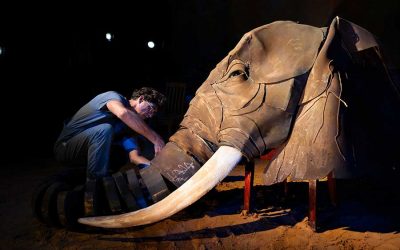
Sculpting Invisible Materials: Expanding Empathy in the Hot Mess of Now with Dylan McGarry of Empatheatre
Empathy lets us do more than just step into another’s shoes, it opens the doors for us to step into their heart and soul with the vast generosity of spirit we’d like others to bring to us, so that we can see through their eyes as the best of who they are. Obviously, we can do this with other people, but we can do it too, with whales, with elephants, with horses, and red kites and moles and spiders – and mountains and trees and landscapes… empathy is the spark that connects us to the More than Human world.
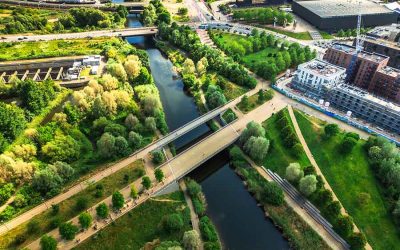
Towards the Symbiocene: Building an Eco-Civilisation with thought-leader, Jeremy Lent
Jeremy Lent is a long time friend of the podcast. His new book, ‘Ecocivilization: Making a World That Works for All’ is coming out at the end of April 2026 and so we got together to discuss what an Ecocivilisation is, why we so badly need to become one, and how we might get there.
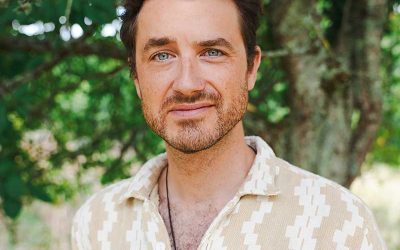
The Joy of Becoming Lost: Maps, Myths and Navigating the meta-crisis with Sam Crosby of Recalling Fire
We are a storied species – we live and breathe and love and learn by the rich tapestry of stories that shape our lives. Everything we do from picking a career to moving house, from finding our life’s co-creator(s) to choosing what to have for lunch is underpinned by stories of who we are and how the world works. Often, we take these stories so much for granted that we don’t even recognise they are stories – we genuinely believe the world works like this…
Pull from the heart, don’t push from the head: Spreading Stories that Work with Matt Golding of Antidote
How do we create stories powerful enough, moving enough, inspiring enough – and grounded enough – to shift the trajectory of our culture onto a totally new pathway?
STAY IN TOUCH
For a regular supply of ideas about humanity's next evolutionary step, insights into the thinking behind some of the podcasts, early updates on the guests we'll be having on the show - AND a free Water visualisation that will guide you through a deep immersion in water connection...sign up here.
(NB: This is a free newsletter - it's not joining up to the Membership! That's a nice, subtle pink button on the 'Join Us' page...)