
#334 Zen and the Age of Celtic Buddhism with Brother Phap Linh from Plum Village Monastery
Contemplatives down the centuries have expressed a sense of unity with the All That Is, the Heart Mind of the Universe, whatever we want to call it. The words may be different, but the sense of non duality, of immanence, awe and inter-being seem universal. Only in our western world do we resolutely decide that the world is made of atoms and nothing really matters.
Except clearly it does, and if we have one central crisis in our world today, it’s one of meaning-making. Even more than our failure to make sense of anything, is our search for a sense of meaning and purpose that must, surely, underlie everything. Where we fall down is in thinking that what we can see, hear, taste, smell, feel is the sum total of all there is: if we can’t sense it – if we can’t measure it – then it isn’t there – and it doesn’t matter. This is the kind of frame that underlies the entire death cult of predatory capitalism; it’s the core of how we have made the world work…and it’s falling apart under our feet and in front of our eyes.
Which makes it a really good time indeed to talk to someone who spends their entire life contemplating the nature of reality, in finding ways to be fully present and then being this in a way that ripples out to anyone and everyone nearby, human and more than human.
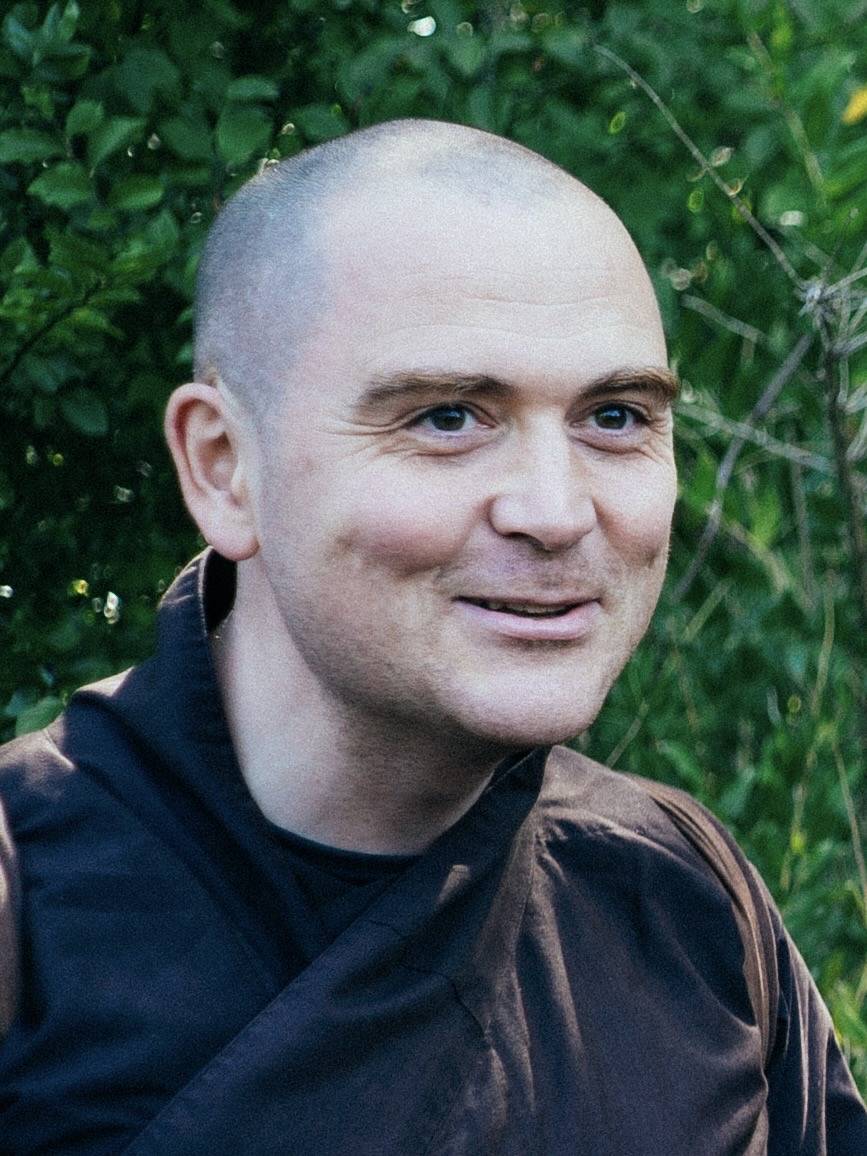
Brother Phap Linh, also known as Brother Spirit, is a Buddhist monk from Plum Village, the Zen monastery founded by the late Thich Nhat Hanh near Bergerac in south west France. Brother Phap Linh is someone who radiates presence, that sense of inter-being or inter-becoming that arise when we are fully present.
As you’ll hear, he began life as a musician and mathematician and then, in searching for the nature of reality, found Plum Village and his teacher. He and Thich Nhat Hanh planned a book: Wonder: Where Zen meets Science. It’s being published later next year and we’ll have another conversation explicitly about the book, but today, we wanted to explore the routes towards a way of being that all of us can follow. This was a wide, deep conversation and felt absolutely right for the chaos of these times. Please share the calm with us, and the joy of discovery.


More from Accidental Gods…
We offer three strands all rooted in the same soil, drawing from the same river: Accidental Gods, Dreaming Awake and the Thrutopia Writing Masterclass.
Our next Open Gathering offered as part of our Accidental Gods Programme is Falling in Love with Life which will run on Sunday 17th May 2026 from 16:00 – 20:00 GMT – details are here. You don’t have to be a member of Accidental Gods – but if you are, all Gatherings are half price.
If you’d like to join us at Accidental Gods, this is the membership where we endeavour to help you to connect fully with the living web of life.
If you’d like to train more deeply in the contemporary shamanic work at Dreaming Awake, you’ll find us here.
If you’d like to explore the recordings from our last Thrutopia Writing Masterclass, the details are here
Manda and Louise both offer one-to-one Mentoring Calls. Manda is fully booked just now, but if you’d like to contact Louise, details are here.
In Conversation
Manda: Hey people, welcome to Accidental Gods, to the podcast where we do still believe that another world is possible and that if we all work together, there is still time to lay the foundations for a future that we would be proud to leave to the generations that come after us. All of this in spite of the current geopolitical crises going on around the world. The question then is, how do we get to a point where we all work together? And this is not a new question. Contemplatives down the centuries have expressed a sense of unity with the All that Is, the heart mind of the universe, whatever we want to call it. The words are different and the cultural background is different, but the sense of non-duality, of immanence, of awe and wonder and interbeing and inter becoming seem to be universal. And they’re universal then between all parts of ourselves, ourselves and each other and ourselves and the web of life. And I think this is one of the parts that gets missed. We tend to assume that non-duality is only myself and the web of life are one. And it’s not just that. It’s all parts of ourselves and me and all the rest of creation, including all of the other humans. Even the ones that keep doing crazier things every day. Leaving that bit aside, the thing is that we in the Western world, the Western educated industrial rich, democratic, ‘WEIRD’ trauma culture, the one that split off from the web of life, however long ago we did, and I would say 10 to 12,000 years at least.
Manda: We are the ones that have decided that the rest of the world is made up of atoms, and therefore nothing really matters. Except clearly it does matter. And if we have one central crisis in our world today, it’s one of meaning making. Even more than our utter failure to make sense of anything, to work out what’s true, what’s real, what we can trust. Our search for a sense of meaning and purpose is, I believe, what drives most of us, even if we don’t understand it. So we’re locked in a world that tells us that what we can see and hear and taste and smell and feel at an external, tactile level, is the sum total of all there is. And most of the time we ignore the inner feelings, unless we are really attuned to concentrating on those and to working with them. So at baseline, what Western science offers us is the belief that if we can’t sense it, if we can’t measure it, then ‘it’, whatever ‘it’ is, isn’t there and therefore it doesn’t matter. Compassion, love, awe, wonder, connectedness, flowing along timelines; all of these things are not part of what Western science gives us.
Manda: And then this carries us forward to the entire death cult of predatory capitalism that says, if it doesn’t matter, we can make a profit out of it. This is the core of how we have made our world work for thousands of years. And you and I have the privilege of being alive at the point when it is actually breaking apart in front of our eyes and disintegrating under our feet. Isn’t that fun? No, of course it’s not. And I am absolutely not minimising the trauma that this has brought and is going to bring. But it had to break. And so the question now is, how can we build something better? Which is what makes it a really good time to talk to someone who spends their entire life contemplating the nature of reality, finding ways to be fully present, and then being this in a way that ripples out to anyone and everyone nearby in the human and the more than human realms. Brother Phap Linh, also known as Brother Spirit, is a Buddhist monk from Plum Village, the Zen monastery that was founded by the late Thich Nhat Hanh and is near Bergerac in southwest France. If you ever want to go and visit, Brother Phap Linh is someone who radiates presence, who radiates experiencing, the sense of interbeing or into becoming that arises when we are absolutely, fully present in the moment and have that sense of equanimity that that brings.
Manda: As you are about to hear, he began life as a musician and a mathematician, and then, in searching for the nature of reality, he found Plum Village and his teacher. And in the course of his time there as a monastic, He and his teacher planned a book called Wonder; Where Zen Meets Science. It’s being published in the spring of next year, and we will have another conversation explicitly about that book. But today, we wanted to explore the roots towards a way of being that all of us can follow. We wanted to look at the origins of how this book came about, of its roots, and where it’s going. And yes, we wanted to explore what it is to be in the age of Celtic Buddhism. What that means and how it can be a hybrid, with hybrid vigour, bringing together two long, deep lineages. So this was another really wide, deep conversation, and I loved every moment of it. So people of the podcast, please do welcome brother Phap Linh, otherwise known as Brother Spirit of Plum Village.
Manda: Brother Phap Linh, Welcome to the Accidental Gods podcast. How are you and where are you on this amazing spring morning?
Brother Phap Linh: Well, first of all, hello Manda, hello everyone. Thank you so much for having me on. And yeah, it’s lovely to be with you. I’m very well. I’m in Plum Village, which is the monastery where I live in the southwest of France. And it’s just a gorgeous spring day. The leaves on the pine trees are just starting to open up everything’s blooming. It’s just beautiful.
Manda: Have you got blossom down there? We just got cherry blossom coming in. A little tiny bit of plum blossom. Do you have that?
Brother Phap Linh: Yeah. Our plum blossom’s already come and gone.
Manda: Oh really? Been and gone. Yes of course; southwest plants.
Brother Phap Linh: Yeah. Cherry blossoms are midway through, Magnolias are already finished.
Manda: Almost over, right. Yes.
Brother Phap Linh: Apple just coming. Yeah, it’s gorgeous. And the daisies! Wherever there’s grass, it looks like stars; Daisies and dandelions and buttercups. Yeah.
Manda: Fantastic.
Brother Phap Linh: Forget me nots. It’s just beautiful. Oh, and the orchids. All the orchids are up now. Tons of wild orchids. I’ve counted like, 12 different species. 12 different varieties. Yeah.
Manda: Gosh, now I have orchid envy. We keep getting green hay and spreading it and trying to bring orchids here. I’m endeavouring not to be a buttercup farmer, with not great success, but, you know, we’re doing the roots to regeneration. It’s a two year training and by the end of roots to regeneration I will have worked out, either I will learn to love buttercups, or I will learn how to help the Land progress so that we don’t have quite so many buttercups. Alrighty. So you and Thich Naht Hanh, posthumously, have written a book which is coming out next year. And we’ll do a whole episode about the book just before it comes out. But I asked you before we started what was most alive for you at the moment, and you said the book, which I can completely resonate with, because I’m finding it very hard to think about anything else than the book that I just started writing. So tell us what the title is and tell us how you came to write it. We’ll go more into the content in the next podcast. We can do a little bit here, but tell us how it’s alive for you just now.
Brother Phap Linh: Mhm. Thank you. Well, it’s particularly alive for me now because I just submitted the final draft of the manuscript last Monday, so exactly a week ago, and I just got an email this weekend that it’s been accepted as the final draft, which is a huge thing. And today, in fact, so still today I’m finalising the illustrations. I’m working with an amazing illustrator called Ileana Kerr. And she’s come up with some just incredible, like mind bending illustrations. So the title is Wonder and the subtitle, which is still a little bit tbd, is where Zen meets science.
Manda: Sounds good to me.
Brother Phap Linh: Yeah, I like it. Yeah. So in terms of how it happened, in fact this is an old debt to my teacher Thich Naht Hanh. So Thich Naht Hanh, Vietnamese Zen master who spent 40 years exiled in France. We call him Thay. Thay just means teacher in Vietnamese. It’s a kind of informal, warm term of address for any teacher, not spiritual, you know, just any normal teacher. So Thay actually asked me to work on this book kind of on his behalf in 2012. So a long time ago. Quite a lot of his books at that time would be assembled from transcripts of his talks. So he would give a series of talks on a certain topic, and then he might propose a title. And for this one, actually, he went quite far. He had a whole chapter structure, he had chapter titles. He even wrote longhand, descriptions of each chapter and so on. And then we talked about which talks, which retreats we would draw the material from. Because there were retreats that he had organised in 2006 and 2012, mainly for scientists. One for neuroscientists, and then one for scientists in general. So he wanted to use those as the material.
Manda: And tell us a little bit about why you, clearly you have a science background, but tell us a little bit of your biography, so that we understand why your teacher picked you as the person to help with this, out of all the possible monks at Plum Village.
Brother Phap Linh: That was a bit of a mystery to me at the time as well, if I’m honest. So that was 2012. I ordained in 2008, so I’d only been a monk for barely four years. And before that, I was actually a composer. So professionally, I kind of made my living, as it were, from composing.
Manda: How did I not know that about you? I mean, obviously, I’ve listened to you play, it makes a lot of sense. Thank you.
Brother Phap Linh: I’ve been through a few different lives in a short space of time.
Manda: Yeah, because that’s not how you trained. You trained as a scientist, right?
Brother Phap Linh: So yeah. So working back from that, I studied mathematics at university and after graduating, I was intending to continue in the direction of research. At Cambridge, you already have a master’s when you graduate, but then there’s this thing called part three, which is like a preparatory year for a PhD. So I had my place for that. And that’s what I was going to continue and do. But before starting that sort of preparatory year, I had a sudden change of heart and I realised I needed to go back to music. And I just sort of declared myself to be a composer, which I really wasn’t, but I just told all my friends that I was, and then they started asking me to write things for them. So then I had to be!
Manda: Tell us a little bit, because I have always internalised that maths and music are very closely linked. There’s something about pattern matching and structure that kind of comes from the same little bits of our neurophysiology, or possibly big bits of our neurophysiology. Was that the case with you? Do you think they both arose from the same root?
Brother Phap Linh: I think so. Sometimes I say that music is what maths aspires to be. So it’s kind of like maths is tending towards something that music already is, in a sense. So maths is very rule bound, obviously, and there’s a lot of rigour. But what both of them are touching on or exploring is the way in which reality, at the deepest level, is structured. And I don’t mean structure as in just kind of simple symmetry or straight lines. I mean like deep organic living structure. Morphology. Like the way that the very air comes to life, when if you have a resonant chamber, like a church or a cave, and you have four people singing, let’s just say a major chord in perfect intonation, the air feels like it just is alive. And it literally is, the resonance, the shape of space resonates with itself when you add frequencies or the wavelengths that subdivide the space perfectly or subdivide each other.
Manda: And so you get standing waves and resonance frequencies, and then it will resonate at the frequencies of our bodies. It’s going to change us, isn’t it?
Brother Phap Linh: Absolutely, absolutely. And I think in a sense, that’s what we are. I mean, on a much greater scale, expansive octaves, as it were, frequencies, you know, frequencies of molecular vibrations up to the frequencies of breathing and walking and these other rhythmic things that we do. Or even the circadian rhythm or the year. There’s a wonderful biologist, Mae-wan Ho, who reckoned that we are coherent activity across a range of 70 octaves. 70 octaves! 70 doublings of wave of frequency. And to put that in context, our human hearing covers about ten octaves at most.
Manda: 70 octaves is a huge span and it’s exponential, it’s not linear.
Brother Phap Linh: Exactl. Doubling, doubling, doubling frequency.
Manda: Wow.
Brother Phap Linh: And that’s kind of what we are in a sense. And it’s all coherent. Like at every level, there’s coherence with all the other levels and all these patterns and resonances are all resonant with each other. I mean, that’s a little bit like some fringe biology.
Manda: But that doesn’t make it wrong. We’ve narrowed down our sense of what is possible and what is real by the very narrow boundaries of what we pay attention to. We were talking to Dylan McGarry, whom you know, because we met at the same gathering, and he was saying that elephants sense sound through their feet. And so the mining explosions are destroying those senses and driving them away. And they will be damaging us as well. It’s just that we don’t choose to pay attention to that.
Brother Phap Linh: Exactly, exactly.
Manda: So this is opening up avenues I hadn’t expected to go down, but that’s a given.
Brother Phap Linh: Mhm.
Manda: So two things are arising. I used to climb with a guy who was doing a PhD in maths at Cambridge called Ivor, who said that at its deepest level, maths was poetry. That if you got to the point where you stopped worrying about the numbers and the angles and the cosines and all the stuff that I think maths is, it was poetic. And I am remembering something that I read that I don’t know enough about, and somebody listening will know a lot about, where people measured the resonance frequencies of things like Stonehenge and Avebury, and in particular, Jamie Wheal talking about the caves in France, which have the Neolithic paintings, and that if you were to go into those and sing, then there were huge resonant frequencies set up. And that some of these caves are half a mile in and they went all the way in to get the right resonance frequency to sing. And the culture that did that was stable for 25,000 years. And our culture at the moment isn’t stable for more than a few minutes, until Trump puts out another tweet.
Brother Phap Linh: A mayfly by comparison.
Manda: Yeah, totally. And somebody said to me last week that healing or self-regulation happens one nervous system at a time. And I thought, yes, that’s completely true. And it’s up to us to regulate our nervous systems and do the healing. But dysregulation seems to happen one Trump tweet at a time, over 8 billion people.
Brother Phap Linh: Collectively, yes.
It’s extraordinary how fast that can happen. So what this is linking in my very strange thread way, is before we started, we were talking about a cave on Skye that I want you to tell us about, because that will have within it the resonance frequencies we’re discussing. And that the capacity to dysregulate that fast seems to me to not be the normal human condition. If we were all experiencing caves with regulation and singing together in places where all 70 octaves were in harmony, in ways that our awareness was attuned to, dysregulation would not happen because Trump sent out a picture of himself dressed as Christ healing people. We’re recording this on the morning after he did that. And so where I’m heading to is that Buddhism, your practice, helps us to hold our attention, it seems to me, cleanly and clearly enough that we can begin to have an awareness of all 70 octaves. And that if one person is that clean and that aligned, there are energetic ripple effects that in themselves are non-linear, and the people around them are more likely to be able to become aligned. And what we need is more caves. That’s where I was heading. Pick that up and run with it anywhere that feels generative to you.
Brother Phap Linh: Oh, beautiful. Beautiful. Yes. So many ways I could take this. My teacher, Thay, was particularly interested in this phenomenon of collective resonance. He spoke about it as coming into phase. So I don’t know if everybody will be familiar with that expression, but it’s a way to speak about any system, not just sound, but any system that has vibratory, repetitive periodic activity. And if you have two different vibratory periods, they can be either in phase, they don’t have to be identical, but they could be like a subdivision of each other, but they support each other, as it were. They strengthen each other. When they’re in phase and or they can be out of phase where they sort of cancel each other out or fight against each other. So there’s a possibility of coming into phase. And so Mae-wan Ho, this extraordinary biologist, she thought that health, in a sense is a large scale coming into phase of the organism, across all these different 70 octaves.
Manda: Oh, interesting.
Brother Phap Linh: And, and there’s, there’s some very interesting research by this guy, Fritz-Albert Popp who is a biologist who discovered this effect of bioluminescence. So it’s a very, very weak, light signal that all living tissues emit. And the healthier they are, the more you get this little, you know, it’s not visible but it’s a detectable emission of photons. And he reckoned that when tissues were healthy, there was a quantum level sort of phase of the vibrations, vibratory modes of the, of the cells which produced this light. And so my teacher somehow read about this or heard about this, and he talked about this as being what meditation can do at the deepest level. That we can bring ourselves into phase with ourselves, but that then it can spread beyond us, so it can become a collective sort of coming into phase. And it turns out Mae-wan Ho also speculated that this resonance or coming into phase could extend beyond the body into the environment. So that we could come back into phase, because the idea is that probably we were in phase much more at some period in the past, probably for most of our history in a sense. And it’s only in the last maybe few hundred years that we’ve been this severely out of phase. So she was speculating maybe this is possible. You know, we have these legends of great kung fu masters who could seemingly sort of fly or jump vast distances to extraordinary things. Maybe that’s what they were doing. And having spent time around my teacher, lived with him and studied with him for many years, I can say that there were things that he could do that would not really be explainable otherwise.
Brother Phap Linh: I mean, in the sense that it very often felt like, and many of his students would confirm this; it very often felt that he was literally just reading your mind, that he could just know to a level, to the microsecond what you were thinking at that moment, and just sort of raise his eyebrow. And it just sort of meant exactly what it needed to mean for you in that moment, to shift you into a different track. Or, he would say something or just smile, you know?
Manda: Right.
Brother Phap Linh: Um, yeah. And there are other things as well, but I don’t want to, the point is not to mythologise or to say that this is a person who has superpowers. It’s more to say that I think there are realms of human being, human interbeing in a way, that we’ve either forgotten or haven’t explored fully yet. But what’s extraordinary to me is that when we think thoughts like that, it can lead to a, oh, it’s too late. We live in a fallen age. There’s no hope for us. You know, I don’t live in a Zen monastery, how could I possibly ever… Da da da da. I’ve seen people go down that path. But I think the good news is that all of these capacities, in a way, are there. They are innate. And in fact, you just need to scratch the surface and it comes back. It’s not far away. You don’t have to go and live in a cave and train for 50 years, you know, staring at a wall. It’s all right there. And in fact, if we organise ourselves in the right way, collectively as communities, this is what comes back online almost immediately. So it can be as simple as standing in a circle and singing together. Or sitting in a circle and breathing together, doing a guided meditation together.
Brother Phap Linh: Our retreats tend to be quite big, like in the summer we might have a thousand people on the site together, and we’re all listening to the sound of the bell and we start to synchronise our breathing because the vibration of the bell provides a kind of carrier frequency. Everybody synchronises with that. Just by paying attention to it, it happens automatically, naturally. And you can feel it happen. You feel your boundaries melt, you feel yourself reconnecting and it’s very natural. It’s very normal actually.
Manda: Right. Oh, there are so many ways we could take this. I have an image in my head of where somebody sets off a pendulum, in an array of ten by ten pendulums. And they’re all out of sync, but then gradually they, and nobody does anything but they all come back into sync.
Brother Phap Linh: Exactly.
Manda: I want to explore that sense of boundaries melting in community when there is intention within it. But I want to come back to your book because that’s where we started. And your teacher being really interested in neurophysiology and the areas of perception. And the concept that this is our birthright, this level of connectedness, this level of being in phase, is what humanity may have had. And we can only speculate about the past, but it seems likely that if people bothered to go into a cave half a mile underground and paint pictures on the walls, and within that cave resonance frequencies are possible, that whatever they were calling it, they understood that. And I come back to a culture that was stable for 25,000 years and didn’t need to declare war. And in my world, my assumption is that they also lived as integral parts of the web of life. And we are still integral parts of the web of life; the question is whether we understand ourselves to be or not. And what leapt out to me, and what I’m guessing you’re addressing in your book, is that we feel as if we’ve lost this.
Manda: And yet interbeing. We are still integral parts of the web of life, and the web of life has got us to here. Whether there was intentionality or not, here is where we are, and here can be the platform from which Interbeing becomes more of what we’re aware of. Where we put our attention is where we get to. And what happens if we were to put all our attention on the nature of the phase within us, and the nature of the phases between us and the nature of the phase between us and the web of life? And that simply changing where our attention is can begin that shift. Plum Village could probably host all 8 billion of us if we all came, but how do we create that phase shift, such that harmony, whatever it is we want to call it, awareness of our into beingness, becomes who we are? And then, what is it that humanity could be? So let’s come to this through the avenue of your book. I still want to come back to the cave on Skye at some point and Buddhism.
Brother Phap Linh: Oh we’ll get there!
Manda: But to what extent does your book begin to take us there?
Brother Phap Linh: Well, that’s a great question, and my hope is that the book is sort of a manual for exactly that.
Manda: I want to read it.
Brother Phap Linh: It’s a manual for the sceptics particularly. It’s not for the convinced. It’s for the doubters. It’s for the ones who are a bit like, yeah, but isn’t that all just kind of woo woo nonsense? You know, anybody can throw around resonance and quantum this and quantum that.
Manda: Which is true.
Brother Phap Linh: But what is it really? You know, where is the evidence, kind of thing. Because that’s also a little bit where I started, you know, when I first came to Plum Village, I was 19 years old. I was a student at Cambridge, I was highly sceptical. I had trained myself in that mode of just attack every claim, basically, try to dismantle any claim that’s a little bit out of the ordinary. Try to take it apart. Show me the evidence, doubt everything, doubt everyone, including myself. So in what I’m saying here, I’m doing a couple of different things, which I think are important. Because this is what happens in the book. So I take people on this journey in the book. But really, as you were saying earlier is, what would it take? How could we have communities that could could start to come into phase and that that would change us. And is it enough to just have to learn new ways of directing our attention? Such as mindfulness of the body. I mean, you didn’t say that, I’m adding that. And I think yes, that’s part of it, but my sense that there’s an extra piece, which is very, very important. And this is, I think, what the book really focuses on, which is a kind of invisible, mostly unacknowledged presence of a worldview, which prevents us from allowing these experiences to unfold, which are natural to us.
Manda: Yeah.
Brother Phap Linh: So there is a way of being with a tree, especially an ancient tree, and the place of that tree and all that’s happened in that place and all the life of that place, which is completely natural and spontaneous to us. But if we come stomping into that place with a certain worldview, we will edit it out. We will self edit that reality to an extent that we can no longer even feel it. So it might start with a bit of doubt. Oh, that can’t really be happening. Which then becomes just outright ignoring, overriding, denying. But it’s also supported by a worldview that tells us things with a lot of confidence. So to make this concrete, I take us back to a specific moment. When I was a student at Cambridge, I had at least two friends, really more than two, but there were two very special ones, that were trees. And they were very, very important friends to me.
Brother Phap Linh: And one is actually right there out in the open in the middle of town. Anybody can see it, but nobody does, because it’s right next to King’s Chapel. And everybody looks at King’s Chapel and takes photos of King’s Chapel, and they miss the fact that there’s this giant horse chestnut. And it is an absolute giant. It’s almost as tall as the chapel. Unfortunately I think it’s sick now, so maybe it’s had some limbs cut, and I don’t know what they’re doing. They’re trying to help it, but they might not be helping it. It’s in a rough spot. In the summer it’s just a wall of green and you can’t see the trunk because the branches and the leaves come right down to the ground. And they root. I mean, the lower limbs of this tree, I couldn’t put my arms around them. And they come out of the trunk like this. And they come to the ground and root and make new trees. All around the edge of this tree.
Manda: Are new babies. Yeah. It’s got its own little grove. It’s created its own grove. It’s beautiful.
Brother Phap Linh: Yeah, exactly. And even the babies are not babies, I mean, they’re big trees. I mean the lower limbs, you can literally just walk on them.
Manda: A climbing frame, a huge climbing frame. I mean, people do actually walk on them a lot.
Brother Phap Linh: Yes, yes they do. Exactly. So I spotted this tree and I waited for the porters at the entrance to King’s College to look the other way, and I ran across the grass which you’re not allowed to go over and then you penetrate through the outer layer of leaves and inside there is this green cave. Enormous cave.
Manda: Yeah.
Brother Phap Linh: And it’s a complete haven. It’s a sacred space. I mean, you can feel it immediately. And you can see that some homeless people have obviously found it and made it their shelter and their spot as well. So there’s a few people who, who are hanging out there. But somehow every time I went, I was alone. There was nobody there. And it became a sacred space. I could spend hours there just lying on one of these giant limbs and staring up into this enormous kind of cathedral of green.
Manda: While doing a maths degree and being quite locked in the Western paradigm, but obviously not that locked.
Brother Phap Linh: Well, I was trying, it was like I was trying to lock myself into it.
Manda: Right.
Brother Phap Linh: Because I was very committed to a kind of intellectual rigour or intellectual honesty. And I thought, if I can’t argue against it, then I have to adopt it, even if I hate the conclusions. Because the thing about Western scientific materialism or physicalism, are that the extreme logical conclusions of that way of understanding reality are unutterably bleak. It is absolutely awful. And most people who work within that paradigm don’t really take it all the way to the end. And in fact, they would probably deny. If I say things like what I’m about to say, it causes a reaction in people who live and work in that paradigm, because it’s very unpleasant when you go all the way to the end. So just to lay it out, because maybe not everybody thinks about this all the time. These are not necessarily familiar terms or ways of thinking. For me when I say Western, scientific materialism or physicalism,
Manda: Cartesian thinking.
Brother Phap Linh: Yeah. So this is basically from the early roots of the scientific age. Galileo decided to make this schism, this split in reality between what he called primary and secondary qualities. So there are those things that we can measure and agree upon and there are those things that we at that time didn’t know how to measure, and some of which we still can’t measure. So for him, the things that we could measure would be things like mass and to some extent speed. But in fact he really had position and time and probably volume, mass, density. It was mainly position, time, and then you could infer speed, you could infer acceleration, various other things. So these are all measurable. Then the secondary qualities would be things like colour and sound and taste and smell. Of course now it’s a little bit more fuzzy because you can say that colour is, you know, we can measure the frequencies.
Manda: It’s a wavelength.
Brother Phap Linh: A wavelength and that kind of thing. But the experience of colour is still not measurable, you know. Do we see the same thing when we’re both looking at the red rose? Do we experience red? What is the experience of red? These are not things that are accessible to the scientific method at the level of conscious experience. So he made that split and it was very effective, an incredibly powerful technique to say, look, reality is very complicated. What happens if we only consider the measurable bits and we just do lots of measurements and we drop things off of tall things and we measure that. And we see what happens when we roll things down inclined planes and we measure that. And it’s incredible that that alone, in a sense, I mean, with a few hundred years, that that can get us to the moon and back. And it just did. Again.
Manda: Around the other side of the moon. It’s incredible.
Brother Phap Linh: Yes. Absolutely amazing. You don’t need Einstein. There’s no relativity involved. Just Newtonian mechanics, basically. Extraordinary. And it’s absolutely extraordinary, the power of that principle and what it’s led to. What that then became later with Descartes and Locke and others, you know, generation after generation of rapid development of technology in the Industrial Revolution and so on, was this sense that what we call reality, is made of matter. And then later we realise matter and energy. And matter and energy obeys what we call the laws of physics, whatever they may be, in the same way throughout all of time and space, everywhere the same. So this kind of universality of these rules. And what was interesting about that worldview is that gradually it put us outside of it. So it put us outside of reality. So it was this idea that this whole thing, you know, when we look up at the stars at night and we see this vastness, is a big churning of matter, following the laws of physics.
Manda: And it’s inert and it has no sentience, and therefore it is not deserving of empathy, so it’s okay to treat it as a resource base.
Brother Phap Linh: Precisely, precisely.
Manda: Yeah.
Brother Phap Linh: And it’s indifferent to our existence because it doesn’t have any awareness of anything. It existed before we came on the scene and would continue to exist if we ceased to exist. It is totally indifferent to the presence or absence of consciousness. It’s just a big mechanical clockwork thing, which is deterministically going about its business. And then even when you throw in quantum, weirdly, you know, you get some causality, you get some non-deterministic things, but because they only produce random outcomes. It sort of doesn’t make any difference.
Manda: It’s still a mechanism. It’s just less predictable than it was.
Brother Phap Linh: Exactly. Exactly.
Manda: Yeah.
Brother Phap Linh: And what’s interesting about all of that, is that that statement, when you say reality is this, is not a scientific statement. That’s not something that science has any business saying.
Manda: Because it’s not a hypothesis that can be tested and proved wrong, which is what science is about.
Brother Phap Linh: Absolutely not. It’s totally outside the bounds of science. What science can say is if you make these observations, this type of observation, using these instruments, then you can feed that into an equation, make a prediction, make further observations, and you have some expected outcomes. If the outcomes are different, if the new observations are different from your expectation, you can then modify your hypothesis or your theory. You can fine tune it, you can get a better theory, and so on and so forth. But all of that happens within experience. There’s no way to make an observation to measure anything without…
Manda: Without human awareness. Yeah.
Brother Phap Linh: And whatever observation or measurement we make, whether it’s through a radio telescope or a microscope, it’s happening in the unbroken field of experience. And what’s remarkable to me is that in this extraordinary thing that we call experience, which is happening… I mean, this is almost the one claim that I can make without further proof or anything. I think it’s the most solid thing that we can say. I think it’s better than cogito ergo sum, I think therefore I am, which has a lot of hidden problems in it. The thing that I think can be said is ‘there is experience’.
Manda: Okay. Yes, that should be pretty uncontroversial.
Brother Phap Linh: I think that’s unarguable.
Manda: Yes. Yeah. Okay.
Brother Phap Linh: I’m not saying I have experience because I is a whole other.
Manda: Well, quite. That’s the first of the assumptions and what does it mean? Yes. Experience exists. Yes.
Brother Phap Linh: Yeah, exactly. But there is experience and there is still experience. And it’s still happening, and it doesn’t mean I know what it is, but there is something.
Manda: Experiencing is a possibility. Yes.
Brother Phap Linh: Yeah. Experiencing maybe is even better. Make it a verb form, because then it’s ongoing. It’s flowing, which I think is important. So I kind of opened up many, many, many different threads here. We’ll try to reel it back to where we were.
Manda: Yes, let’s reel it back to what’s the hardness? That if people do follow all the way to the end, what’s the brick wall that we hit that people don’t like?
Brother Phap Linh: Yeah. Because I was committed to rigour. So I was like, okay, well, if that’s true, then what’s true? Then what’s true? You know, what are the implications? And what I got to is first of all, meaninglessness. There is no way that this whole thing can have any overarching meaning, because it’s a mechanical process unfolding. And we are an accidental by-product of some very complicated interactions of chemistry.
Manda: Yeah right.
Brother Phap Linh: And if we’re accidental, then everything’s accidental. You know, my life has no particular meaning. Nothing has any meaning. And there’s no reason to suppose that there’s any continued experience after death and so on and so forth. And and there’s no reason to suppose that even such a thing as cooperation or altruism is, to the extent that it exists, it would be an accidental by-product of trying to survive and just finding a more effective survival strategy. So it’s still a mechanical thing.
Manda: Yeah, yeah. It’s totally nihilistic as a worldview.
Brother Phap Linh: That’s where I got to, you know, when I was about 14 or 15. I’d read enough pop science books, Dawkins and others. And I really felt like it got very, very deep into me. And I call it a corrosive acid of rational scepticism. And whatever experience you have, you can drip this reductive acid onto it and it’ll deconstruct it and you will have to conclude that it’s meaningless.
Manda: Yeah. And all of your feelings then just become an imbalance of lithium ions in your brain. And it’s not actually a feeling and it doesn’t need to touch you and you can just rationalise your way out of it. I have met many people who think like this.
Brother Phap Linh: Yeah, exactly. And you can insert the word ‘just’ into almost any statement. Oh, that’s just neurotransmitters, you know. Oh, that’s just evolutionary drives, you know, that’s just the laws of physics playing out.
Manda: And that gets us very quickly to the middle of the sixth mass extinction. Because if this is the case, then racing for profit as giving you a sense of meaning, of accumulating stuff, without looking at what are the gaps in yourself you’re trying to fill with this stuff? Because they don’t matter because that feeling is not actually a thing. It has its own internal logic. And then you end up with a Muskian worldview where the entirety of reality as we know it is actually a computer simulation. And the chances of this being base reality are so small that it can’t be. And everybody else is a non-player character, so I don’t need to treat them anything as if it has any sentience other than being a computer simulation.
Brother Phap Linh: This is really important for me. That there is a straight line between what I described as physicalism and that worldview, which is now dominant in Silicon Valley in the hands of at least a few very…
Manda: Very wealthy people who therefore, because we’ve let wealth be power, are extremely powerful. Yes.
Brother Phap Linh: And in a way, to reach out to them a little bit in my heart, I have to conclude that if I still believed those things to be true, I might agree with them. If you start from that worldview, and if you take it all the way, that is what you get. So to come back to the story that I was about to tell about this tree, because it gives a little microcosm, a kind of example of where we end up with views like this. This was my special place and I became friends with someone who was doing a PhD in philosophy and we were very close and I just thought, hey, wouldn’t it be lovely, I’ll take him to see this special place and we can hang out there and we can talk. And so I take him to this tree and he, I think like anybody, he feels this sense of awe and beauty. And then immediately the worldview kicks in and he starts to, because he has a need to not feel that, because he can’t explain the awe, so because his worldview is telling him something different, he has to sort of do something to deny it, to counteract. So what does he do? He reaches out, he grabs some leaves, and he rips them off the branch. And he laughs and he says, oh, isn’t it funny? You know, I can rip off as many leaves as I want and the tree can’t feel anything because as we know, the tree has no central nervous system, it doesn’t feel anything. How interesting. Isn’t that interesting? Ha ha ha. And there I am, you know, at the time, kind of still in that worldview, but feeling something very different. And the presence of those feelings for me was sort of undeniable. And I sort of said, look, I can’t argue against you, I can’t tell you that the tree feels, but what I can say is, couldn’t we have a little bit more humility. Are you sure that the tree doesn’t feel right? Isn’t there enough evidence of us having been wrong? Like, how many times have we made these grand claims? I mean, every scientific paradigm turns out at some point to be at least importantly incomplete and very often substantially wrong.
Manda: Actually wrong. Yeah.
Brother Phap Linh: So based on that, you know, our track record would suggest that we’re probably wrong again. So isn’t it safer to have a little bit of epistemic humanity and to sort of say, well, currently we think the tree has no senses, but we could be wrong. We don’t know. And of course, now fast forward, that’s 27 years ago and now we know that trees have all kinds of sensory capabilities and maybe intelligence, maybe sentience.
Manda: Yes, and communicate with each other.
Brother Phap Linh: Connection. Exactly. All these things, you know, I mean, essentially the trees, even the cells are not that different functionally from neurones. They’re essentially the same. The transmitter molecules they use are the same chemicals as are neurotransmitters. I mean, there’s so many, they’re just working on a different time scale. So it’s harder for us to appreciate their sentience. Unless you go into the feeling realm where it’s very obvious.
Manda: Well, exactly.
Brother Phap Linh: But what I’m trying to paint is this picture of how the worldview, if it’s there, actually alters the experience. It interposes itself in between us and our felt intuited sense of what is important and what is real. And that’s what I wanted to make this book about. The problem is that for most people, because most people don’t spend much time thinking about what worldview they have. And I think many people might even typically not really think of themselves as having a worldview. They just have the world, right? The world is just given. It’s the way the world is. So the first thing you have to do is to make visible the invisible presence of a view, right, of a worldview. And to sort of reveal that it is there. Even if, and this is the craziest part, even if we declare ourselves to be spiritual, not to be tied to scientific materialism, my sense of it is that to a very large extent, we are still living within the worldview of scientific materialism, even when we don’t want to, even as we’re trying to fight it and resist it and push it back.
Manda: Yes, yes, it’s the sea in which we swim. It’s really hard to leap out of it.
Brother Phap Linh: The collective water.
Manda: Yes. Because it’s its tentacles extend to become predatory capitalism and everything around it. They all arise from the same human supremacist position. And one can see why Galileo and Descartes, they were pushing against a monotheistic death cult, basically, that was trying to tell them that there was a psychotic being in the sky who controlled everything and to whom they had to pay fealty, or life and then the afterlife were going to be actual hell. So faced with that, I would probably become quite materialist. But those were not the only two options. I think that’s what we forget, is that somewhere along the line, our culture had lost the knowing of our sense as an integral part of the web of life. Jon Young, whom we also both met, says that the average indigenous youngster, by the time they’re 12, has made really relevant heart based connections with over 400 other forms of life. And I don’t know about you, but at the age of 12, I was struggling with making connections to humanity, including myself.
Manda: So we’re back to resonance frequencies. It seems to me that that interconnectedness, that interbeing that your teacher spoke about so beautifully and so often, or Indy Johar has taken it forward to inter becoming.
Brother Phap Linh: Oh, beautiful, beautiful.
Manda: And that we are inter becoming beings. And that whether we choose to live beneath the tree and rip the leaves off, or whether we choose to lie beneath the tree and feel the awe, we are interacting with the tree, and the tree is interacting with us. And the grass and the moles and the worms and the sky and the stars and everything else. And that reality remains. And all that’s different is the extent to which we are acknowledging our awareness of it.
Brother Phap Linh: Absolutely.
Manda: And I have a vision of a world where we’re all proud of being human again. And proud of being human because we have the inter becoming, and we’re offering ourselves in service and are being whatever it is that that total awareness requires of us. And I’m imagining that your teacher, and I’ve been in a place where I felt this from you, are on the knife edge of that moment. You’re fully aware in the present moment, and therefore fully connected and aware of that connection and that that is therefore not lost to us. And that there are ways that we can as a whole culture and probably quite fast; it feels to me that this is a thing where there’s going to be a critical mass and a tipping point of enough people get there and then suddenly everybody is there. And then people are going, oh, this isn’t possible, we have to continue with capitalism because it’s the only game in town. But it’s really not. There are an infinite number of games in town, and we just have to be in the right place and the game changes. Does your book take us there? That was a very long winded way to get to a question.
Brother Phap Linh: No, I hope it does. I mean, at least part of the way. So there’s four parts, four sections. And the first section is about beginning at least to make visible the unacknowledged presence of this worldview. Then we start easy with sort of cognitive biases and the ways in which our assumptions intrude, especially our certainty. So I think we’ve got to be very careful when we’re very certain of our understanding of things. And then in the second part, we get a little bit more into how language, and certain kind of key concepts get into us. And there’s a sort of feedback relationship between language and these concepts, which then causes our perceptions to conform in a way to those pre-existing concepts and linguistic structures. So we can take inside and outside as an example, right? So to a very large extent, we have this unexamined belief that what we are individually is somewhere inside here (the head). And in different cultures, they might point here (the heart).
Brother Phap Linh: But in the West, I’ve noticed that people mostly point here (the head). And that becomes a felt experience that I’m in. I’m living from somewhere in the middle of my head, and I am inside and the cosmos is outside. So there’s this inside and outside. And if you take someone like Elon Musk, it’s very interesting because he visibly suffers and he speaks about this suffering, which is this idea that the bandwidth is not high enough, that the speed of data exchange between inside and outside is not high enough. Therefore, we need Neuralink. Therefore, we need brain implants. Because for him, the data throughput is by means of language, and that means like thumbs, texting or typing or speaking. And it’s not fast enough. And you can hear it. Like he has pressured speech. He tries to speak faster than he can speak because he believes that he’s stuck inside. That what he is, is his thoughts, his stream of consciousness. And he’s trying desperately to convey to you, to us, to everyone, his inner reality. But he thinks the only way he can do that is by talking faster.
Brother Phap Linh: And so that’s really interesting that that just that one idea of inside outside gets you to this place where you feel trapped, you feel alone, you’re cut off. The only way you have to connect is through speech. And it’s obvious to anyone who spends any time doing some introspection, that speech will never convey our inner world, not fully. It’s just impossible. And so if you take that to its logical conclusion and you’re kind of like, oh, wow, we’re doomed, you know, we’ll always be strangers. But what if we upgrade humanity with brain implants and then we can have this kind of telepathy? All of this is completely irrelevant because it’s just starting from a wrong assumption that inside and outside are real things. I don’t think they are right. There is no inside and outside, not in the way that we conceive them. What I perceive as inside is all of this. All of this is inside me, actually.
Brother Phap Linh: And my inside is the outside. There’s no meaningful inside and outside. So language breaks down. But as an experience this is very accessible. This is not remote. This is very direct. It’s very immediate. If we just take the time to suspend our certainty and really check again. So what I love about this is in a sense, it’s just being more scientific. Like I’m not anti-science, I think science is great, but we need to be better scientists. We just need to look more closely with fewer assumptions at the present moment. And my laboratory, like where I do my science, is the present moment. My present moment, embodied, felt experience is what I have. That’s all I have. But it’s immense.
Manda: It is everything. Exactly. Yes.
Brother Phap Linh: Yes, it’s everything, in fact. So that’s a wonderful laboratory, you know, and we all have that laboratory and we can enter that laboratory. And there are ways to do that. So in the book we’re providing the discipline of Zen, this ancient methodology which can bring us in a very rigorous dependable way into this space. It can stabilise our attention so that we can really investigate. It can help us recognise the presence of assumptions and suspend them or even remove them altogether. It can help us recognise the limitations of language and the way language interposes itself or interferes with perception, or then feeds back modifies perception to make that concrete. Like if I think in terms of inside and outside, then I start to perceive in terms of inside and outside. Because I perceive in terms of inside and outside, I get the feeling that the categories of inside and outside are real things, because I start to see the world in those terms. So that reinforces the presence of that assumption, which then further strengthens my perception of the world as being determined by inside and outside.
Manda: And you get an iterative loop where what you believe reinforces what you see, and then you only see the things. This is back to the experiment where the gorilla walks across the screen in the middle of the basketball game, and the people have been asked to see how many times the red team passes the ball, and they don’t see the person in the gorilla suit because it wasn’t part of their perception. And that’s a very old study now.
Brother Phap Linh: It is.
Manda: And yet people still behave as if that reality were not there.
Brother Phap Linh: Exactly. We still behave as if our perceptual reality is given, its reliable and so on. So a lot of the book is kind of deconstructing that, is really finding ways to check, no, we’ve got to be very aware of the role language plays and the role worldviews play and the role that these hidden beliefs, or I wouldn’t even call them beliefs. It’s more like things that seem to be self-evidently true. Like one amazing one is birth and death. Like, it really seems self-evidently true that we are born and that we die, that we sort of appear and then disappear as selves or as entities. But again, upon close examination, this falls apart. Like we could go into that, but that’s a whole other kettle of kedgeree.
Manda: That’s probably a whole other podcast. I’m doing a mediumship training at the moment, and I would say that as soon as you start doing that work, that blows everything out of the water. My science brain finds it very hard to put controls into that kind of experience and to verify. Let’s not go down there just now, because we’re running out of time and I really wanted to get to the cave. And before we started, you talked a little bit about Celtic Buddhism and I thought, oh, I want to know more about that. That feels really exciting. So we’ll come back to the book. We will definitely come back next spring and we might do podcast number three and explore life and death, because I think that would be so interesting. But at the moment, talk to me a little bit about Celtic Buddhism.
Brother Phap Linh: Mhm. Thank you. When I first came to Plum Village I was 19 years old. I was studying maths. I was super sceptical. But my mother had died the year before when I was 18 and kind of unbeknown to me, I was in a deep depression. My lived experience was of numbness. I didn’t really feel anything. And that was partly, again, the presence of my worldview, which was telling me my mother was a semi-stable pattern of neural activity, which once it ceased, that’s it, she’s gone. And it was meaningless anyway. And I’m meaningless anyway, and it’s all meaningless. So why be sad? Because nothing means anything. So I was trying to fit myself to what I thought the paradigm was telling me is the reality, and I have to try to live as though that is how I actually feel.
Brother Phap Linh: I think actually that’s what took me to this desperate sense that something is really wrong. Like there’s something about this paradigm which is not actually accounting for my lived reality and this enormous rip in the fabric of my life; that my mother is gone or seems to be gone. How do I account for that? How do I live with that? How do I feel with that? How do I allow the grief to be there and how do I continue to function and so on. So that’s actually what took me to Plum Village, even though I thought I was going there to find out what the Zen master thought the nature of reality was, and so on. Anyway, so I was very lucky, I think, to fall into this river of practice, to discover ways to be with that grief, to gradually learn how to be a functioning, feeling, listening, sensing human being again. To come to find ways to be more embodied. I was fighting it all the time. So just to be clear, I was doing everything I could to deny this reality that was in front of me, of this enlightened being. And because the problem for me was if what he’s saying is real, then well, it’s very annoying because then I have to do it. It’s extremely irritating. Then all of my life plans have to go out the window because clearly this is the only thing really, that’s kind of worth doing. So I fought it for about 7 or 8 years and then eventually concluded that, yeah, this is it. So hence you find me with the shaved head and robes. Because I was then a composer and a musician and it was an enormous sacrifice in a sense, to feel like I have to do this training. I have to be close to this person. He’s getting old and he’s not going to be around forever. I don’t know of any other human being alive on the planet right now like this person, this is the only time and place that I can get this training. I have to do it, which means I have to sacrifice. I have to give up not only the love of my life, you know, my relationship of eight years, but the other love of my life, which is music and composing and this career which seems to be taking off. And it’s like I am just exploding with music and joy in that work and I have to give it up because I need to do this thing. So when I ordained, I asked can I bring my cello? And he looked at me kind of sternly, he had some ferocity in him. And he was like, you have to bring your cello. Of course you’re bringing your cello. I was like, oh! Okay.
Manda: Not optional.
Brother Phap Linh: Not optional. And then he would say things like, you know, Zen and art have always gone together and so Zen and music can go together. And as soon as I was ordained, he said he didn’t want us just to chant the traditional Vietnamese chants. He wanted to translate everything into languages that people could understand. So he’d already been doing that in Vietnamese, because in Vietnam typically they chant in Chinese and classical Chinese, and many people don’t understand. Even the monks often don’t understand.
Manda: Like doing a Latin liturgy over here where you’re just saying words that you have no concept of what they mean.
Brother Phap Linh: It sounds beautiful, and it’s maybe the sound, the feeling is inspiring, but you don’t really know what’s going on.
Manda: Yeah.
Brother Phap Linh: And often, weirdly, it’s like Sanskrit that’s been transliterated phonetically into classical Chinese, and then in Vietnamese. So it doesn’t even mean anything in Chinese because they’re just sounds, you know, they’re just phonetic Sanskrit sounds. So first of all, he was translating it into vernacular Vietnamese so that people could understand. And then he was translating everything into English and French, Italian, German, Dutch; everything. And he wanted chants in all these languages. So he looked at me and he was like, you have to take the situation in hand. You have to do this. Start writing chants in English and French, and you have to train the brothers and sisters. I didn’t know anything about chanting! I was a cellist and I knew about orchestras; singing was a different thing. Like, I don’t write for singers, you know, there’s this whole snobbishness about instrumental musicians in music college. I spent a year at music college before I went to Cambridge, and the singers and instrumentalists do not talk to me.
Manda: Don’t talk to each other. Wow.
Brother Phap Linh: Different worlds. So I had inherited this whole thing. I don’t sing, da da da da da. Anyway, I had no choice; I had to sing. I had to train my brothers and sisters to sing, even though I didn’t know how to sing myself. And I had to write new chants. And the thing that Thay said, and again he was kind of fierce; he would just look deep into your eyes and he’d say, “use local materials”. I was like, what do you mean? You know, because obviously from ecological, construction, building, you use local materials. Fine.
Manda: Yeah, but singing?
Brother Phap Linh: What does he mean in this case? And what I understood him to mean was that I have to find a musical language which is familiar to people in their hearts, that resonates with us, with whatever us is. And what are we? Even the Western monastics, we’re a hodgepodge of Italians and Spanish and German and Dutch and people from the US and Latin America and Asia, Indonesia, Taiwan, Japan, many from Vietnam.
Manda: Everybody.
Brother Phap Linh: Some from Australia and New Zealand. You know, so who are we? Like what’s local materials? And especially the English speaking population is very diverse. So what I came to, because some previous efforts had been made, some other singers had written chants in English and French, and they tended to default towards kind of Gregorian chanting, which is beautiful. It’s extremely beautiful and it’s there and it’s quite a deep root. But I felt like it’s not deep enough and it’s not universal enough. So I thought actually what’s maybe more common to all of us is Celtic tunes. You know, Celtic melodies. It’s just very ancient and it’s there for many of us. It’s a bit nebulous, like, what does that even mean? I’m not even sure. But it meant something to me. And I think what I was going on, before I ordained I read this book that really influenced me, called How the Irish Saved Civilisation. It’s a beautiful, beautiful little book. It’s very short, by an Irish historian, who describes the period of the collapse of the Roman Empire between 400 and 500 A.D. and at the time, the last phase of the Roman Empire, it became Christian. And so the whole Roman Empire was suddenly Christian, which means Christianity was everywhere. And there were even missionaries in Ireland, even though Ireland was never conquered by the Romans. But the missionaries had already got there. But then the Roman Empire starts collapsing and they can no longer maintain the roads. So basically the control of the church, the kind of political and temporal control Disappears. You’ve got Christianity in its outposts, but it can’t be tied with political power anymore. It’s not an instrument of state. It’s just the beautiful parts of Christianity.
Manda: Right. So Celtic Christianity, as it existed, was really druidic for a while until it got crushed.
Brother Phap Linh: Right. Exactly. Because you have this little window, it’s maybe 2 or 3 centuries between the fifth and the eighth century, because by the eighth century Rome was strong again and started reaching out and extending its control again. But you’ve got this little period, a couple of centuries, where you have these little outposts and specifically monasteries in Ireland. When they recruited people to become monks, the population from which they were drawing were young men or boys who had basically grown up animist, who were completely embedded in the natural world. Like their whole world was animism. So they come into this sort of faith tradition and start practising. And I think what happens is you get hybrid vigour.
Manda: I love it.
Brother Phap Linh: It’s just my little pet theory, okay, so just go with me for a while. I mean, this is probably very ahistorical, but I think when you have these two very different worldviews or sort of worlds meeting, what results is potentially better than both. Stronger than both. And my exemplar I have for that is the Book of Kells, which if you’ve seen this illuminated manuscript, it is an absolute treasure of human creativity and art. And it’s completely infused for me with an animist worldview. And in a sense, so I understand it, I could be wrong. Maybe there’s a listener who’s going to show this is totally ahistorical and nonsense, but it’s just in my little world. This is how it works. You have Christianity in the text, but in the imagery, which is like creeping around.
Manda: You have the animism. Yes.
Brother Phap Linh: You have this non-verbal presence. Image based presence of an animist worldview and it is deeply alive. It’s still alive now. It’s alive in the colours of inks. It’s alive in every flick of the nib of the quill. You know, it’s so powerful when you spend time with those pages, they’re just vibrating. They’re amazing. So hybrid vigour. And you get a couple of centuries of very inspired monks, you know, who go like Saint Columba is reckoned to have founded 60 monasteries in his lifetime. And it’s just insane. These people were monsters, you know, they were just like…
Manda: That’s more than one a year!
Brother Phap Linh: Yeah. You know, crossing the Irish Sea to Scotland in little Coracles. They were going across and they’d be like, okay, cut the rock from the cliff, boom! Monastery. Boom, boom, boom, you know. And they work down through Scotland, through Northumberland and the UK to France, to Switzerland, to Italy. And they founded what turned out to be basically the backbone of European medieval society, these centres of learning. And this book on how the Irish saved civilisation, his thesis is that basically in most other places, all the other libraries were burned. Because you’d have these waves of non-literate warlords coming in, displacing the Romans. And one of the first things they would do is burn all the scrolls because they couldn’t read them and it made them feel inferior. But these texts, which are not just Christian texts, importantly, but ancient Greek and Roman texts, continued to be copied in these scriptoria in Ireland, and then were reseeded throughout Europe. Held and copied again and again in these monasteries over the next few hundred years. So anyway, that’s a whole other world that we could visit, a whole other rabbit hole. But I’m getting there and gradually reeling this thread in.
Manda: To the hybrid of this and Buddhism.
Brother Phap Linh: Yes, exactly. So for me, what am I? I’m a Celtic Buddhist, to the extent that I’m anything. I’m not really sure that I’m Buddhist, but I’m pretty sure that I’m Celtic.
Manda: You’re a monk at a Buddhist monastery. How else would we define you, brother?
Brother Phap Linh: It’s more that I don’t want to be in any box.
Manda: Okay.
Brother Phap Linh: You know the problem for me with saying that I’m Buddhist is that it depends on what you mean by Buddhism. Because then I’ve jumped into your box.
Manda: Okay. Got you.
Brother Phap Linh: With you I’d probably be okay, but with many people, I might not agree with what you think Buddhism is. So there’s nuance. But anyway, there’s just a resistance.
Manda: But Celtic Buddhism, does that feel better?
Brother Phap Linh: It does. Again, it’s a form of hybrid vigour. It’s of its time. We live in this extraordinary age where in a sense, to some extent, all spiritual traditions are just there available for us. These ancient rivers have been flowing and now they meet and we can be in them, we can be of them. And they continue to grow and evolve. We’re not inheritors of a dead thing, we’re inheritors of a living thing.
Manda: Yeah. They’re not carved in stone. We can live them.
Brother Phap Linh: Yeah, exactly. The image my teacher transmitted to us, which for me is very important, is he said it’s like an ancient plum tree, which every spring produces new flowers and leaves. And every spring, no matter how ancient the tree is, the flowers are totally fresh.
Manda: And you could take a plum and take the stone and plant it. And you have a new tree.
Brother Phap Linh: So you’ve got this combination of ancient roots, that we’re not cutting ourselves off from tradition, we’re not denying. So it’s weirdly conservative. Like my teacher was in one sense extremely conservative about really, what did the Buddha say? Like, how close can we get to the source Buddhism? And totally progressive. You know we can let go of all the accretions of superstitious beliefs and devotional practices and this kind of thing and we can be very progressive, modern scientific, but deeply rooted at the same time. These are not in conflict. They can go together. So that’s where I find myself, deeply inspired by these Celtic Christian monks, deeply inspired by this encounter with an ancient Buddhist lineage that I met through my teacher. Living in a time where I also inherit the scientific tradition to to a great extent and situate myself within that. But also I’m more and more discovering my kind of Celtic rootedness in place, like I’m living right now only a couple of hours away from where all my ancestors on my mother’s side lived for at least a few hundred years. And I would actually suppose in some lines of that family for thousands of years, maybe up to 55,000 years.
Manda: Your ancestors were in the caves where the cave paintings are.
Brother Phap Linh: Why would they have moved once they found those places?
Manda: Yeah. Why would you? Wow.
Brother Phap Linh: And then on my Welsh side, you know, Plum village community in the UK has just found a site which is an hour and a half from all my ancestors on my father’s side of the family. So how how did that happen? Both parts of me are somehow very rooted. And yet in Buddhist monasteries, which are situated in these ancestral places, that some part of me.
Manda: And it’s all still alive.
Brother Phap Linh: Still alive, it’s still there. All the threads are just waiting to be picked up. Maybe I grew up cut off to a very great extent from those threads of ancestral transmission. But they can be rediscovered.
Manda: You can find them. Because time is a construct as much as anything else. You can walk the timelines as much as you can walk the dream lines. It doesn’t matter. Oh, there are so many ways we could have taken this. Anyway, we’re going to have to stop very soon. I just am thinking and while we’re here, I want to say this while we’re still recording, that I need to introduce you to Carolyn Hillyer, because she’s working with forensic linguists in Oxford and they are rediscovering the proto Gaelic that was the pre Boudican language. And I have been chanting with her in that and it melted the marrow in my bones. It was one of those experiences where every part of me resonated with the chants that she had created using that language. And I think you would find that a similar experience.
Brother Phap Linh: I would love that.
Manda: So at some point I will introduce you to her. She’s in Devon. So yeah. Is there anything else?
Brother Phap Linh: Yeah. Before we end, let’s get to the cave, because that’s important. It ties together so many of these threads.
Manda: Yes please. Thank you.
Brother Phap Linh: So I was in the process of working on my book and trying to come up with this last draft. And I had asked for permission from my brothers to have a few weeks off from the monastery schedule, just to be totally focussed on the book. And I had a little sort of 2 or 3 week window. And I was looking for a place to be, just to work. Because as long as I’m here, it’s very…
Manda: It’s hard. Solitude is necessary. Yes.
Brother Phap Linh: Yeah. So I’m just embedded in a lot of relationships. And there are young brothers who want training and people who come for practice, who might seek me out to ask for a consultation or whatever. So if I want to be completely focussed on something, actually weirdly, I need to leave the monastery. It’s just a sort of slightly ironic factor in my life right now. But anyway, so I was looking out for a place. I reached out to a few of my old friends and does anybody know? Does anybody have a room where I could work? And, this friend of mine said, well, we’ve just got this holiday let on this island, which is completely uninhabited. I can’t think of anything better really, in terms of isolation. And at first I said, no, it sounds complicated. It’s very far. It’s quite hard to get to. But she insisted a little bit. And then I realised that Ian Mcgilchrist was nearby on Skye. So I reached out to him and asked if I could come round and have tea. And so that made it worthwhile; if I get to go and spend a day with Ian mcgilchrist then then it’s all good. I’m willing to make the trip. So I get up there, and it’s a whole thing. Got to go to Inverness and then somebody picked me up in Inverness and drove me to Skye. And I’m trying to live a very simple Buddhist life of I don’t have any money, I live extremely simply. And yet doing this type of thing ends up being very expensive for my friends. But anyway, she really wanted me to do this thing. So she has to charter a boat to get across to this island.
Manda: The boat to get you out there.
Brother Phap Linh: There I am. And of course there’s no food, there’s no shops, there’s nothing. So you have to bring all the food with you. So I thought, well, that sounds complicated. So I’ll just fast. I’ll just fast for ten days then it simplifies everything. So there I am, completely alone on this island. There’s a sort of groundskeeper person who lives in another house, but I told him I’m here to be alone. You know, I’m going to be meditating. So that was me. And on the last day that I was there, I had spotted on Google Maps, there was a pin that identified this place called Church Cave. And I thought that it was probably just a cave that somebody had given that name, because maybe it felt a bit church like or something. I just thought it was a cave with the name. But on the last day I thought, well, you know. I’d visited a lot of other parts of the island. It’s very small. I’d sort of walked the bounds of the whole place. Let’s see if I can find my way to this cave. And in fact, there wasn’t really a path but I managed to figure it out. And there was just enough reception on my phone, I could sort of find my way. And the last bit is quite steep. You go down this gully and it all seems a bit precarious, and you’ve got the waves crashing on the rocks far beneath you, and you’re like, is this safe? Is this wise? You know, is this okay?
Manda: And you haven’t eaten for ten days.
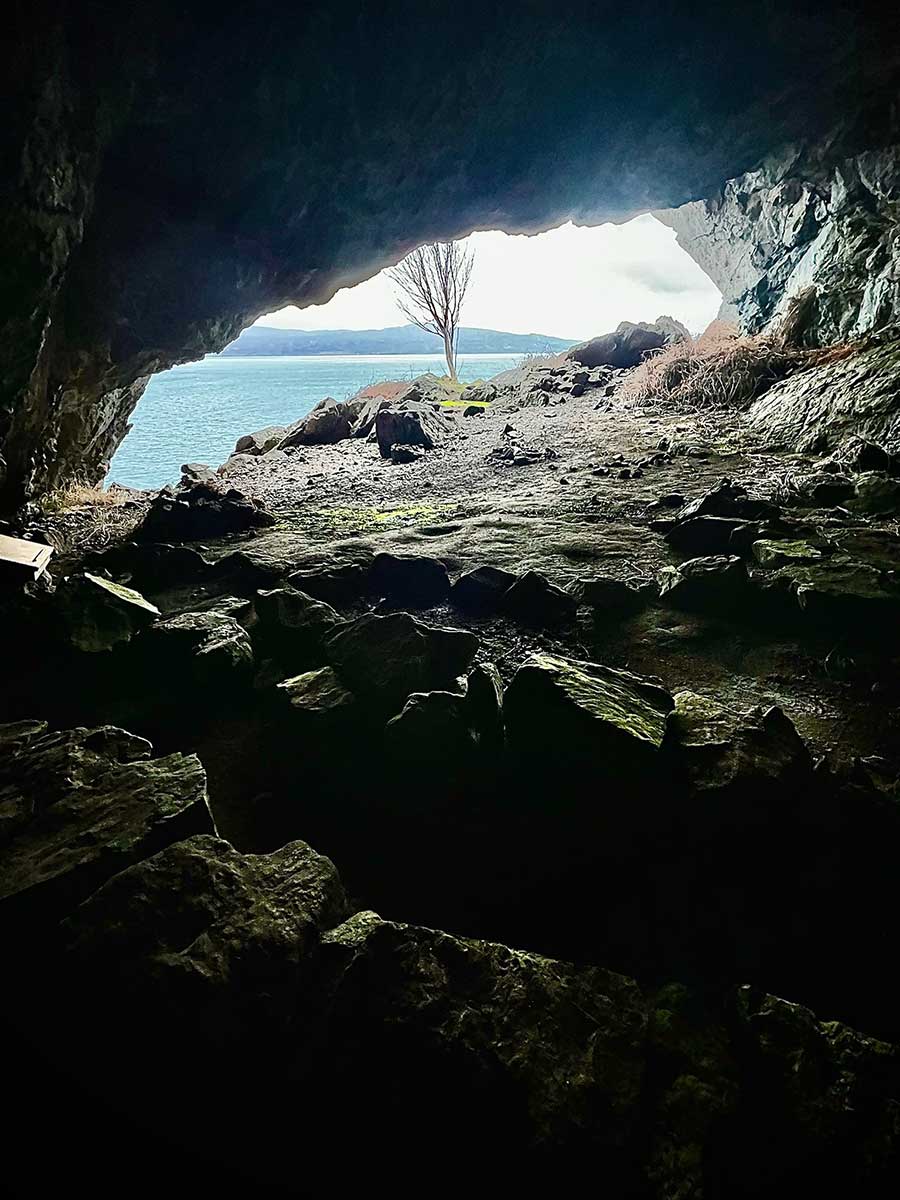
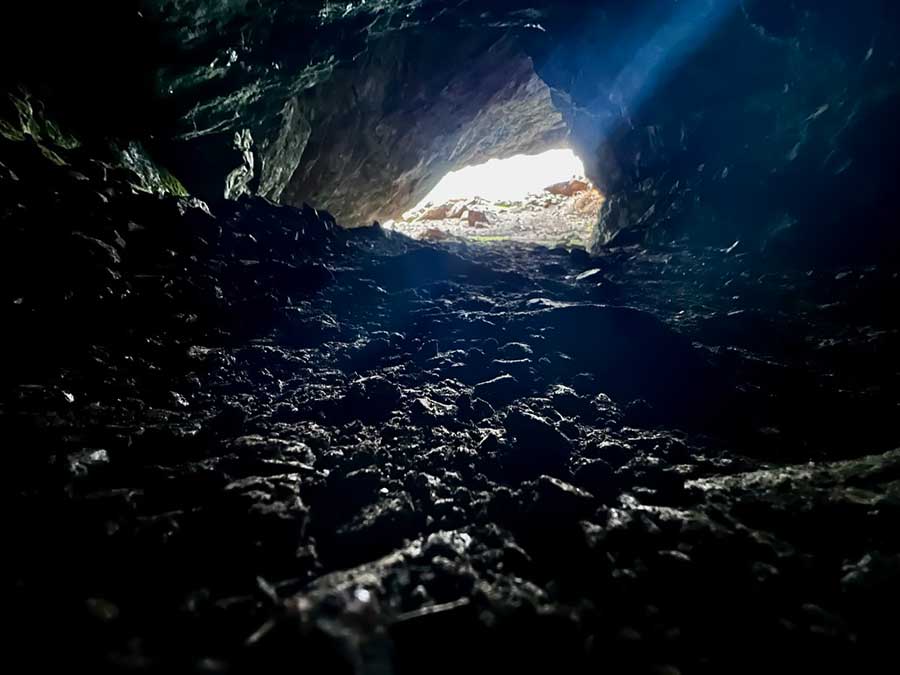
Brother Phap Linh: That was okay. That’s not so extreme for me. So I get down to the bottom of this gully and I thought, wow, do I have to go all the way down to the ocean? I’m not sure. But then I see a little path going up, going back up along the cliff, and then this cave suddenly appears. I sort of see the cave mouth above me, and there’s a solitary tree standing in front of it. It’s very Lord of the rings at this point. So I get up to this cave and go in, and it’s at that point that I realised that Church Cave is not just a name. It really was a church. Because the rocks are arranged in pews.
Manda: Have they been carved or it’s just the way it is?
Brother Phap Linh: No, they’re just just big rocks, just arranged, you know, one per person, but in in rows. So you could have fit maybe 20, 25 people on these pews. And I later found out, when I went back and I talked to people back on the mainland, back on Skye, they said, no, no, that really was their cave for hundreds and hundreds of years.
Manda: That was the church.
Brother Phap Linh: In fact, there were Celtic monks who lived on this island. I also didn’t know that. So there were Celtic monks for centuries, who lived in their cells. There was a little tiny, tiny fishing community and they didn’t have a church, but this cave was their church. So at least once a week they would have gone there. So I didn’t know any of that at the time, I was just in the face of the reality of this place. And I’ve been to a lot of extraordinary places where you feel things and thin places where you feel a certain intensity. But of all of the places I’ve been, this is the strongest that feeling has ever been for me.
Manda: Wow.
Brother Phap Linh: And all logic told me to leave, because it was about 4.30 already in the afternoon and it was in February, so it was getting dark. And, you know, there isn’t really a path. I’ve got a good four kilometre trek to get back. Maybe a bit more, more like six. So I should leave right then. But I couldn’t. There was a part of me that just said, I don’t care, I don’t know how this is going to work, but I cannot leave. I have to stay. So I just sat down on one of the rocks and I just entered a very spontaneous, effortless kind of concentration state. I didn’t feel like I was doing anything. I mean, I was in meditation, but somehow I was just drawn into a deeper and deeper and deeper concentration. I didn’t move for six hours. I just sat there. And it was freezing cold, you know, I wasn’t properly dressed and I was wet, all my clothes were wet, I was soaked to the bone, but I was grinning ear to ear.
Brother Phap Linh: I can’t express it any other way than I was just in the presence of my ancestors, of my spiritual ancestors and the collected goodness of their intentions over centuries. And this is a little bit in the realm of the imagination, you know, I can’t prove this, but it just felt to me that I’m in a place where the only thing that has happened here for centuries has been good. The only wishes and intentions that have been expressed here have been of love, of connection with the divine, of humility, of compassion. People there, they wouldn’t have been praying for riches or wealth because there was nothing to get. There was no advancement on this island. There’s nowhere for them to go. There’s nothing more for them to have.
Manda: They just want to connect with the All That Is. Yeah.
Brother Phap Linh: That’s it. When you strip away all possible ambitions and sort of worldly success, what do you have? You just want to connect with whatever it is. And straight from the heart, just in the purest way. And I just felt like here is a place, perhaps one of the only places where nothing else has happened other than that, that kind of immense movement of the heart towards the divine for hundreds of years. And it feels to me like the rocks are just pregnant with it. And you sit in the middle of that, and it’s like a resonance chamber.
Manda: Right. I’m thinking just your breathing will set up resonance frequencies and standing waves and bring you into that place.
Brother Phap Linh: And in front of you is like an eye with the tree in the middle and the sea behind and Ben Nevis behind it. And it’s just like nature’s meditation hall. And you’re in the earth. You’re in Mother Earth. She surrounds you above and all around.
Manda: Yeah.
Brother Phap Linh: And she holds you and just everything is vibrating. And I experienced, yeah, a kind of peace and just a feeling of connection with everything, but with myself in a sense. Because we’re not just this, we’re not just this time, we’re not just this lifespan. We’re not just this apparent individual or separate self. We’re a stream and it’s a stream without beginning or end. In fact, we’re many streams, none of which are really separate from the whole tapestry. And we are the tapestry, we are the whole.
Manda: We are the web of life. Yes. And of being and of everything.
Brother Phap Linh: No separation can be found. And yet there are within that whole and that web and that tapestry or stream of streams and all the streams, there is still somehow echoes and resonances and things that we are tuned to more readily, or that are more recognisable, that we have affinities. We’re related to everything, connected to everything, but maybe more closely related and more closely connected to some elements, some remembered melodies, you know.
Manda: Right. Yeah. Where our ancestral lines of blood and of spirit come together. Yes, yes, yes. So we’re not denying the reality of flesh and blood and being and timelines and dream lines. And yet we are still part of the all that is, but we are that particular resonance. I think this is where we get back to music. We are that tuning fork that is nonetheless part of the overall symphony.
Brother Phap Linh: Exactly. Exactly. And so like a melody itself, let’s take music as a metaphor. Your favourite melody is an expression of the whole, in the sense that it takes consciousness, space, time, resonance, mathematics to bring it back to where we started. All of those things need to be there for a melody to be possible. So it’s an expression of the whole field of everything, but it’s recognisable, instantly, whether it’s played on this instrument or that instrument or sung in this language. But you recognise it. It has its characteristics, as an instantiation of the whole, but recognisably it has characteristics, as do we. We’re not separate, we’re not individual, there’s no separate self. And yet there is character. There are parts, there are histories.
Manda: Yeah. The web of life has to have threads and crossing points and nodes to be a web. But that doesn’t stop it being A Web. This is the paradox of living, isn’t it? And yet once that sinks into your heart, mind or whatever, it doesn’t feel paradoxical.
Brother Phap Linh: Not at all.
Manda: And you got back from that cave safely? Just tell us, you got back in the dark?
Brother Phap Linh: Oh, yeah. Oh, yeah. It was amazing. So I sort of came out of this deep meditation. I really wanted to continue, but the body was starting to say you are now very cold. Maybe there’s a little risk of hypothermia at this point. Also fasting, you tend to feel the cold. I didn’t feel cold until that point but then suddenly I did and then I was like, okay. Everybody else that cares about me in my life would be saying, you’re a crazy person, go home, get warm now.
Manda: Yeah. Frostbite is a thing. Let’s not risk it.
Brother Phap Linh: It wasn’t freezing, but it was about three degrees, I think. I checked later. So it’s not warm when your clothes are wet, you know. By that point, my clothes were actually dry, but still. So I thought, okay, time to go. I’d turned my phone off, because I just didn’t want it interfering with whatever was happening. So I turned it back on. I think I had 11% battery. So I was like, okay, this is gonna be fine. You know, turn on the torch, turn off every app, turn off Wi-Fi, turn off cell phone, turn off everything. It’s just a torch now.
Manda: Just the torch.
Brother Phap Linh: And off I go. And I completely missed the path that I’d come on. I ended up sort of crossing over the highest point of the island. I probably walked twice as far as I had to, went through all these bogs and marshes. And I was not worried for a moment, not at any point. I was completely relaxed. I was totally fine. I have a good sense of direction so I knew I could orient.
Manda: And it’s not a huge island. I’ve seen that island. You could have spent a lot of time crisscrossing it, but you’d have hit a coast quite fast.
Brother Phap Linh: Exactly. And then you work your way back up the coast. And I mean, there’s cliffs and there were some points where I’m going down and this is getting very steep. Is this now a cliff or is it soon to be a cliff? Or is that dark spot in front of me a bush?
Manda: Or is it the sea!
Brother Phap Linh: There were a few hairy moments, but I was just floating. I was just so deeply nourished and in myself and in the world and connected, I didn’t feel in any danger. I just felt everything was exactly as it needed to be. And I knew that because there is a path, there’s a sort of gravel path that connects one harbour to the other harbour. So I just need to get onto the path and then turn left and then I’ll be fine. And it took a bit longer. I was like, mm, have I veered off, you know, am I now going parallel to the path? Am I still going to hit the path? Eventually I found it. And the strange thing was literally the moment my foot touched the path, my battery gave out.
Brother Phap Linh: And then I still had a good couple of kilometres on the path, which I couldn’t see. It was cloudy.
Manda: February in Scotland. It’s pretty darn dark.
Brother Phap Linh: And there was no moon, no stars, nothing. There was just a slight little tinge of light bouncing off the clouds, I think. I could just see a sort of hint of path in front of me, but mainly I just had to use my feet. I could feel where it was spongy or rocky and then I could come back and I was fine. I was just in heaven.
Manda: And you got home. And had you finished writing by then? You’d had ten days.
Brother Phap Linh: No, I was still in process, but I was in a much, much better place. And there was still a couple more weeks ahead of me, of hard work. But yeah, we had a very deep connection with Ian McGilchrist as well. And his soulfulness, his kindness, his generosity of spirit, of heart, it just buoyed me up. And we commiserated a lot on like how hard it is and the obstacles to writing a book like this. Because, you know, my book is much shorter than his and I can’t really in any way compare myself to his brilliance and depth of knowledge and so on. But there is something particularly hard, in this day and age, of the dominance of the scientific materialist or physicalist paradigm, which is also the capitalist paradigm. It’s also the patriarchal frame. It’s in so many things, the colonial. And they’re all kind of supporting each other and connected to each other. And so to write against that or sort of within it, but trying to get people who are actually deeply entrenched in that to, to see the ways that it’s not as solid as it seems. It’s not as reliable as it seems. It’s not even remotely scientific. And to take them by the hand and bring them into this other way of sensing, feeling, being back in embodiment. And checking again, like, are you sure you know what you think you know? So that is very hard and there’s a lot of obstacles. In the publishing world, there’s obstacles.
Manda: That was a whole thread we could have gone down but we didn’t. I think we should. But yes.
Brother Phap Linh: Everything is set up for you not to say those things. You know, everything’s set up to make it difficult to say those things, to make it so that…
Manda: The master’s house will not be dismantled by the master’s tools. And this is the master’s house you’re in.
Brother Phap Linh: And everybody will tell you, oh, there’s no audience. That’s too complicated. I don’t understand what you’re saying.
Manda: What they mean is that touches bits inside me that are uncomfortable. And I don’t want to.
Brother Phap Linh: Don’t want to go there! Because you’re saying, I’ve got to dismantle everything and start again. And that sounds complicated and like too much hard work and not very entertaining. Whereas in fact, it’s all the opposite. It’s not that hard and it’s very entertaining. This is the way to live!
Manda: Yeah. And the more people that do it, the more you have support. Lovely. You have to be somewhere else two minutes ago. We could carry on forever, but we’re definitely coming back in the spring, shortly before your book On Wonder is published. And let’s talk more about the possibilities then. And in the meantime, thank you so much for coming on to the Accidental Gods podcast. I have loved every moment of this. Thank you.
Brother Phap Linh: Likewise, always such a joy to be with you and to kind of create together.
Manda: There we go. That’s it for another week. Enormous thanks to Brother Phap Linh. For his beingness, for the sense of experiencing that comes from being in his presence. For his calm, his connectedness, for his trip to a cave in the Western Isles, which I strongly suspect is going to become a pilgrimage site quite soon. But we didn’t tell you exactly where it was, so maybe not. And anyway, I think you have to ask permission. But that apart, this concept of diffusion of who we were on these islands, the islands of Britain and the long, deep traditions of Buddhism feels to me really quite exciting. Buddhism has a science of consciousness that we in the West completely lack. It has 3000 years of people deeply exploring what it is to look inside and then recording the answers and the results, and doing what is in effect, deep, deep neurophysiological science built over time. Because people are replicable things. Whatever is the conscious and cultural overlay, fundamentally, we work quite the same. And if we can pare back the cultural stuff and get to the heart of that and find the roots of what it was to be deeply connected to the land, to be integral nodes in the web of life, then I think we are several steps towards the Conscious Evolution that we need to bring about quite fast.
Manda: So we’ll come back in the spring and talk more about the book called Wonder. And perhaps it will have the same subtitle or perhaps it won’t, because publishers. But in the meantime, I have put links to Plum Village and the version of Plum Village in the UK and anything else that I could think about in the show notes. Please do go and explore. And if you get a chance to go there, take it. We are in the poly crisis. Everything is falling apart. Nothing is ever going to go back to the way it was. While you can travel, if it’s worth it, if there’s a really good reason, and particularly if you can just take a series of trains, then do it. And if not, then we can always connect over the internet for now.
Manda: So that being the case, we will be back next week with another conversation. In the meantime, huge thanks to Caro C for the music at the Head and Foot and for this week’s production. Thanks to Lou Mayor for doing the video, in spite of being in a new house where everything is not yet quite working. Welcome back to Anne Thomas for the transcript. Huge thanks to Faith Tilleray for doing the website and the tech and all of the conversations behind the scenes that keep us moving forward. And as ever, an enormous thanks to you for listening. If you know of anybody else who wants to explore what it is to be in the moment of experiencing, and particularly if they want to explore that fusion of what it is to go deep into our animist roots, and to connect that with the Buddhist science of consciousness, then, as ever, please send them this link. And while we’re here: thanks as ever to those of you who subscribe and who leave reviews and who come to the gatherings. The next gathering is called Falling in Love with Life. And it’s on Sunday, the 17th of May, online, 4 p.m. to 8 p.m. UK time. You’re all welcome. And I would say this is a time to really focus on being in love with every single moment of being alive, because why else are we here? Anyway, that’s it for now. See you next week. Thank you and goodbye.
You may also like these recent podcasts

Creditism: Building the Ledger of Life with Remzi Bajrami of the Common Planet Foundation
How do we make a peaceful transition to a wholly new system when the old one is sustained by those who profit most from the self-terminating zombie of predatory capitalism? Our guest this week has spent the past decade devising an answer to this most central of our questions. Remzi Bajrami is co-founder of Common Planet Foundation and creator of Creditism, which is his answer to our dilemma.
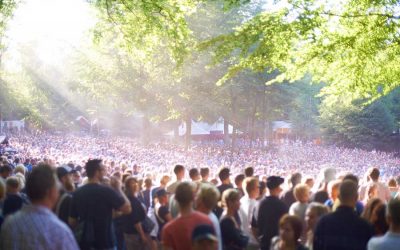
We Need a Victory Story: Mobilising the Silent Majority with Liam Kavanagh of the Climate Majority Project
But what if you knew you were not alone in caring about the crises our planet faces? What if you knew that almost everyone in our culture cares about this, they just don’t know what to do about it? They don’t have what this week’s guest, Dr Liam Kavanagh, calls the ‘Victory Stories’ to show how we made it through.
We Need to Talk about Tech: Exploring AI, fresh Hope…and the power of Song with Nathalie Nahai
How do we shift the dial on the future when so many of those whose fortunes are sunk into Tech, and AI in particular, seem to be steeped in the Dark Triad of psychopathy, sadism and narcissism? Is there any sign of hope amidst all the chaos and the frozen despair that narratives of inevitability foster in us?

Grown Up Politics 2: How can Andy Burnham deliver a future that works? With Rupert Read and Clive Lewis MP
How can we bring power to those with wisdom and wisdom to those with power? Specifically, how can our new Prime Minister deliver a future that repairs the ruptures within our national and international culture in a time frame that works while in the face of biophysical collapse and the onward march of the political wing of predatory capital?

STAY IN TOUCH
For a regular supply of ideas about humanity's next evolutionary step, insights into the thinking behind some of the podcasts, early updates on the guests we'll be having on the show - AND a free Water visualisation that will guide you through a deep immersion in water connection...sign up here.
(NB: This is a free newsletter - it's not joining up to the Membership! That's a nice, subtle pink button on the 'Join Us' page...)