
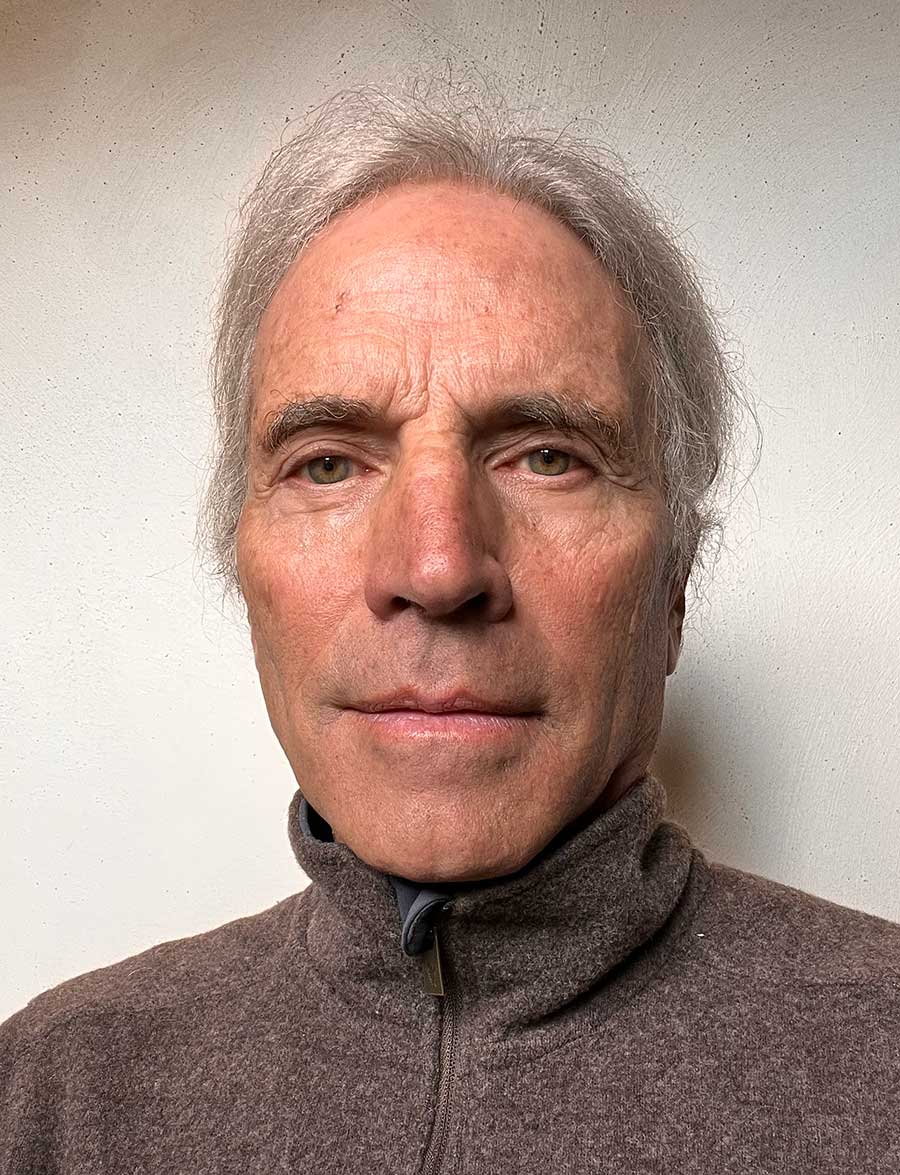
#311 Walking the wild, mythic Edge of Being with visionary elder and soul initiator Bill Plotkin
What is the true vow of your life, the one it would kill you to break? This phrase comes from the poem ‘All The True Vows’ by David Whyte, but there can be no better introduction to this week’s guest, who knows how to help people – ordinary, every-day people from our culture – build true, heart-felt connections with the web of life such that we come to know what we are here for, our unique gift to the world, the promise is would kill us to break, what it feels like to be so heart-explodingly in love with the sheer wonder of being alive that we can step out of the world we thought we knew, into the world as it really is, alive with connection to all parts of ourselves, each other and the whole of the more than human world.
Bill Plotkin is one of those who has found what he’s here for. He’s been a Thrutopian activist and cultural catalyst since long before those were buzzwords in our firmament. Over the years, he has been a research psychologist, professor of psychology, psychotherapist, rock musician, and whitewater river guide. Now, I would say he is a visionary, a mystic and an elder. More importantly, he’s a map-maker, a way-breaker, a trail-leader of the routes we will have to take to walk out of this moment of dissolution, into a world of remembering and creating anew.
Back in the early 80s, Bill founded the Animas Valley Institute, whose central purpose is to assist people through the initiatory process that leads to visionary leadership and cultural artistry. Its primary work is with those ready to undergo the joys and challenges of the underworld descent to soul, which flowers into a life of meaningful service and abundant fulfilment — or a deepening for those already on the journey.
In other words, Animas Valley Institute supports people in our culture to find what they’re here for, to undergo, in his words, the journey of soul initiation. To embark on this journey requires that people break out of the perpetual early adolescence of modernity and endure the ecstatic initiations of late adolescence and that eventually result in true adulthood and perhaps, for a few, genuine elderhood.
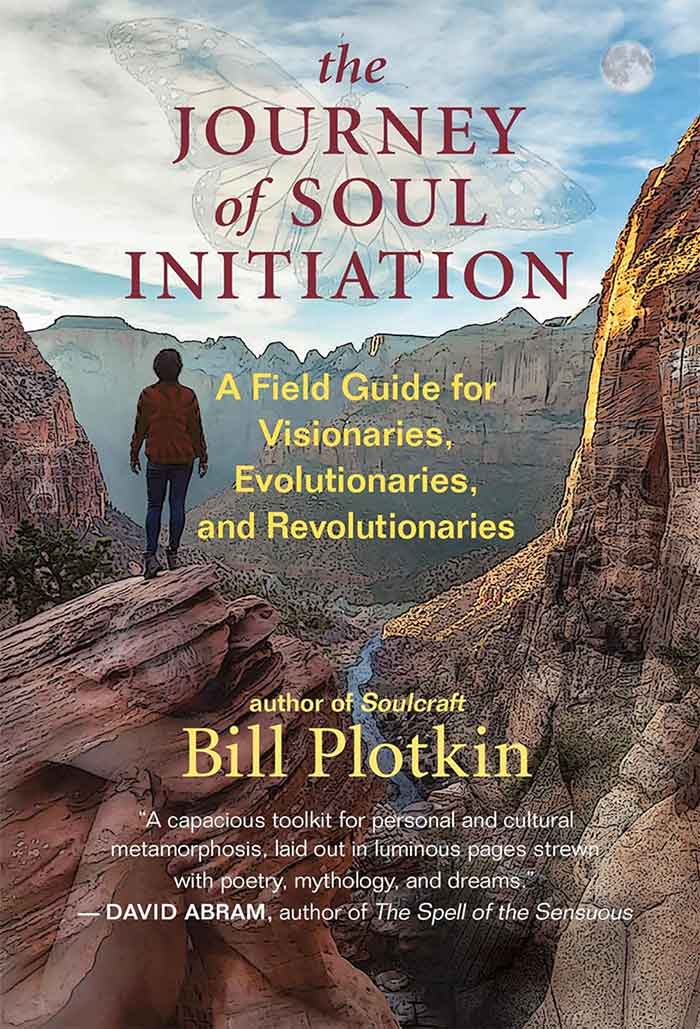
Bill offers maps and models for his work in depth and detail. He has four books to date and I encourage you to read them all in order from Soulcraft: Crossing into the Mysteries of Nature and Psyche, through Nature and the Human Soul, to Wild Mind and finally, The Journey of Soul Initiation. He writes a blog, Soulcraft Musings, which I also recommend, because we could have explored the basics of Bill’s models of human evolution and what it means for people of our culture, who have been subject to what he calls ‘systemic human developmental oppression’ for many hundreds of generations… and in the long conversation that follows, we did explore the basics of this, but in the days before recording, Bill shared the early draft of a paper called ‘A Map to the Next World’ and this lit all kinds of fires in my heart and mind and soul—because Bill’s capacity to write lucidly the things this podcast is all about is beautiful and sharp and perfect.
He writes:
‘We need a map to the next world because our current world is clearly in its death throes…
We need a map to the next world, a way to navigate the long trail from here to cultures that we will be proud to leave for the future ones — of all species. And nature, as always, including human nature, provides this map, or at least templates for creating one.
And we need to translate the map into a contemporary language that we can understand — and act on — even though the journey is necessarily through realms of great mystery. We won’t find our way using the maps of other peoples or of other times. We must make our own map.’
As and when his paper on the Map becomes available, I’ll put it in the show notes. In the meantime, I have included the poem by David Whyte, because truly, it is one of the guiding lights of our movement, and I’ve included Joy Harjo’s poem, also called ‘A Map to the Next World’ both as a YouTube recording of her speaking it, and the poem, and the book of the same name from which it came. Please do explore these.
And now, let’s head into the ways we can change our world, with Bill Plotkin.
Episode #311
LINKS
Animas Valley Institute
Bill’s blog – Soulcraft Musings
Bills Books –
Soulcraft: Crossing into the Mysteries of Nature and Psyche
Nature and the Human Soul: Cultivating Wholeness and Community in a Fragmented World (a nature-based stage model of human development through the entire lifespan),
Wild Mind: A Field Guide to the Human Psyche (an ecocentric map of the psyche — for healing, growing whole, and cultural transformation)
The Journey of Soul Initiation: A Field Guide for Visionaries, Evolutionaries, and Revolutionaries
AG #302 The Crisis and the Call with Sara McFarland
David Whyte ‘All The True Vows’
David Whyte website
Joy Harjo ‘A Map to the Next World’ on YouTube
Joy Harjo ‘A Map to the Next World’ text
Joy Harjo ‘A Map to the Next World’ book
Joy Harjo website
What we offer
If you’d like to join the next Open Gathering offered by our Accidental Gods Programme it’s Dreaming Your Year Awake (you don’t have to be a member) on Sunday 4th January 2026 from 16:00 – 20:00 GMT – details are here
If you’d like to join us at Accidental Gods, we offer a membership (with a 2 week trial period for only £1) where we endeavour to help you to connect fully with the living web of life (and you can come to the Open Gatherings for half the normal price!)
If you’d like to train more deeply in the contemporary shamanic work at Dreaming Awake, you’ll find us here.
If you’d like to explore the recordings from our last Thrutopia Writing Masterclass, the details are here.
In Conversation
Manda: Hey people, welcome to Accidental Gods. To the podcast where we do still believe that another world is possible and that if we all work together, there is still time to lay the foundations for a future that we would all be proud to leave to the generations that come after us. I’m Manda Scott, your host and fellow traveller in this journey into possibility. And this week we start with a question, which is ‘what is the true vow of your life, the one it would kill you to break?’ You might be familiar with this question. It comes from the poem All the True Vows by David Whyte. And sometime soon I will record this and Joy Harjo’s poem. But in the meantime, there can be no better introduction to this week’s guest, who knows how to help people; ordinary, everyday people from our culture; build true, heartfelt connections with the web of life, such that we come to know what we are here for. What is our unique gift to the world? What is the promise it would kill us to break? And what does it feel like to be so heart explodingly in love with the sheer wonder of being alive, so that we can step out of the world we thought we knew, into the world as it really is. Alive with the connections to all parts of ourselves, to each other, and to the whole of the more than human world. Bill Plotkin is one of those who has found what he’s here for.
Manda: He’s been a thrutopian activist and cultural catalyst since long before these were buzzwords in our firmament. Over the years, he’s been a research psychologist with a PhD in depth psychology. Professor of psychology, a psychotherapist, a rock musician, and a whitewater river guide. Now, I would say he’s a visionary; a mystic, and an elder. More importantly, he’s a mapmaker, a way breaker, a trail leader of the routes that we will all have to take if we’re going to walk out of this moment of dissolution and into a world of remembering and creating anew. Back in the early 80s, Bill founded the Animas Valley Institute, whose central purpose is to assist people through the initiatory process that leads to visionary leadership and cultural artistry. Its primary work is with those ready to undergo the joys and challenges of the underworld descent to soul, which flowers into a life of meaningful service and abundant fulfilment. Or a deepening for those already on the journey. In other words, it exists to set the conditions by which people in our culture can find what they’re here for. Can, in Bill’s words, undergo the steps of soul initiation, to break out of the perpetual early adolescence that afflicts our culture and work towards the initiations of late adolescence and thence into adulthood, and perhaps for a few into elderhood. Bill has written the theory of his practice in depth and in detail. He has four books to date and I encourage you to read them all in order, from Soulcraft; Crossing Into The Mysteries Of Nature and Psyche, through Nature and the Human Soul, to Wild Mind, and finally, The Journey of Soul Initiation.
Manda: He writes a blog too: Soulcraft Musings, which I also recommend. Because we could have spent the whole of this podcast exploring the basics of Bill’s theories of human evolution, and we did actually spend pretty much the first hour doing just that. My plan had been to do that as a foundation and then explore something slightly different. Because in the days before we recorded this, bill sent me the early draft of a paper called A map to the Next World. And this lit all kinds of fires in my heart and my mind and my soul. Because Bill’s capacity to write lucidly the things that this podcast is all about, is beautiful and sharp and perfect. In this paper, he writes: ‘We need a map to the next world, because our current world is clearly in its death throes. We need a map to the next world, a way to navigate the long trail from here, to cultures that we will be proud to leave for the future ones, of all species. And nature, as always including human nature, provides this map, or at least templates for creating one. And we need to translate the map into a contemporary language that we can understand and act on. Even though the journey is necessarily through realms of great mystery, we won’t find our way using the maps of other peoples or of other times. We must make our own map’.
Manda: So we do get to this, I promise you. It’s just that we had to lay some foundations first, and that did take almost an hour. As and when Bill’s paper on the map becomes available, I will put it in the show notes. In the meantime, I have included a link to the poem by David Whyte, because truly it is one of the guiding lights of our movement. I’ve also included Joy Harjo’s poem A Map to the Next World, which Bill uses as the frame for his paper, both as a YouTube recording of her speaking and the poem itself, and also the book of the same name from which it came. So please do explore these, and if you’re moved, obviously go and read Bill’s books, read his blog. If you have the means, then go and do the Animas Valley courses, either online or in person. There are many around the world taught now by some of his guides, one of whom is Sarah McFarland, who we talked to back in the summer. I’ll put a link to that in the show notes also. And there we go. After that long introduction, people of the podcast, please do welcome Bill Plotkin of the Animas Valley Institute.
Manda: Bill Plotkin, welcome to the Accidental Gods podcast. How are you and where are you on this October day, which is morning for you and afternoon for us?
Bill: Yeah. Thank you Manda, great to be here with you, by the way. I’m a big fan of your work and your leadership in helping us all imagine possible futures that we hope to be able to leave the next generations. So I’m well this morning. It’s an absolutely gorgeous morning here in the North Cascade mountains of the Pacific Northwest of the North American continent. I’m in a river valley that is very, very dry during the summer and can get pretty warm, it’s a fire ecology here. But this time of year, the rains and the snows start showing up and we’re right now in an actual fog, which basically never happens. It’s the opposite of England.
Manda: Yeah, where we get fog all the time.
Bill: Yeah. It’s just really gorgeous. And the colours are at peak cottonwoods.
Manda: Yeah. You sent me a picture and it is stunningly gorgeous. I will probably put that picture up on the show notes, so people can see how the not foggy version of your land looks.
Bill: Yeah, exactly.
Manda: Very beautiful. Have you lived there all your life? Because you got your PhD at the University of Colorado. So you’ve been Pacific.. Oh, no, Colorado is more central, right?
Bill: Yeah.
Manda: My knowledge of US geography is not great.
Bill: Yeah, Colorado’s Rocky Mountain West, and we’re closer now to the coast. I’ve been here only three years. I was in Colorado for 42 years. Grew up in Boston. Went west for grad school basically.
Manda: And carried on going west.
Bill: Can’t go too far west.
Manda: Okay. So you are founder of Animas Valley. And I think it would be useful, because given the demographic and the spread of the listeners to this podcast, there will be a percentage who know exactly who you are and have probably worked with you, and there will be a percentage for whom you are a new person. So can you just give us a little bit of how it is that Bill Plotkin came to found Animas Valley and what it is and what it does?
Bill: Yeah. I’ll attempt to make a brief version. I was a young person who was interested in the mysteries of life and found no support for that in the social and religious background of my family and community. But I kept looking and first found something that really deeply engaged me in a mystery way in just the natural world, surrounding my home in the suburbs outside Boston. And I had this, I think it’s a natural human intuition, that there’s an upper world mystery and an underworld mystery, both. And I started wondering about the difference between the word spirit and the word soul. And so many people in spiritual circles would use those terms interchangeably. But I just had this, as I say, natural human intuition these are very different things. And the first person I found who actually talked about it was the depth psychologist James Hillman. And then studying various indigenous traditions, I discovered more about depth and soul and the animate world. And meanwhile, I went to graduate school in psychology and became a depth psychologist, but first a researcher, studying non-ordinary states of consciousness. And then in 1980, a little bit the year before, I learned about the work of two people who became my teachers. And that’s Stephen Foster and Meredith Little of the School of Lost Borders. And through correspondence, which back in 1980 was done by paper and pen and post office, they gave me support to enact my own first vision fast. So I took myself out into the mountains of Colorado at tree line at 11,500ft and fasted for four days and had an experience there, maybe we’ll talk about it later,that completely changed my understanding of what the world is and also of what who I am and what it is to be a human being. So soon after that I started Animas Valley Institute in southwest Colorado, where the Animas River flows through. Animas, of course, is the Spanish word for souls.
Manda: Yes. I hadn’t realised it was a river. I just thought you’d picked it up from soul.
Bill: Yeah, and the actual name of that valley is that river is the river of souls lost in purgatory. Which was the Spanish missionaries projection of their own lost souls onto the indigenous people of that area. And of course, contemporary people you might say we, for the most part, have lost touch with our souls. Wouldn’t necessarily say it’s purgatory, but… So, Animas Valley Institute became a place where my colleagues and I started to learn about what is it to support contemporary people of modernity, to go on this underworld journey, to discover or to remember their original instructions. Which is to say, the reason they were born, the gift that each person, each human, is born to carry to the more than human community. And so it’s been 45 years of constant learning. One of our most important things for me, from the beginning, was not to try to mimic or copy any other tradition, especially native people. But to find our own way and to find the roots that are still there in the Western tradition. So a lot of our work comes from Western poetry and Western depth psychology and also from the Greeks. There are some aspects of what is known as the descent of soul that are universal, that you find certain patterns in cultures all over the world. And so we use those universal patterns, but for specific practices and frameworks, we’ve borrowed primarily from our own Western traditions. What else can I tell you about it? We’re now approximately 20 or 25 guides, and we have hundreds of trainees. We’re offering what we call immersions, ceremonial immersions, in about, I don’t know, 15 or 20 different countries around the world. And the most important thing to say we’re constantly learning about what we’re doing and how to do it better.
Manda: Okay, so we had a plan of where we were going, and already I’m deviating off that, because there’s so many things I would like to unpick with this. Let’s start with Upperworld, lower world and spirit and soul. You learned from James Hillman, but that was 45 years ago, and I’m thinking you probably evolved them somewhat since then. How do you distinguish spirit from soul now in the 21st century?
Bill: Yeah. To attempt to do it somewhat simply, by spirit I mean the great mystery of the cosmos, the cosmos itself, the vital mystery that is at the root of it, that unfolds as the cosmos. And so it’s the mystery that we all humans and all things have in common. It’s the ultimate place of wonder of this world, of this cosmos. Soul refers to the specific place that creatures and things, what we would call living or non-living things have. The specific place that each thing or each being has, in the larger context of spirit. So soul is very individual and spirit is universal, but they’re both transpersonal. They’re both way bigger than our conscious minds.
Manda: And if we were to explore the more mystical aspects of this, just briefly and purely for my own interest, and this may not be Animas Valley work at all, but do you, Bill Plotkin, consider that souls undergo reincarnation? And are they born from and eventually returning to the heartmind of the universe, the Great Spirit, whatever we call it, the thing that stands outside of space and time, which is what I am hearing you defining as spirit. Are you seeing that each soul’s path is evolutionary? Or is that not something that is relevant in your framework?
Bill: Yeah, it is relevant. I don’t know the answer, definitively, authoritatively, I don’t know if anyone does. But I do function as if that’s the way it works. But I have a somewhat different take on soul when it comes to reincarnation. I mean, I even have a different take on what I mean by soul, which we’ll probably get to. Buddhists ask what goes from one life to the next? What exactly is reincarnated? In some ways my take is similar to a Buddhist approach, that there is no self that is reincarnated. But it’s a little bit different, and here it is. Well, actually to get there then I need to tell you what I mean by soul. For me it’s an ecological concept, much more than a psychological one. For me, when I say soul, I’m referring to the particular place or ecological niche that a being or creature, including humans, is born to take in a given lifetime. So it’s really a way of talking about ecological niche. The particular, you might say, ecological function that every being has, that each individual human is born to enhance life in a particular kind of way.
Bill: And I believe that’s true of all creatures; we’re not different that way. So the me in my lifetime, the way I think of myself, however a person thinks of themselves, that’s really ego. By ego, I don’t mean anything negative, I just mean our conscious self. It’s that small part of our psyche that’s aware of ourself. So my take is that the ego, the conscious self, doesn’t reincarnate, but that every human, and this has to do with other creatures too, but every human, as I say, is born to take a certain place, occupy a certain niche in the world, and when they die, when that individual dies, that niche is empty. And it’s likely that before too long, some other human will be born who will take that same niche. A niche which, by the way, may have unfolded and developed and evolved in some ways during the last lifetime. So a person who is born, a human who is born to take a niche that has been occupied in the past by some other human, is likely to be able to remember those past lifetimes. But in a sense, those past lifetimes isn’t theirs, it’s just that they occupy the same niche.
Manda: That makes a lot of sense.
Bill: And so it’s kind of like Rupert Sheldrake’s notion of morphic fields. Like there’s a morphic field that goes from one lifetime to a next. But maybe the ego doesn’t go from one lifetime to the next. Anyway, that’s one take on a very ancient mystery.
Manda: Yeah. It’s so interesting. We could follow that rabbit hole a long way. I’m doing a training in mediumship, and it’s so interesting watching the projections that happen around it, but also the unanswered questions that arise. But let’s leave that at the moment, because I want to come to the core of what we want to talk about. But before we get there, you said that you drew on Western mystery traditions and on the Greeks. And it seems to me that whatever we term our Western culture, the damage happened 10, 12,000 years ago. I listened to you talking on another podcast about the parable of the tribes, and that seemed really interesting, in terms of how does dominator culture, trauma culture, whatever it is we call our current, not functional culture. How does it arise and how does it perpetuate? And that it arose many thousands of years ago. And so it’s always seemed to me that the Greeks were perpetuators of a dominator culture, and yet clearly In Animus Valley you find things of value in Greek myth. Are you seeing it that they are drawing forward older myths from a pre-dominator culture? Or do you think that they simply have threads of non dominator wisdom within their existing myths? Does that make sense as a question?
Bill: Yeah, that’s a good question. I’m definitely not an authority in that area, so I don’t really know. But I suspect yes. The sacred stories that we call myths, the version that are Greek, come from way back and from way down, from the depths of the land and the psyche. So when the social and political system, Greek systems, became dominator, they still have those myths that come from an earlier time. Maybe you’re familiar with Peter Kingsley’s work? He goes into that in quite some depth.
Manda: Not familiar, but I’ll look it up.
Bill: So Western psychology in so many ways has its roots in Greek philosophy. But just as a small example, one of our practices at Animus Valley Institute is something that has been showing up in the Western world for the last 50 years or so, and it’s the practice of counsel. A way of groups to meet together in a circle, where everyone has a chance to speak and everybody is practising listening from the heart. And apparently, I mean, in fact, it seems to be well known, that there are Native American traditions which use the practice of counsel. But I learned it from Elizabeth Cogburn, who was one of my teachers. She was primarily my teacher of trance dance, but she also taught us counsel, and she got it from her husband, Bob, who was a scholar of Greek traditions. And he got it from the Greeks. So it was actually a story of a Greek warrior who, the warriors would practice a form of counsel. Anyway, so we actually got our counsel practice from the Greeks.
Manda: All right. Interesting. I bet they only let the men go. And only the men who were not slaves. But anyway, it’s still a good start. And the point is that we take what we’re given and we build it into something fit for the 21st century. So I would love to ask you so many more questions about the kind of theoretical and philosophical underpinning, but let’s get to the meat of what we want to talk about, which is building a map to the next world. So we both agree that the current system is not fit for purpose, if that purpose is the continuation of complex life on Earth. That we’re hitting up against biophysical and cultural limits and the current system, the culture that we live in, has ceased to be life affirming and become life destroying. And yet, I think one of the things that we both agree on really clearly, is that it is possible to turn the bus from the edge of the cliff. And you have a really clear, clean, succinct, beautiful, to me, set of concepts of how we might do that. A kind of short term step where we cease to be a destructive culture and become at least neutral, and then we become constructive. And that this requires that we evolve. That we shift our culture from being a dominator culture and become more communitarian and more connected. Particularly that we take our place as the self conscious nodes in the web of life. That we fulfil our niche. That each of us finds what it is that we’re here to do, and shines in doing it, as an integral part of the living web.
Manda: At some point, I want to know if your concept of spirit is… It seems to me that the web of life is, for me certainly, is the life of the living planet, and that the spirit that we were speaking about is much bigger and more transcendent. But at any rate, that everybody, every living human, every living thing, actually probably every rock and river and mountain has a role to play within the life of the web. And at some point, we just need to learn what our role is and step into it. But you have a much more elegant way of putting that. So take that wherever you want. I’m very tempted to quote from the draft of the paper that you sent me, but also it’s a draft, so you might not want me to, But if you do, I think the first few paragraphs lay this out really cleanly.
Bill: Okay. Yeah. You could quote from it. Sure.
Manda: In that case: ‘We need a map to the next world because our current world is clearly in its death throes. Our current world is the one that has been referred to as the Industrial Growth Society, or empire, or dominator culture or modernity. I, Bill Plotkin, have referred to it as the consumer conformist culture’ (I love that) ‘or as patho adolescent egocentric society’. (I Love that also). ‘We need a map to the next world. A way to navigate the long trail from here to cultures that we will be proud to leave for the future ones of all species. And nature, as always including human nature, provides this map, or at least templates for creating one. And we need to translate the map into a contemporary language that we can understand and act on, even though the journey is necessarily through the realms of great mystery. We won’t find our way using the maps of other peoples or of other times. We must make our own map’. And that, absolutely goodness, that feels to me that’s the crux of everything that we who are alive in the planet at this moment need to do. And so many people get lost in the concepts of linearity that are integral to the concept of a map, or the fact that we’re within the dominator culture, whatever we call it, and how do we break out of it from the inside? And you kind of cut the Gordian knot really cleanly. We need a map. It cannot be based on previous maps because we’re in a different space. And yet we need to make it in a way that is crafted in concert with the web of life. One last thing; you’ve got a few lines from a poem called A map to the Next World. And you’re going to tell me how to pronounce the author’s name. Muscogee? Is that how I say it?
Bill: Muskogee.
Manda: Muskogee. And she says: ‘the map must be of sand and can’t be read by ordinary light. It must carry fire to the next tribal town for renewal of spirit. In the legend are instructions on the language of the land. How it was we forgot to acknowledge the gift, as if we were not in it or of it.’ And then you craft the rest of your blog post, which I reckon could quite easily become a book on that concept of the map to the next world. So, Bill, let’s just talk about maps to the next world, because this feels like the work of this moment. What is the map and how do we build it, and what are the steps to getting there? Over to you.
Bill: Yeah. Okay. Thank you. So my take is that the map to the next world is essentially a map of how to become fully human again. Humanity is evolving like everything else, so our way of becoming human is evolving. But we lost our way many thousands of years ago, at the start of dominator culture, as you were talking about earlier. So there’s at least three maps or models that we’ve been working with at Animus Valley Institute. The main one is a way of mapping what are the stages of human development, from the perspective of nature and soul? Like how did we humans evolve to develop individually? What are the stages? So, starting back, I don’t know, 35 or 40 years ago, I started mapping human life stages onto nature’s template, one of nature’s templates. The most universal of her templates is the four directions, which are also for those places in the world where there are four seasons, it overlaps with four seasons, and it also overlaps with the four times of day: dawn, noon, dusk and midnight. So nature gives us this basic universal pattern of wholeness, and one of the things you can map onto it are the stages of human development. Starting in the east and ending in the east is the way I’ve done it. I’ve asked, again, what do the stages look like? What would the stages of childhood, adolescence, adulthood, and elderhood look like if the stages unfolded in resonance with that universal nature template? And not surprisingly, the stages look really, really different than the way contemporary Western psychology thinks of it.
Bill: And it seems to me, this is something I’ve been tracking for at least 40 years, that most contemporary people of most any dominator society on earth, which is virtually all of them now, that most contemporary people, their personal development is arrested in what amounts to early adolescence. By adolescence, I don’t mean ages 13 to 19, I mean a psychological stage. And we get stuck in early adolescence, which starts with the passage of puberty. We get stuck there because of trouble or challenges that we had in the two stages of childhood; early childhood and middle childhood. We don’t succeed at the task of childhood as well as we evolved as humans to do, because our parents got stuck in early adolescence. And it goes back many, many, many generations. And if you think about it, it becomes immediately obvious, that if the vast majority of contemporary humans get stuck in early adolescence, that means there’s very few true adults and genuine elders. And if you have societies or communities with very few adults and elders, then you don’t have very healthy communities. So contemporary humans, and this goes back many hundreds if not thousands of years, are being raised in communities that no longer have true adults and elders in them. And so, naturally, our personal development does not unfold in anything close to an optimal way. So we have two developmental maps at Animus. One is what we call the soul centric developmental world, which is our view of how the stages are meant to unfold. And among other things, it helps us understand what true adulthood is and what true elderhood is.
Manda: Can can you unpick those for us in a bit? Continue with what you’re saying, but then I would really like to unpick what true adulthood and elderhood are.
Bill: The second developmental map we have is called the egocentric developmental wheel. And that takes a look at the stages, the eight stages of life. In communities that are egocentric, and egocentric simply means that think of the conscious self as all we are, and so that conscious self doesn’t develop, doesn’t mature very much at all. Then we get stuck in a not particularly healthy version of early adolescence. So here’s a definition of a true adult. And it implies something about adolescence that is not consistent with the kind of adolescence we have in the contemporary world. A true adult is a human whose experience of their primary membership in life is that they are a member of the larger Earth community. That’s their primary place of belonging. It’s more fundamental and foundational than any religious or spiritual discipline they might be born into, even their ethnic group. And certainly more fundamental than the nation one happens to live in. Thomas Berry famously said that that the idea of the nation state was the single most pathological idea humans have had so far. And our membership in the natural world is obviously way more fundamental than our favourite sports team.
Bill: So there’s three parts to this definition of an adult. The first part is that it’s an individual human who experiences their membership primarily, their root membership is being in the natural, the larger Earth community. And second, they’ve had one or more visionary experiences of what their unique place is in that larger Earth community. And third, they’ve developed at least one delivery system, which is to say one way of embodying or manifesting that unique place. And they’re doing so as a gift to the larger Earth community. So, in short, a true adult is someone who knows who they are on a soul or ecological level and is contributing to the enhancement of life in the place where they live. Not just the human life, but the more than human community. So that’s a true adult. And I’d say that less than 5% of contemporary people ever get there. Partly because the initiation process of getting to that place is not understood in the contemporary world, it’s been basically lost. And it’s hazardous to physical, psychological and spiritual health. It’s very, very demanding. There’s a kind of dying that one must go through. And there’s very few people left in the contemporary world who understand that initiation process and are able to guide others in it.
Manda: But you are one of those people.
Bill: I’m one of the people learning again how to do that. So if we’ve been doing it for 45 years or learning for 45 years, it’s just a start. Because the traditions, and there’s reason to believe that there are a few traditions left in the world where small communities still have intact versions of this particular kind of initiation. There’s many, many initiations in life. This is the one I call the journey of soul initiation. I might have lost a particular piece of the thread there, but what I wanted to say was about adolescence, that there’s two stages of adolescence I’ve come to understand now. I spoke earlier about early adolescence, the main task in early adolescence is to fashion one’s first persona or social presence that is both authentic to your true values and interests and so on, and also socially acceptable to your peer group. Social acceptance is relatively easy to obtain, but authenticity is much more difficult. That’s what you might say, if you had to say in one sentence what the problem people have with early adolescence now, is discovering one’s authenticity. Which is to say the capacity to be real and be the person you actually are, just on a social and psychological sense.
Manda: And partly because nobody is modelling this or very few people are. And if you don’t see authenticity, it’s really hard to understand what it looks and feels like, I imagine.
Bill: Exactly. It’s really hard. And all the emphasis is put on social acceptance, and that’s what we learn to do. And we often realise that we’re an impostor or a fake, but at least we have a lot of friends, which is better than nothing. But late adolescence is the stage that most contemporary people never reach. It’s a very, very different stage than early adolescence. In a healthy society or community late adolescence would start maybe at age 16 or 18 or so. And again, in the contemporary world, it never starts because we get stuck in early adolescence. But late adolescence is the stage in which the journey of soul initiation takes place. The shift or the passage from early adolescence to late adolescence, is a shift from a world in which crafting one’s social presence and one’s relationship, and learning about one’s gender identity and sexual preferences and so forth, and how to be a healthy lover to another human being. That’s what we were doing in early adolescence, but we make the passage, which I call confirmation, from early adolescence to late adolescence, then life is a totally different kind of place. In late adolescence, we’re asking the question, who am I beneath my social persona and my social relationships? Who is the person that I was born to be? And what is the gift that only I can give to the enhancement of life? Very, very different questions.
Bill: And so we’re going from the light and the relative surface world of everyday social, early adolescent life, to the the depths, the darkness, the unknown. And we’re making that descent into the depths. And along the way in that descent, we are dying to the story that we’ve been living, the identity that we thought was truly ours and what we understood the world to be. It’s a very, very challenging, but also ecstatic journey. And in healthy human cultures, again, there’s not many left, but in all healthy human cultures there are not only elders, but adults whose whose work is serving as initiators for youth and can take the young people through that journey. Which results in not only discovering in a mythopoetic way what my place is in the world, but more importantly, that discovery itself of our soul place is something that shapeshifts the ego. So we become a very different person. In other words, soul discovery is not just about getting some information like you might get from a vocational guidance test: you would do really good at a certain kind of work. It’s not that kind of thing at all. It’s a visionary experience that itself is profoundly transformative of the human consciousness.
Manda: Right.
Bill: And that’s the part of the journey of soul initiation we call metamorphosis, and it’s the most important part. It follows the vision. The vision itself does nothing but the way that the vision shapeshifts our Conscious selves is where the real work gets done.
Manda: Can we unpick that a little more deeply?
Bill: Yeah.
Manda: Because 95% of us or more are still locked in early adolescence. And the process that one undergoes. I don’t know whether you’re able to speak either to a hypothetical process or perhaps your own process of the metamorphosis happening. What is the difference between the vision and the lived extension of that, so that one becomes a different human being in the world?
Bill: Yeah. Good question. Let me back up briefly to say something I probably forget to say otherwise. And that is, I want our listeners to know that what I’m saying should sound really, really radical. This idea that 95% of contemporary humans get stuck in early adolescence. If you take that idea seriously, whether you really believe it or not, it’s saying something really profound. That our contemporary societies are significantly degraded socially, psychologically and spiritually. But it also implies, this framework implies, that going through a journey like we call the journey of soul initiation is naturally human. It’s it’s part of being a native human. And it’s embedded in our psyches and in our ancestry. It’s in us. And so it’s actually not that hard to find. And it’s not it’s not as challenging or difficult to go through the processes as it might seem.
Manda: It’s available to everybody is what you’re saying.
Bill: It is available to everyone. We’re designed for it. But back to your question here, a really good one; let me give you an example from me. In early adolescence, which lasted for me up until my early 20s, which by contemporary standards makes it relatively short. That my life was about being a really good student and becoming a professional, in my case it was becoming a psychologist. And I had ambitions to be a well-known psychologist and to have a successful practice as a psychotherapist and maybe someday to, you know, write books. By the way, none of the sort that I ended up writing at all. And that’s what I assumed my life was going to be about.
Manda: This is what your culture gives us. This is what everybody aspires to because that’s what we’re told is what we’re for.
Bill: Yeah, it might be, you know, make a lot of money. But in my case, it wasn’t so much to make a lot of money, it was more like to be well respected as a psychologist. And to help people through whatever tools I had. And then I went on my first vision fast, as I mentioned, I got support from a distance from Stephen Foster and Meredith Little. And during that first vision fast high in the Colorado mountains, I had my first visionary experience, which I use the phrase soul encounter to refer to that kind of experience. And it doesn’t really do it justice to speak about it briefly, but it involved three days of meditation upon a spruce tree on the shore of a high mountain lake. Alpine lake. And that tree taught me a bunch of things about being present with the larger natural world. The tree for me became a monk who was in conversation with the beavers of the lake and the songbirds and the raptors around the lake and so on. And on the fourth day, the tree, which had become a monk, made a gesture with one of his arms to his left. His back was to me and which was my left. And I followed his gesture to another tree to my left. And from that tree a butterfly flew in my direction. And the butterfly actually grazed my cheek and I heard the words ‘cocoon weaver’ as she went by.
Bill: And to my conscious mind, the spruce tree monk was way more interesting and the community of pikas, which is a very small mammal that lives in high altitude. They kind of look like tiny rabbits and are related to rabbits. This was in early fall and so the pikas were really busy gathering watercress and other herbs for winter, which was coming soon. And their community, I was learning all kinds of things about being like a spiritual gatherer of things. That’s what was really interesting to me. And this butterfly experience didn’t seem like much at the time. And I was actually writing in my journal at the time about the pikas and about the monk. And I didn’t want to waste any journal space for this butterfly experience, so I actually turned the journal on its side, and I wrote it in the margin; butterfly just came by and said ‘Cocoon Weaver’. Because in the altered state one gets into after four days of fasting alone in a wilderness spot, things like that don’t seem particularly unusual. But that only lasted about five or ten seconds and then I got it, like a door to my deep imagination, my muse opened up and I understood that I had just had an experience that would change everything in my life.
Bill: And I had no idea what it meant. It wasn’t great vocational guidance. It wasn’t like, okay, now I’m going to study and become a weaver of cocoons. I just really had no idea at all. But my belief is that it’s an image I was born with, and that’s why I connected so strongly. And having that conscious, visionary experience, opened up some trapdoor to my deeper psyche that allowed that image and that possibility to start doing its work on my conscious self.
Manda: Okay.
Bill: To summarise, to simplify, over the next year or two I asked my muse to show me ways I can show up in the world as someone who weaves cocoons even without yet knowing what it meant. And I started to guide vision fast myself, but I knew nothing about weaving cocoons. But it was a space in which I could ask that image that lives inside of me to shift my shape into someone who can weave cocoons. And it took a few years. But there were certain moments where I recognised, oh, that’s what I did earlier today, that actually did something that corresponds to weaving cocoons. So I gradually grew into that field of possibilities.
Manda: Right. I can tell that you’ve edited the highlights a lot, but it still feels really important in that part of our culture is the kind of disneyfication of mystery, such that people expect instant gratification, instant transformation. That the eagle will descend and I will become a transformed person in that moment, and that if that doesn’t happen, then nothing has happened. And I’m guessing you have this also with people that you work with, is helping them to understand that transformation is an iterative process that can take time, and sometimes it’s only when you look back at who you were and who you are now, that you realise the disparity and the shapeshifting that has happened. Does that sound fair in your experience?
Bill: Yeah, very much so. Yeah. It’s like the shapeshifting process starts and takes a course of its own. It can be very challenging at times and very ecstatic. Those who don’t have a framework for what’s going on can be very destabilised by it. And the demands upon our psychological wholeness become greater. So one of the things that we focus on in our work as guides at Animas Valley Institute, is when people reach this late adolescent stage, which we call the cocoon, for obvious reasons, that we support people to further cultivate what we call their four facets of wholeness. Which are these innate human capacities that all humans have in common, but are either ignored or suppressed in the contemporary world. These four basic facets. Again, we use the nature’s template to understand and describe these four basic facets of human wholeness.
Manda: So you’ve mapped them on to the cardinal points of the compass and the seasons and the times of day.
Bill: And a person in the cocoon in that late adolescence, which is to say the journey of soul initiation; during that journey they need higher levels of cultivation of wholeness of our four facets than people in early adolescence need. And so that’s an example of the kind of guidance that we’re able to offer people who are in the cocoon. Which when our egos are shape shifting, it can be really destabilising if you don’t understand what’s going on. And some people get stuck in that stage and can have psychotic breaks and a loss of social status and so forth. So it can be quite destabilising. But with a little bit of guidance, it can go quite a bit easier. So I was saying that after a few years of guiding Contemporary Vision Fast, I had these moments where I would realise, oh, that’s what I’m doing now; I’m actually weaving cocoons. I’m not just guiding a vision fast. The muse would start to show me things to do and certain patterns in the process. And that’s basically what my colleagues and I have been doing now for 45 years is tracking the patterns. Not theoretically, but by just noticing what in fact, how it unfolds for people, contemporary humans.
Bill: And one of the things we’re tracking, this is what you were speaking to, is that contemporary humans tend to try to get ahead of themselves. Like there’s all kinds of numinous experiences, which is to say, experiences of the holy or the sacred that we have when we’re starting in late adolescence, especially. And there’s a tendency for contemporary people to take their first big dream or their first numinous experience in the natural world and say, oh, that must have been a soul encounter. When it wasn’t, it was something really important, but it was not that. Because we all have these inner protectors, part of our psyche that try to keep us safe and have done a pretty good job at it. But they limit us in all kinds of ways to keep us safe. And one of our inner protectors we call the inner flatterer. And when we start having our first numinous experiences, the inner flatterer tries to keep us safe by flattering us into believing, oh this is some ultimate spiritual experience that I must be basically done with my journey, when maybe it’s really hardly just begun.
Manda: Oh, I have so many questions. Bill, I would like at some point to ask about inner protectors, and I particularly would like to unpick the concept of shame as a healing. We need to get back to the map, and I’m aware of the time. However, I think I have heard you say, I think somewhere online; my concept of inner protectors comes from internal family systems and yours, I think, comes from depth psychology and Jung. But they’re pretty adjacent. And yet it seems to me that our modern psychotherapeutic technologies are designed to help us function in the dominator society. They’re not necessarily designed to help us transcend the dominator society. So they all have limitations because they’re basically going to help us become more functional early adolescents, rather than necessarily helping us to become adult. I think if what we desire to do is to become adult and then elder, then we can probably use the social technologies and the psychotherapeutic technologies that they offer. But I’d be really interested, without going into the depth, you’ve got whole books on the nature of the protectors and what they are, without necessarily naming them all and their functions, how can we best use the understanding of our inner protectors and work with them to step into the cocoon, and then begin to work our way towards the adulthood and the elderhood that our world needs of us?
Bill: I first started calling our inner protectors Subpersonalities, and that actually doesn’t come from Jung, it comes from Roberto Assagioli, who’s an Italian psychiatrist who developed a body of work called Psychosynthesis, which is very explicitly spiritually oriented. And Assagioili would use this term Subpersonalities. Later, my partner Janine Marie Haugen said she didn’t like the word subpersonality so much. She would prefer to call them inner protectors.
Manda: Okay.
Bill: And, you know, invariably she’s right about language when she says something like that. So we’ve started calling them inner protectors, which really honours them. So these are the parts of ourselves that show up in early childhood or middle childhood, and whose job is to keep us safe enough in our family settings and our dominator culture settings, which can be quite abusive, as you know, to children. To keep us safe enough, so that we at least physically make it to early adolescence somewhat psychologically intact. So in our work, and again we use the four directions template to help us understand the four categories of inner protectors. Basically in the East there are the escapists and addicts, and in the south are wounded children who might be victims or rebels or conformists or entitled ones, which we call the princes and princesses. And in the West there’s the shadow, the human shadow, which is not to be confused with what we call outcasts. We got the word outcast from our friend Francis Weller. Outcasts are actually a type of wounded child. Outcasts are parts of ourselves that we know about but hide. The Shadow is what we don’t know about ourselves and would sincerely deny if accused.
Bill: Well, that’s at least a podcast just on the Shadow, because I believe Jung had a much deeper understanding of shadow than contemporary psychotherapists do. And we’ve been following Jung’s lead on that. And in the North, there are, among other things what we call our loyal soldiers. There’s our inner critics and flatterers and so forth. But the kind of work we do at Animus puts an emphasis on cultivating wholeness as even more important than healing our wounds. We’re big believers in healing, but we don’t think healing is the most important thing. Cultivating our human wholeness is actually more important and more foundational, because the more whole we are, which is to say the more we cultivate what we call the four facets of wholeness, the less we need to rely on our inner protectors. And so a lot of healing happens simply through wholeing. But you need a map of wholeing. So that’s part of our map to the next world is our map of what are the four facets of human wholeness and how do you cultivate them? And one of the things you do with your wholeness, it’s only one thing, but it’s an important thing, is that you heal yourself.
Bill: And in particular, the north facet of wholeness, which we call the nurturing generative adult. And Dick Schwartz in Inner Family Systems just calls it the self. The nurturing, generative adult is the part of us that can heal our inner protectors by loving them, not getting rid of them or criticising them, but loving them and thanking them for their great work with their survival strategies, which worked well enough. So that’s just something I want to emphasise, that in my view contemporary psychotherapy, which is to say all the way back from when it started 125 years ago; the emphasis is on healing. And when we can’t heal ourselves, thank God that we have access to others who can get our healing going. But ultimately, the deepest healing is when we heal ourselves from the resources of our four facets of wholeness. And that template, that larger framework of cultivating wholeness, is even more fundamental and important to our humanity than healing. Is a very different one than you’ll find most elsewhere in the contemporary world.
Manda: Right. And I’ve heard you use the metaphor of the difference between pulling the weeds out of a plot of land, as opposed to supporting the biodiversity of that land and helping it to regenerate. And you can go out on the fields here and pull as many docks as you like, but until we regenerate the land, it’s not actually going to make that difference.
Bill: Yeah, that’s the idea.
Manda: Okay. That feels like it is indeed a whole other podcast. However, I still want to look back at maps. So let’s park that because we could easily talk about that for another hour. And actually, we’ve already gone for an hour. In your paper you say: ‘a map to the next world must provide foundational instructions on how to generate healthy human communities by supporting everyone’s nature based, full spectrum development’. Which is broadly what we’ve been talking about. And you say: ‘it will require transitional social systems and structures that are way more eccentric and life sustaining than what we have now’. And so could we talk a little bit about the map, about the transitional structures? This is what I meant the entire podcast to be about, but I just would really like to unpick a bit of your thinking on the nature of maps, the map that we need for now and the wider map for the longer term.
Bill: Yeah, right. That’s where I thought we were going to go as well, but there’s so many trails.
Manda: We just needed foundation and it took longer than I thought. Yeah.
Bill: So our map suggests that there’s two major phases from getting from here to new, truly mature and healthy communities. There’s actually two steps. Or if you start with where we are now, there’s three. And you could simply say it’s going from life destroying societies, which we have now, to life sustaining ones. And from there, from life sustaining, to life enhancing, with the understanding or the belief that all of life is, you might say, designed or evolves to enhance the life of its environment. And we’re not an exception, although we’ve been an exception for thousands of years. But humanity, we have our own species gift to the world. We could talk about that; that’s another whole hour. And so it’s our destiny, or the promise of our species to become a life enhancing element of the natural world. But that’s two steps from here. That’s going from life destroying to life sustaining to life enhancing. A life enhancing community or culture is one that can’t be designed. The strategic mind cannot design it. It’s something that has to unfold organically and especially through generations of true adults, initiated adults and genuine elders being in relationship to each other and the larger, more than human community and discovering what their community is at at some depth.
Bill: And that takes many generations to get a healthy community like that. And the only thing we can do strategically to get there is to start using whatever maps we might have that would support us to. One way to say it is to grow genuine elders, and genuine elders are are grown from birth. But it’s really a better way to say it is the way you grow genuine elders is starting at the birth of their parents, so it goes way back. So strategically, the question becomes how do we support people in early adolescence to become whole enough that mystery will move them from early adolescence into late adolescence, when the journey of soul initiation can begin, that culminates with the passage into true adulthood. And after many years of true adulthood, one can get into elderhood, which we haven’t even defined yet. But it’s different than adulthood and way different than just being an old person.
Manda: Could you give us the edited highlight definition, just so that people are aware of where we’re trying to get to?
Bill: Yeah, an elder is a person who’s been an adult for 20 or 30 years or more, and during that time has honed their soul work. But once they move into Elderhood, they’re no longer attempting to do their adult soul work, because now they have a role that only elders have. And there’s five versions of that role. I’m just going to mention 1 or 2 of them. And one is that it’s the elders who have the task of seeing to it that the human village and the larger earth community are in support of each other. But in particular that the human village is operating in a way that supports the life of the larger ecology, the larger environment. That’s one of the tasks of the elder. I’ll just mention one other; another task is to help shape the unfolding of the community, of the culture.
Manda: All right. Those two are quite closely intertwined I would have thought.
Bill: Yes, very much so.
Manda: Because the unfolding of the culture has to be within connection to and informed by and supporting the web of life. The larger. Okay.
Bill: Okay. Now remind me where we were.
Manda: Before I asked you to do that, we were looking at the first step in our strategic map. So the the wider map is getting to the point where we have elders. But given that almost all of us are locked in early adolescence, how do we create a strategic map that will land with enough people? I’m really asking, how do we transform at scale in time? I suspect that my concept of time scale is a bit shorter than yours, but how do we do this at scale? How do the people listening begin to take the steps? And what I’ve understood from your paper is that the end result is is mythic. We can only do this by asking the web of life, what do you want of me? And we can’t plan for that, but we can plan for how to get to the stage where we can ask the web of life what do you want of me? So it’s the strategic steps of the early moving from dominator destruction to sustainable culture.
Bill: Yeah. And for me, that’s the really big question now. And it is for a lot of people who are offering their attention to our moment. So yeah, we need to create transitional societies or we need, I call them transitional social structures and systems. Of the sort that healthy cultures of the past didn’t have because they didn’t need them, because they didn’t have the problems we have now. And hypothetical possible healthy cultures of the future won’t need them either, because they won’t have the problems we have now. So the transitional systems and structures are basically are all ecocentric versions of what we have now. So economies that are actually Eco nomies that actually allow us, the way we do business, so to speak, as part of the larger Earth community. To ecocentric economies and ecocentric parenting and ecocentric religions. I personally have the perspective that truly healthy cultures of the past and possible ones in the future won’t have, don’t have, didn’t have religions and won’t have religions.
Manda: Are we defining religions as monotheist structures designed to control?
Bill: That’s a pathological version of a religion. But more generally, I’m referring to a realm of life that’s separate from everyday life. Like the sacred happens on Sundays or through certain ceremonies. Or the sacred books and the non Non-sacred books and so forth. In a truly healthy community everything is sacred, everything’s a miracle. There’s magic everywhere. There’s no point in separating out part of life and calling this religion and this other part isn’t religion.
Manda: Yeah.
Bill: But that’s not where we are now. And during this transitional time of life sustaining societies, we’re probably going to need religions for at least some people who are oriented that way. But the question is, how do we create ecocentric religions, religions that embrace the world as animate, that everything’s alive and everything speaks and everything’s relative and everything’s intelligent? It’s the Bioneers saying. And there are people over the last many decades who are creating new religions that are ecocentric and so that’s starting to happen. But I was talking about, okay, transitional structures; we can design these. We can design consciously ecocentric religions, ecocentric parenting, ecocentric education.
Manda: Yep. Food and farming systems. Yes.
Bill: Forms of governance, forms of energy production and food gathering and so forth. And there are visionaries all over the world for a number of decades now and longer who have been designing those kinds of things. They’re available. We know how to do it. One of the biggest questions before us is how do we get from here to there? And that could divide into two kinds of questions. One is how do we get whole societies as they exist now, to move in that direction? To me, that’s a much, much more difficult question. But there are people, and you know them better than I do, who are coming up with some really good answers to that. Including yourself with the notion of thrutopias; that if we can imagine it, it’s more likely we’ll be able to do it.
Manda: Yeah, if we can create the narrative shift; the frame shift and the story shift.
Bill: But the in some ways easier question is how would we design a small community of maybe 40 to 60 people or so?
Manda: Is this the Chrysalis project?
Bill: This is the Chrysalis project.
Manda: Okay, that was my next question. Thank you.
Bill: Yeah. It’s what the muse has been talking to me about for the last 10 or 20 years. She calls it the Chrysalis Project. Essentially, the next phase that’s just starting now of my work, which I’m moving away from guiding experiential programs. I’m still doing a lot of training. I want to be able to dedicate more of my time to conversations with other visionaries around the world who are experimenting with, not just philosophising about, but experimenting with creating healthier human communities now.
Manda: Yeah.
Bill: And there are people who are doing it. So we want to help get the learnings from the communities that have actually been doing this kind of thing out there in the world, so other people can benefit from it. And in particular, the Chrysalis project involves this. The background is that the visionaries around the world who are working with creating healthier human communities, not that many of them put a major focus on human development as an important part of that. The emphasis tends to be on economies, governance, energy systems, and so forth. But to me, human development is at the core because what we have now is, I call it systemic human development oppression, in most everywhere in the world. And systemic human development oppression is at the core, or the root of all the other oppressions, of race and class and gender and so forth.
Manda: So the core question is how do we evolve communities of place, purpose and passion where each person is doing the inner work to connect all parts of themselves, create your wholeness, and able to then connect with other people who are doing the inner work. So that we’re aiming towards adulthood and elderhood and connecting to the web of life. And we could have all the economies and food and farming systems and transport and biomimetic architecture we like, but if we’re not connecting with all parts of ourselves, each other in the web of life, then we’re perpetuating the old system, basically, I would say. Is that where we’re at?
Bill: Yeah, but it’s not just the inner work. At Animus our our map of the four facets of wholeness and the four Bundles of inner protectors; that could be thought of as inner work. But when we look at human development as the eight stages of life, and each stage has two developmental tasks; one is nature oriented and one’s culture oriented. Addressing those tasks are not primarily inner work. They really have to do with our relationship to the other humans, to the natural world, to human community. So a lot of human development is what we might think of as outer work and not just inner work. So that piece is essential and people are designing practices and settings in which people can address the developmental tasks of the first three stages. And also cultivating the four facets of wholeness and healing our inner protectors. And so if systemic human development oppression is the primary oppression or problem, then it’s our nature based, full spectrum human development is the most essential thing to address. Not in lieu of all those other more technological and politically oriented pieces of a healthy community. So the Chrysalis project is to initially to be in conversation with people around the world, like yourself, who have various pieces of understandings of the dimensions of a healthy human community, and that we want to offer what we’ve learned about human development in particular. And then we want to help small communities around the world put the various pieces together. And I think of these communities as like kind of a seed bank. It’s like they’re seeds for really the future of humanity. We say they are rungs in the ladder to the next world. Given that it might be really, really difficult and possibly impossible to have whole societies change in a life sustaining or life enhancing way, we can at least do this with smaller communities. And it might take many, many generations from now before these communities are linked up in a way that essentially all of humanity has started to grow life enhancing cultures again. It might take quite a while. But again, I think there’s every reason to work on both levels. Like how would we change like a whole nation, like England? What kind of things could could make a difference? Tipping points.
Manda: Right. What’s the critical mass that would take us there. Do you have a sense, because you said it may take many generations. I promise I’ll stop asking questions in a second. But with all the epistemic humility that I am aware that we need and with what you call the muse, and I would probably call the gods and the guides and the spirits, saying that it is possible to turn the bus from the edge of the cliff, I still look at the biophysical limits and the tipping points. We crossed one of the tipping points, or at least the measurement of its having been crossed, last week. It strikes me if we don’t at least move away from being a dominator, destructive culture to being more neutral, we haven’t got many generations. I think we’ve got this generation does it or it doesn’t happen. Is that not part of your thinking?
Bill: Yeah, I certainly wonder about that as well. I have been wondering about that for years, as many of us have. I don’t know the answer. I’m not sure I see any major problems with proceeding as if that’s true. Some would say, well, it’s going to discourage a lot of young people if too many of us are older people are saying we’ve got to get it right in this generation. That could be a downside. But certainly aknowledging that we’re in an urgent circumstance and we need to do all we can. I just I want to put a lot of emphasis on the things that can be done. That we’re actually incredibly fortunate to be alive at a time like this, because it’s such a major turning point. And what a blessing to be alive at this time. Just as a balance to ‘this is the worst nightmare anybody could possibly imagine’, which is also true.
Manda: Yes, but every single thing we do, every breath we take, every heartbeat, every moment of gratitude that we offer makes a difference, I guess. And that was probably the case for all the previous generations, but it’s obvious to us now. And that seems to me exactly as you said; this is the time of miracles. And what an amazing time to be alive. So thank you. We could easily talk for another couple of hours, but you have a day to lead. And what I’d really like to do is invite you back for another conversation. Let’s talk about some of the many things that we kind of looked at and veered away from, because there’s so much that I would like to explore with you, Bill. But in the meantime, was there anything else that you wanted to say to finish off the map conversation for now?
Bill: Good question. Um, no, I think it’d be best to leave it there, for now.
Manda: All righty. In that case, Bill Plotkin, thank you so much for coming on to the Accidental Gods podcast. I have so enjoyed this conversation and everything that you write.
Bill: My pleasure.
Manda: I will put links in the show notes to as much as I can possibly find.
Bill: Thank you so much! I loved the conversation as well.
Manda: And there we go. That’s it for another week. Enormous thanks to Bill for all that he is and does, for the depth of his thinking, for four decades of experience of how we bring ordinary people, you and me, out of the oppression that locks us in the phase of early adolescence, whatever age we are. And gives us the capacity to move towards late adolescence, where we find out what we’re for, and then into adulthood where we bring that gift into the world. Where we act on it, where we share it, where we live it, where we become all that we are here to do. And what I really want to emphasise in this is Bill’s absolute certainty. And I am sure he is right that everybody has the capacity to do this, that this seed resides within each of us. And I would say, I think the time frames are really short. I don’t think we have many generations to accomplish this. However frightening it may be, however daunting, this is the task of this moment. If we want there to be a future for humanity, if we want the whole of humanity to step up and take our place as self conscious nodes in the web of life, then the one thing that we can do is this: step out of the oppression. Let go of all of the death cult of predatory capitalism and focus everything that we are on finding what is ours to do, and then doing it.
Manda: And as I hope is really obvious from all of this, from Joy’s poem, from everything that Bill has said and is and does, this is not a head mind activity. We can’t decide what we think it is or what we fear it is that we are here to do. We have to step into what I would call heartmind. Make the connections to the web of life and let that be our teacher. This is at heart a spiritual, if we like, a mystical experience. If we were a whole healed culture, this would be part of our everyday existence. Because we still live in the trauma culture where our full development has been oppressed for many, many generations, we have to rediscover this. We have to make it the baseline of our lives. The thing that is real all day, every day and all night every night. But the corollary to this is that when we do this, the whole of the world changes. The simple act of living becomes an act of awe and wonder and magic, and life becomes something we can fall in love with every new moment. So let’s go for it, eh? What else is life for? Go and read David Whyte’s poem. Go and watch Joy Harjo reading her own poem. And then find the poem of your life and see how things change. Because if enough of us do this, it becomes the new reality.
Manda: Okay, so that’s it for this week. We’ll be back next week with another conversation. In the meantime, huge thanks to Caro C for the music at the head and foot and for hopefully massaging out the fact that I still have quite a lot of Covid in my voice. And there’s a puppy in the background, but hey, production is as production does. Thank you Caro. Thanks to Lou Mayor for the videos, to Anne Thomas for the transcripts, Faith Tilleray for all of the work behind the scenes, and particularly this week for juggling the gatherings and the fact that I am fundamentally pretty resistant to recording anything. And yet I realise that those of you who can’t make the gatherings still want to have the recordings. We’re recording this ahead of the gathering; I will probably have done a recording of it. You can always ask. Anyway, thank you Faith for managing all of that and for the conversations that keep us moving forward. And as ever, an enormous thanks to you for listening. If you know of anybody else who wants to understand the ways that we can map forward to a new way of being, to a new world, to a world where humanity flourishes as part of a thriving web of life, then please do send them this link. And that’s it for now. See you next week. Thank you and goodbye.
You may also like these recent podcasts
Open Mind, Open Heart: Evolving the nature of Eldering with Alain Gauthier of the Regenerative Elder Process
In a culture where age is, at best, ignored, how do we rebuild a cohort of genuine Elders fit for the rapid transitions of the 21st Century: those who can combine the wisdom of wide boundary perspectives with the humility that allows flexibility of thinking, feeling and being?

Call to Adventure! Crafting an Integral Altruism with Jonas Søvik
What is Integral Altruism and how could it crowd-source the answers to our meta crisis?
It’s a while since I learned about ‘reverse mentoring’: a young person mentoring someone of an older generation. The idea really took hold, so when a mutual friend connected Jonas Søvik and me, I knew I’d found someone from whom I could learn a huge amount about life, ideas, thoughts and how the world feels in circles I would otherwise never reach.

Honouring Fear as Your Mentor: Thoughts from the Edge with Manda Scott
Manda dives deep into the nature of fear, what it is and how we might find our own resources, resilience and capacity to work with the parts that catch our attention. Given this, it is recommended that you listen at a time and place where you can give it full attention.
Co-ordiNations vs the Network State: Greenland and the Schism in Global Vision with Dr Andrea Leiter
What is a Network State and how does the concept matter in relation to the Trump administration’s attempts to take Greenland – and their ‘peace’ proposals in Gaza and Ukraine?

STAY IN TOUCH
For a regular supply of ideas about humanity's next evolutionary step, insights into the thinking behind some of the podcasts, early updates on the guests we'll be having on the show - AND a free Water visualisation that will guide you through a deep immersion in water connection...sign up here.
(NB: This is a free newsletter - it's not joining up to the Membership! That's a nice, subtle pink button on the 'Join Us' page...)