
emergence from complex systems
Here at Accidental Gods, we believe that we’re on the edge of evolutionary change – this change can be one of consciousness, consciously chosen. We believe that the hypercomplex system that is our interconnected world is on the edge of emergence into something new – and if we’re going to get our heads around this, we need to understand the difference between Complicated and Complex systems. So that’s what this blog is for – a basic look at how these arise, why they matter and how emergence from complex systems might work.
Complicated systems – are really very simple – like a car, or a plane…
So we’re talking about systems, which is to say collections of things that interact, that have boundaries around them and that can reasonably be grouped together. And the first thing to take on board is that Complicated systems are (relatively) straightforward and entirely predictable. They interact in predictable linear fashion which is to say the input is directly proportional to the output.
So a car is a complicated system. A Boeing 747 is an even more complicated system. It’s huge. It has really very large numbers of parts. But it is, in essence, a giant IKEA kit. According to Google, it has 6 million parts, half of which are fasteners. If someone gave you a six million boxes all labelled in the right order, and a really comprehensive instruction set, and the right Allen keys and screwdrivers and the like… you could make your very own airliner. It might not fly first time, but if you knew what you were doing, it would – there are people across the globe taking carbon guzzling flights to prove it. And if a part breaks, it can be fixed and everything goes back to normal. And their actions are defined by the linearity of their input. If I step on the accelerator in my car, it goes faster. If I step harder, it goes faster… faster.
Complex systems, on the other hand… are a whole different kettle of sea-life
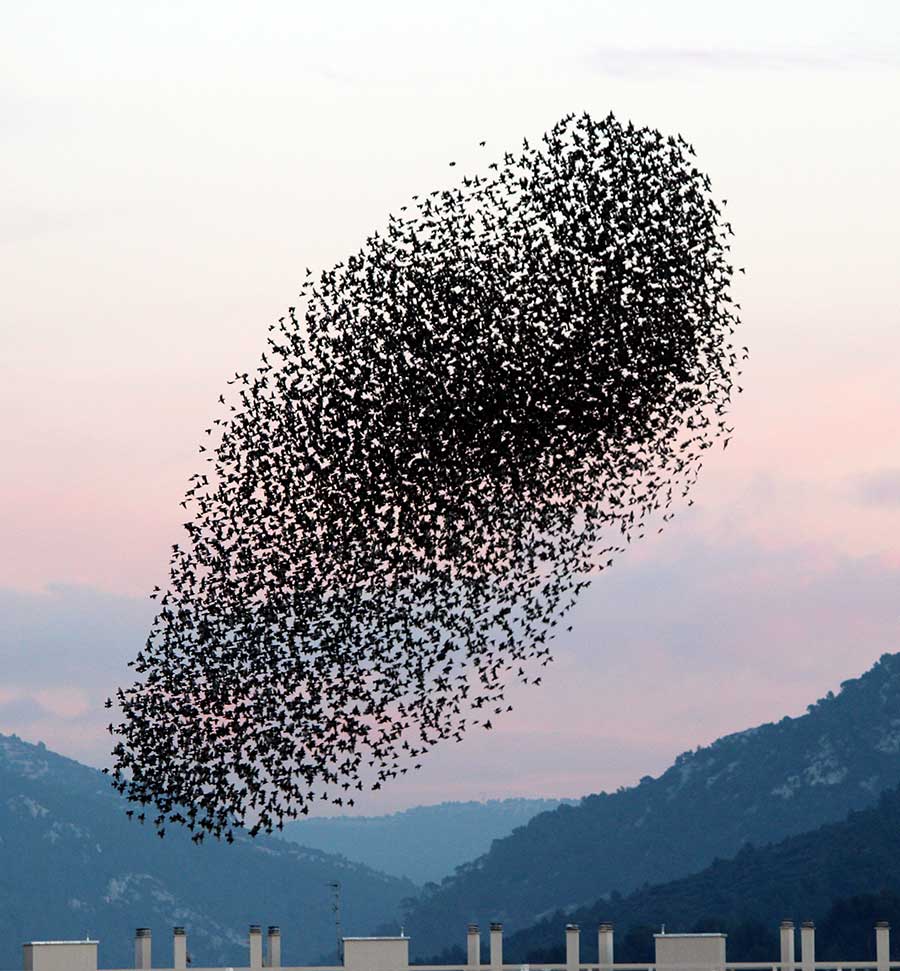
Complex systems on the other hand, are not predictable. They are not clockwork, they are defined by their unpredictability. These are things like… a cell, or an organ – like the human brain – or a human body; or an ant colony, or a school of fish or a flock of birds or the population of a city, or even a city neighbourhood, or a political system, or an economy, or the planetary climate, or the ecosystems of land or sea… Complex systems on the other hand, are not predictable. They are not clockwork, they are defined by their unpredictability. These are things like… a cell, or an organ – like the human brain – or a human body; or an ant colony, or a school of fish or a flock of birds or the population of a city, or even a city neighbourhood, or a political system, or an economy, or the planetary climate, or the ecosystems of land or sea…
So basically – the things that people make are complicated because that way we can fix them. The things the rest of creation makes are complex, because that’s how things need to be to work in massively complex biospheres. (And this is why, if you’re over the age of around 26, you’ll find that an increasing number of people in your immediate circle are not getting well when they go to a medical system that still insists that the human organism is a complicated system and if they just change the oil filter one more time, it’ll run like new again…. Energy medicines get that this model doesn’t work.)
Anyway, back to complex systems. These function by positive and negative feedback loops that are absolutely not linear and not predictable and can rapidly lead to exponential responses – so parturition – childbirth – is a positive feedback loop – uterine contractions start and move the foal or the pup or the child down towards the cervix and the pressure there releases more oxytocin that causes stronger contractions that drive it further down towards the cervix and it all keeps going until birth. Or, to take one that’s less charming, if anthropogenic global heating warms up the arctic to the point where the frozen blocks of methane begin to sublimate and release gaseous methane, which boils off and rises up into the atmosphere as it did last summer. And methane is 86 times more potent than CO2 as a greenhouse gas, then we’re heading for a positive feedback loop that could go catastrophic quite quickly. And yes, it will eventually self limit, but that’s on geological time scales and we might not be around to appreciate it.
Tippings points – scary things
So action A creates action B which serves to promote more of Action A… positive feedback and if Action A created Action B which served to reduce the action of A, then we’d have negative feedback.
And the balance of these in most systems leads to the homeostasis that keeps us and when the homeostasis breaks down, the entire systems emerges to something different. Which takes us to emergence
The emergent properties of complex systems are what fascinate me most. In essence, as Prigogine said, a genuinely complex system will increase its complexity up to a threshold beyond which its timeline bifurcates and it either collapses into chaos and extinction OR it emerges to a new system, with new properties that were entirely unpredictable from the state of the previous system.

Caterpillars skating on Ice…
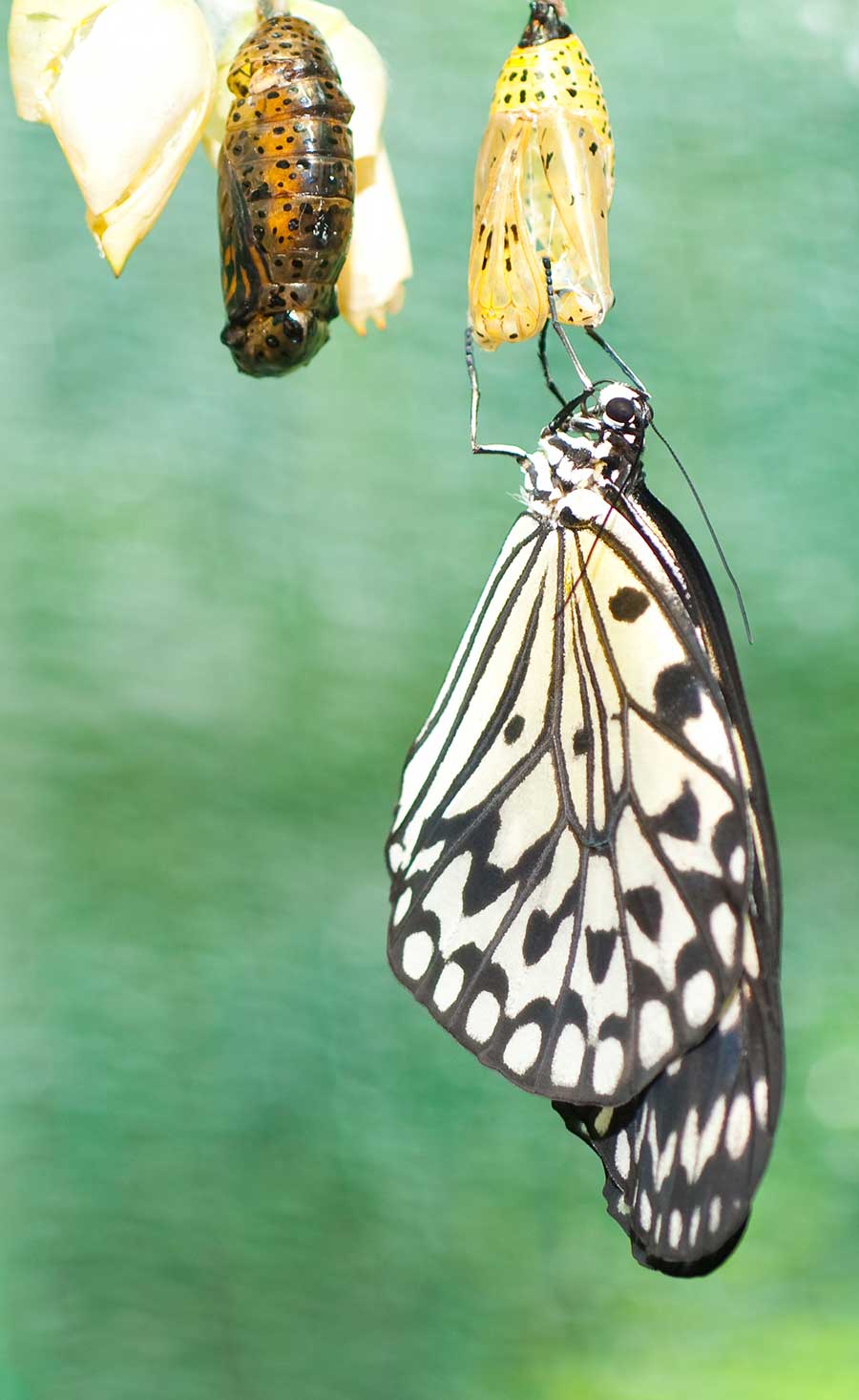
The freezing of water into ice is an easy one to imagine: when the temperature drops and the average kinetic energy of the molecules falls, then they reach a point where the push-pull forces that have kept them moving in fluidity resolve into a new more solid balance and we get snowflakes, or the amazing glass-like structures of ice. Which is what’s known as a phase shift – from solid phase to liquid phase… but this increasingly is being used to describe all emergent systems – like the butterfly emerging from a chrysalis.
This, too, is one we can get our heads around – everyone knows what a caterpillar looks like: you can imagine the green slinky ones or the brown fuzzy ones with the black dots that used to be everywhere up on the island of Skye when I was a kid… and we know they munch leaves and grow big and fat, but only up to a point. Then they slow down and spin themselves a chrysalis and their entire being dissolves into a kind of DNA soup.
Which is a pretty radical phase shift. If that was all, it would be quite impressive – and if you arrived as an Alien out from beyond alpha centauri and didn’t know any planet earth carbon-based biology, I don’t think you’d predict a chrysalis from the caterpillar. But even less would you predict the imaginal cells that arise from the DNA soup, or the ways they are at first rejected as being alien, but they keep arising, and they clump together into little imaginal clumps and some of these are rejected by the DNA soup as well, and broken down, but some keep going and they clump together to make imaginal islands which clump together more and more until what you have is a butterfly or a moth, ready to emerge from the chrysalis. And I absolutely defy you to predict that if you didn’t know it was coming.
And this – the unpredictability – is one of the inherent properties of emergence from complex systems – that the end result is entirely unpredictable from the perspective of the original phase.
Primordial nuclear soup
And that takes us to my other favourite example of emergence from complex systems which is what happened very early in the evolution of consciousness – and of complexity – on our planet.
Leaving aside the philosophical problems of the big bang that Rupert Sheldrake enumerates so well, let’s fast forward in our planet’s history to the point where we have a primordial soup full of prokaryotes – very simple single celled organisms with NO NUCLEUS, a bit like bacteria that consume carbon dioxide and emit oxygen as a waste gas…
This creates a problem because over the milliennia, the oxygen builds up in the atmosphere until it’s reaching toxic levels and displacing the CO2 so, from the point of view of these simple organisms, the future is looking pretty grim… until something happens, and we could argue about exactly what or why, but it’s a spontaneous emergence from the complexity of the existing system – and what emerges are cells with a nucleus – what we call eukaryotic cels – and these metabolise oxygen and emit carbon dioxide as a waste product.

Oxygen – our favourite respiratory gas
And then we’re all set for humanity to arise. Not quite. There’s a lot of interesting gaps in the between… but what I want us to take away from this is – again – that the end result is unpredictable. If you were viewing the prokaryotic soup, facing extinction from its own success in releasing oxygen, you wouldn’t predict the fusion that formed the nucleus and allowed those cells to metabolise the oxygen so it was no longer a problem. That’s the first important take-home point – the utter unpredictability.
But the second – and perhaps more interesting point – is that the problem before the phase shift is no longer a problem after it.
Which is also pretty key – There are clearly a lot of people concerned about the climate and ecological emergency, or the ghastly injustices and inbuilt pain, fear and horror of disaster capitalism, or any of the other issues that assail us… and a great many of these people are endeavouring to fix these systems from the inside. Which is laudable, and understandable.
Why phase shift matters
But I’m pretty sure it’s not going to work. We need a phase shift. We need to become different. I keep saying this, but no problem is solved from the mindset that created it and if we don’t change ourselves, then all we’re doing is creating endless variations on the same theme. We need to be different. Which is pretty cool when you realise that the only thing each of us can reasonably change is ourselves.
So I’m pushing pretty hard for each of us to do the work on ourselves at least along side the work of trying to change our political culture or our economy or our impact on the biosphere. I’m not saying these things don’t need to be addressed, but they can’t be addressed in isolation.
Donella Meadows – Systems Heroine – finding the Leverage Points
So – while we think about this, I want to look briefly at one of the heroes of complexity thinking – Donnella Meadows. Dr Meadows wrote the seminal book, The Limits to Growth which is well worth a look if you have any interest at all in economics, But, here, I want to look at her list of twelve leverage points or Places to Intervene in a system. These came from a paper published by the Sustainability Institute back in 1997, and, for me, they are absolutely crucial to what we’re doing.
Meadows was asked how best to intervene in a complex system to affect change. Given that we know the point of complex systems is that they’re non linear, and unpredictable, changing them is… non linear and unpredictable – and hard. But we can at least nudge them. She came up with a list of twelve leverage points, which she ranked in order of efficacy from the least effective to the most:
12. Numbers: Constants and parameters such as subsidies, taxes, and standards
11. Buffers: The sizes of stabilizing stocks relative to their flows 10. Stock-and-Flow Structures: Physical systems and their nodes of intersection
9. Delays: The lengths of time relative to the rates of system changes
8. Balancing Feedback Loops: The strength of the feedbacks relative to the impacts they are trying to correct
7. Reinforcing Feedback Loops: The strength of the gain of driving loops
6. Information Flows: The structure of who does and does not have access to information
5. Rules: Incentives, punishments, constraints
4. Self-Organization: The power to add, change, or evolve system structure
3. Goals: The purpose or function of the system
2. Paradigms: The mindset out of which the system—its goals, structure, rules, delays, parameters—arises
1. Transcending Paradigms
Changing the Goals of a complex system
As we can see, the least effective lever of change is changing parameters- tweaking the numbers – the tax rate, the subsidies… this is what politicians do because it gives them headlines, not because it makes any serious difference to how equitable a society we live in.
As we go on up through the list, increasing the strength of negative feedback loops, changing the structure of information flows and changing the rules of the system until we reach the third to last level, which is the goals of the system.
So if we could change the goal of our extractive economy from enriching a small number of people, to distributing equally, it would be a fairly big change. But it would still be an extractive economy.
To change this, we have to change the mindset or paradigm out of which the system arises – which is Meadows’ penultimate change.
If we could change our economic paradigm so that it was regenerative, not extractive, that would be huge.

Transcending all systems – an empty-handed leap
But there’s one more lever above this, though – and I didn’t understand this one at all when I was first introduced to this when I was doing the Masters in sustainable economics at Schumacher. Because the very top of list, the most effective lever of change – is – transcending all paradigms.
It took me to this summer when I spent most of the day driving a dying owl from Brecon to Evesham, and the shamanic work that arose from it, to understand the core of this. It’s where we reached the understanding of the final step in the Accidental Gods four-step dance towards conscious evolution, which is Letting Go. Or Making the empty handed leap into the void. And even when I understood this, it took me a while to make the link to Dana Meadows’ levers of change – to understand what a visionary she was, and to mourn again that I never went to listen to her when she was alive.
But still, we can honour her now, for her understanding.
Emergence from the complex system which is our world – changing the direction of travel
Because this is where I think we need to go, because doing the same thing time after time and expecting a different result is the functional definition of insanity.
But – if we can get our heads around the nature of emergence from complex systems the fact that they spontaneously arise of out of chaos… Then we can stop expecting things to be the same.
And even if we don’t know where we’re heading – because phase shift takes us somewhere unimaginable, there are always aspect of the chaos that are ripe for the new emergent phase – the imaginal cells forming clumps in the chrysalis. We need to be those imaginal cells. We’re not the butterfly. We don’t know what the butterfly is going to look like, but we can be in the right place at the right time in enough numbers, for the butterfly to emerge.
So – we need to the work on ourselves so that we can move towards phase shift – And we need to transcend our paradigms – letting go of everything we believe to be true. And yes, I’ve said this before, but I’m hoping this podcast helps to put that into context.
We can become the levers of change. It just takes some mental and emotional flexibility – some resilience – on our part.
SHARE YOUR THOUGHTS
Recent Posts you might enjoy

Thresholds of Being
In a world where the only constant is change, how can we find the best of our wisdom? How can we find true connection to the spirits of the places we live so that we might learn better how to be in the transition that is coming? How, above all, can we approach death with equanimity, and even joy? This week, we explore all of this with author, mythicist – and elder – Sharon Blackie.
Power to the People
How are we going to create the power that we need in a world where fossil fuel use has to end? How can we end the central control of power and keep safe our data in a world where data-mining is a pernicious – and lucrative – as coal mining? Howard Johns has spent all his professional life finding answers. He shares them here.

Beaver Rewilding
How can we begin to reverse the destruction of our countryside, the pollution of our rivers – and our disconnection from the Natural World? Beavers, of course. Eva Bishop of the Beaver Trust tells of the UK introduction of beavers and puts it in a whole-system context.

Meeting the World unmasked
When Forrest Landry was 16 years old, he took a vow to meet the Natural World openly, fully, without any projection or expectation on his part – he was not going to take one step and wait for the rest of the world to take 99 steps to him – he was going to go all the way. His life has been shaped by the experience – and he talks to us this week about where that has taken him.
Climate pilgrimages
COP 26 takes place in Scotland in November. How can ordinary people persuade our elected Overlords that they need to change the system? Across the UK, Climate Actions are being prepared. We speak to two people involved in Pilgrimages to Glasgow about what drives them and what they hope will change.

A Bridge to the Future
What is it that makes us human? How can we bring the best of ourselves to the current crises – individually, and as a civilisation? This week, we talk to Matthew Taylor, former Chief Executive of the RSA, former political strategist to Tony Blair on the road to a better future.
Active Hope
As our world hurtles towards tipping points, how can we be part of the solution? How can we find resilience, in ourselves, our lives and our communities? Above all, how can we bring Active Hope to the world? Dr Chris Johnstone and Madeleine Young have set up an online training course based in Joanna Macy’s work that reconnects and we talk about it in this week’s podcast.

Bringing the sacred to a turbulent world
As we hover on the edge of the Great Turning, how can we find a spiritual practice that draws from the roots of who we are and yet provides the sustenance we need to help us navigate our changing world? Sue Philips of Sacred Design Labs explores the possibilities.
The Mermaids had to happen – reflection
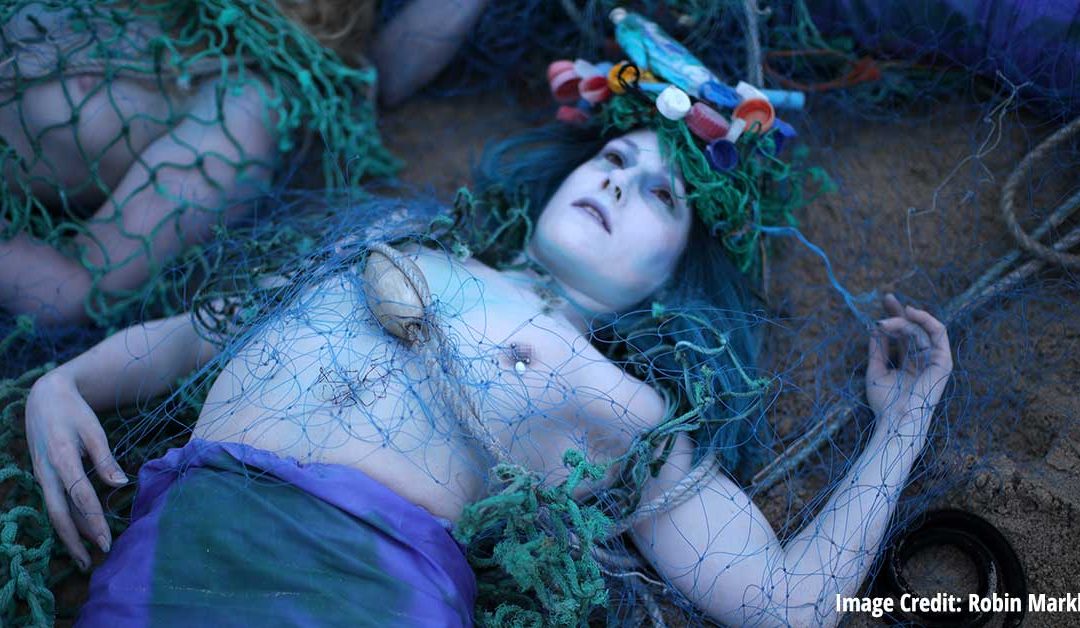
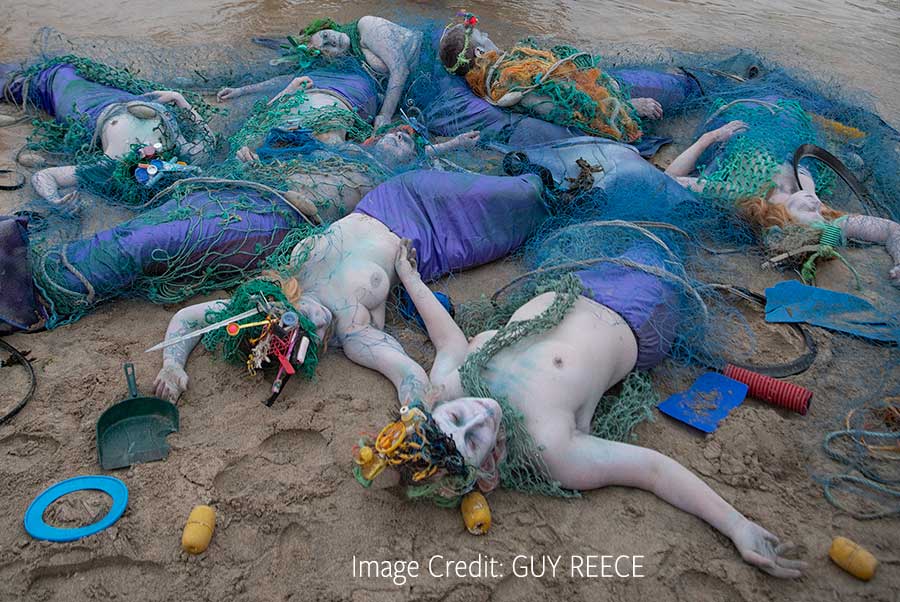
In a world that is literally burning, with politicians whose positions of power are predicated on their not listening, what are the most creative, thoughtful, caring people on the planet doing to bring about change? Sophie Miller of Ocean and Extinction Rebellions was an integral part of the stunningly impressive actions at the G7 summit earlier this summer. In this second of two parts, she reflects on her experience – and looks ahead to future actions.
Activism and mermaids at G7
‘Never doubt that a small group of thoughtful, committed citizens can change the world. Indeed, it is the only thing that ever has.’ As our world burns ever faster and our politicians cling ever more desperately to the old ways of being and behaving, Sophie Miller of Ocean Rebellion commits her creativity, artistry and courage to bringing truth to power.

How to Save Our Planet
How did we get here? How bad are things really? Is there still hope? (Yes!) and… crucially – what can we do, individually, collectively, in our businesses, in our governments, around the world, to turn the bus from the edge of the cliff? Professor Mark Maslin is a climate scientist with a mission to explain in clear terms all we need to know. And he does it with panache, enthusiasm and optimism.

Behave More! Rebuilding Our World Differently
Imagine a world where we listen to the voices of the young as much as the old, the women as much as the men, all races, all abilities, all income streams – all species… where we honour difference, where compassion and empathy are our keynotes, not competition and separation. If this is the world we want, how do we get there?
0 Comments